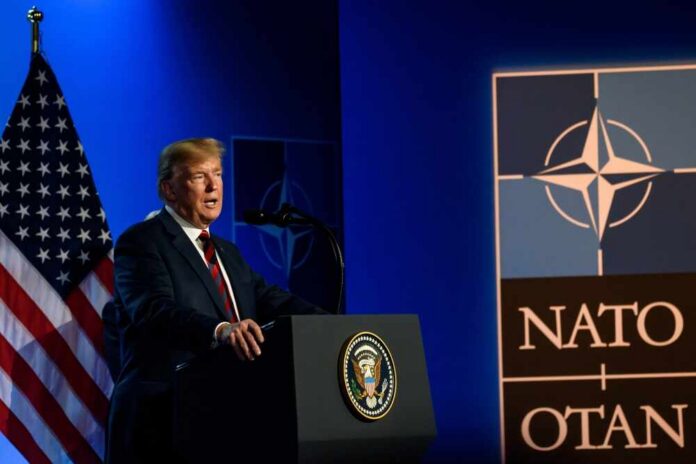
A quiet Pentagon planning session just signaled a seismic shift in NATO firepower, and Europe is about to learn what it really means when America says, “Time to carry your own weight.”
Story Snapshot
- U.S. plans reportedly cut NATO-available fighter jets by one-third and strategic bombers by half in a crisis.[1][2]
- Warships, submarines, refueling aircraft, and armed drones pledged to NATO would also be sharply reduced or removed.[1][2][4]
- Trump officials frame the move as long-overdue burden-sharing after decades of U.S. taxpayers carrying European defense.[1][3]
- Critics warn the cuts could weaken visible deterrence and fuel media claims of an American “retreat” from Europe.[1][2]
What The Reported U.S. Cuts To NATO Forces Actually Mean
German outlet Der Spiegel, echoed by multiple reports, says a U.S. envoy told NATO allies that in a crisis the United States will now make only about two-thirds as many fighter jets and roughly half as many strategic bombers available to the alliance as before.[1][2] According to these accounts, the United States Navy would offer fewer destroyers, provide no submarines at all for NATO crisis plans, and scale back mid-air refueling aircraft and armed drones that Europe has come to rely on.[1][2][4]
These changes reportedly were presented behind closed doors in Brussels as part of a wider rebalancing of NATO responsibilities, not as a treaty-breaking withdrawal.[1][2] A North Atlantic Treaty Organization spokeswoman, cited in coverage of the briefing, even acknowledged there has been “over-reliance” on U.S. capabilities in NATO force planning and suggested that increased European and Canadian defense spending makes a redistribution of roles possible.[1] Still, allies are only now confronting what it looks like when Washington converts that rhetoric into force numbers.[1][2]
Decades Of American Overload Now Come Due For Europe
For years Washington has warned European capitals that U.S. taxpayers cannot forever underwrite their security while they prioritize welfare states and green experiments.[3] A 2016 White House fact sheet under President Barack Obama noted that the United States covered about 22 percent of NATO common-funded budgets and roughly 40 percent of the alliance’s airborne warning and control (AWACS) costs, on top of a far larger share of deployable combat power.[3] Analysts have repeatedly documented how many European countries fell short of spending even two percent of their national output on defense while enjoying the U.S. nuclear umbrella and conventional shield.[3]
In that light, the reported Trump-era plan looks less like sudden abandonment and more like the overdue bill coming due.[1][2] Commentators following the briefing say the intent is to force European defense planners to confront their dependence on U.S. bombers, naval assets, surveillance drones, and logistics and to fill those gaps themselves over time.[1][2] Research from policy institutes has long argued that aligning America’s global posture with vital national interests requires shedding unnecessary permanent commitments and pushing wealthy allies to secure their own neighborhoods.
Supporters Call It Burden-Sharing, Critics Call It Risky Retrenchment
Supporters of the rebalancing argue that with the United States still maintaining the nuclear deterrent and unmatched global reach, trimming the visible NATO crisis pool is a reasonable way to encourage European self-reliance without gutting core security guarantees.[1][2][3] They point out that the military budget of the United States still dwarfs every European nation and funds all six service branches, from the Army and Navy to the Space Force, giving Washington options to surge forces if a true emergency demands it. From this perspective, Europe finally investing and planning for its own defense is not a threat to the West but a long-overdue correction.[1][3]
Critics, including some in European media, see something more ominous: a visible thinning of American steel that adversaries might read as opportunity.[1][2][4] They highlight that strategic bombers, submarines, and destroyers are not just metal; they are symbols of U.S. resolve that Moscow, Beijing, and Tehran closely track.[1][4] Cutting strategic bombers by half and assigning no submarines to NATO crisis plans, they argue, risks weakening immediate response capability and could tempt miscalculation if European forces cannot quickly plug the holes.[1][2]
What We Still Do Not Know, And Why The Media Narrative Matters
Despite the headlines, important details remain hidden from public view, because the underlying Pentagon directive and full NATO briefing materials have not been released.[1][2][4] The available reporting describes categories and percentages of reductions but does not show the classified threat assessments, war-game results, or cost-benefit analyses that planners used to conclude deterrence would hold with fewer U.S. jets, bombers, and ships earmarked for NATO.[1][2][4] Without that record, outside observers cannot yet judge how carefully American commanders weighed the risks or what contingency backstops remain in place.[1][2][4]
Trump administration plans to significantly reduce US military contributions to NATO. Europe is being told to step up fast. What’s really behind this move?
According to reports, the US has informed NATO allies that it will sharply cut the pool of military assets available to… pic.twitter.com/9yt1rwCH0S— Behind The Headlines with Shaw Bester (@BTH_with_Shaw) May 27, 2026
This information gap gives media outlets wide latitude to frame the move either as “abandoning Europe” or as “finally making Europe pay its fair share,” and that narrative will shape public reaction across the alliance.[1][2] Analysts also warn that polarized politics around Donald Trump and NATO mean every adjustment risks being spun as extreme, regardless of the underlying military logic.[1][2] Until the administration or NATO releases fuller documentation and European governments clarify how they will expand their own forces, citizens on both sides of the Atlantic are left choosing between dueling storylines rather than hard data.[1][2][4]
Sources:
[1] Web – Report: U.S. To Cut Strategic Bombers and Warships Available to NATO
[2] Web – US to Cut Military Assets for NATO, Spiegel Reports | KuCoin
[3] YouTube – Pentagon Announces US Will Cut Thousands Of Troops In Europe
[4] Web – FACT SHEET: U.S. Contributions to NATO Capabilities