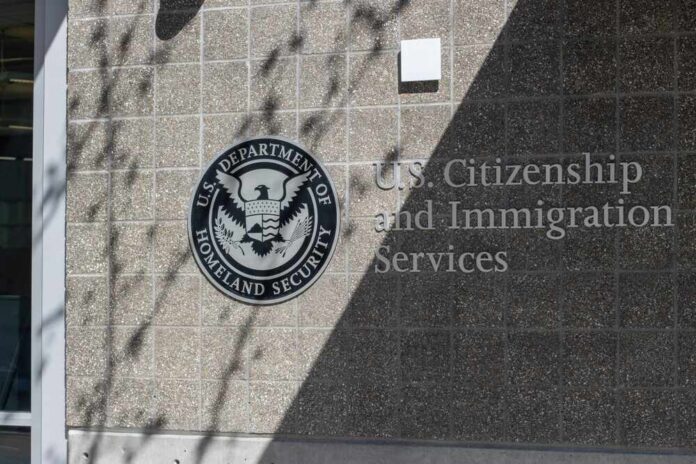
The Trump administration is now requiring many foreigners already living in the United States to leave the country and apply for their green cards from their home nations — a sweeping policy reversal that is upending the lives of thousands of legal immigrants who believed they were on a clear path to permanent residency.
At a Glance
- The United States Citizenship and Immigration Services (USCIS) issued a policy memo directing many in-country green card applicants to instead pursue consular processing abroad.
- The administration cites enhanced Federal Bureau of Investigation (FBI) vetting and fraud prevention as justification, including re-running biometrics on applicants already inside the United States.
- Applications filed before the cutoff date have been paused, and pending cases without a newly required medical exam form face denial — even for previously compliant applicants.
- Critics argue the policy’s breadth extends far beyond targeted fraud prevention, sweeping in refugees, asylum seekers, and long-term residents without individualized suspicion.
What the New Policy Actually Requires
Under the new USCIS policy memo, many foreign nationals who are already living legally in the United States and were pursuing what is known as “adjustment of status” — the standard in-country path to a green card — are now being directed to leave and apply through consular processing in their home countries instead. The change took effect immediately for applications filed starting June 11, and it also applies to a significant number of already-pending cases. [1]
The policy also introduced a new medical exam filing requirement. Pending applications that do not include the associated medical form face outright denial — even if applicants had previously met all requirements in place at the time they filed. That means some immigrants could be forced to repeat medical exams, pay additional fees, and restart portions of a process they had already completed in good faith. [6]
The Administration’s Stated Rationale
United States Citizenship and Immigration Services and the Department of Homeland Security (DHS) have framed the policy shift as a security and vetting upgrade. Officials say the agency is re-running fingerprints and biometric data through an expanded FBI screening system to identify applicants who may have previously slipped through the cracks. The stated goal is to ensure that permanent residency benefits are granted only to fully vetted, qualified individuals — a rationale that carries genuine weight given documented gaps in prior screening processes. [2][4]
The Trump administration has also moved simultaneously on several related immigration fronts, including stricter public charge assessments, expanded in-person interview requirements, and electronic payment mandates. Executive orders issued earlier in the administration directed DHS and the State Department to implement enhanced vetting for both visa applicants and those already in the country. [14] Taken together, these layered changes represent one of the most comprehensive restructurings of the green card process in recent memory. [8]
The Real-World Disruption Is Significant
Reporting from immigration attorneys and news outlets documents concrete disruptions already unfolding. Green card applications have been paused, pending asylum-related work permits have been placed on hold, and approved benefit requests for people from certain countries are being re-reviewed. For affected individuals, that means potential job loss, disrupted schooling for children, and family separation — not from illegal immigration enforcement, but from changes to the legal immigration process. [3][5]
L.J. D'Arrigo, leader of Harris Beach Murtha's Immigration Practice Group, says the Trump administration's most recent immigration move means most foreign nationals temporarily in the U.S. seeking a green card will have to return to their home country to apply at a U. S.…
— Harris Beach Murtha (@HarrisMurtha) May 22, 2026
What makes the policy particularly controversial is its breadth. The biometric re-vetting pause applied to all pending adjustment of status, asylum, citizenship, and other in-country applications filed before a specific cutoff — not just cases flagged for specific concerns. Re-review has also extended to refugees, naturalized citizens, and lawful permanent residents in certain categories. [2] Critics across the political spectrum have questioned whether forcing tens of thousands of applicants to leave the country — and face consular processing that carries its own denial risks — is proportionate to the fraud prevention goal being cited. [8]
A Pattern With Deep Roots — and Real Consequences
This is not the first time an administration has used administrative adjudication changes to tighten or restrict immigration without going through Congress. Both Republican and Democratic administrations have used procedural levers — enhanced vetting requirements, public charge expansions, medical exam mandates — to reshape who qualifies for legal status and how difficult the process becomes. Courts and advocacy groups have repeatedly challenged these moves, and operational disruption typically follows regardless of which side ultimately prevails legally. [7][8]
What both frustrated conservatives and frustrated liberals can likely agree on is this: a system that forces legal immigrants who followed the rules to uproot their lives, leave the country, and restart a process — while providing little transparency about the actual scope of the policy or the fraud data justifying it — is a system that is not working for the people it is supposed to serve. Whether the policy proves legally durable or collapses under court challenge, the uncertainty it has created is real, and the people bearing the cost of that uncertainty are not the officials who designed it. [5][8]
Sources:
[1] YouTube – Trump admin changes requirements for green cards …
[2] YouTube – Trump’s BIG changes to Green Card Adjustment of Status …
[3] Web – Trump Immigration Policy Changes – USAHello
[4] Web – Immigration: Recent Changes and New Regulations | Insights
[5] Web – Trump Administration Abruptly Stopped Processing Green Card …
[6] Web – New Green Card Rules 2026: What Immigrants Should Know Under …
[7] Web – Trump Administration Public-Charge Rule Would Ampl..
[8] Web – The Trump Administration’s 2025-26 Changes to Immigration Law …
[14] Web – A Summary of President Trump’s Immigration-Related Executive …