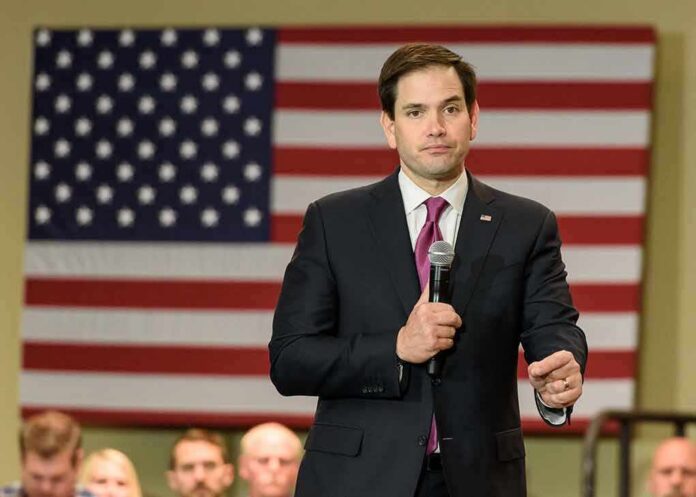
Secretary of State Marco Rubio is publicly warning that Iran nuclear talks are producing “significant progress, although not final progress” — a careful distinction that separates real diplomatic movement from the premature celebration some commentators are already declaring.
Story Snapshot
- Rubio confirmed “significant progress” in U.S.–Iran talks but explicitly cautioned that no final deal has been reached.
- Iran’s nuclear enrichment and the Strait of Hormuz remain the central sticking points, with Rubio drawing hard red lines on both.
- Rubio warned the Iranian system itself is “fractured,” raising doubts about whether any agreement could hold even if reached.
- The administration signaled that U.S. leverage increases every day the conflict continues, leaving military options openly on the table.
Progress With Conditions Attached
Rubio acknowledged publicly that the United States and Iran have made real movement in ongoing negotiations, describing it as “significant progress, although not final progress” over a recent 48-hour window. According to official State Department remarks, the administration is working toward an outline that would keep the Strait of Hormuz open and address key issues tied to Iran’s past nuclear ambitions. The President’s stated preference is a negotiated solution, and diplomacy remains the active policy channel.
That optimism, however, comes with firm conditions. Rubio stated clearly that Iran must surrender its enriched uranium and highly enriched uranium stockpiles as part of any acceptable arrangement. The core American red line remains absolute: Iran can never obtain a nuclear weapon. These are not vague aspirations — they are publicly stated preconditions that any framework must satisfy before the administration will consider a deal complete.
Hard Lines That Cannot Be Crossed
One of the most concrete disputes to emerge publicly involves Iran’s proposed tolling system in the Strait of Hormuz, through which roughly one-fifth of the world’s oil supply passes. Rubio rejected that idea without qualification, stating that “no one in the world is in favor of a tolling system” and that pursuing it would make a diplomatic deal “unfeasible.” That single unresolved issue illustrates how far apart the two sides may still be beneath the surface of reported progress.
Rubio also warned that the Iranian political system itself is “fractured,” suggesting that even if negotiators reach an outline, internal divisions within Tehran could prevent Iran from honoring or sustaining any commitment. That observation matters because it goes beyond the usual diplomatic caution — it raises a structural question about whether any agreement, however well-crafted, has a reliable counterpart capable of enforcing it on the Iranian side.
Leverage, Pressure, and the Military Option
The administration has been deliberate in keeping non-diplomatic options visible. Official State Department remarks state that “every day the conflict continues, our leverage on Iran will continue to increase and their position will continue to weaken.” That framing is not accidental — it is a negotiating posture designed to signal that the United States is not desperate for a deal and that time works against Iran, not Washington.
BREAKING NEWS: US and Iran Closing in on Pakistan-Mediated Deal to End War
US Secretary of State Marco Rubio said a US–Iran deal could be reached within hours, with negotiations reportedly nearing conclusion through Pakistan-mediated diplomacy. pic.twitter.com/ZD461WTSIn
— WE News English (@WENewsEnglish) May 24, 2026
Rubio reinforced that posture by stating the Iran issue “needs to be solved, as the president said, one way or the other.” That phrasing keeps military action openly on the table without formally threatening it, preserving maximum flexibility while keeping pressure on Tehran. It also reflects a broader pattern in U.S.–Iran diplomacy: public signals of progress rarely tell the full story of what remains unresolved behind closed doors. Americans watching this unfold — whether they supported the 2015 nuclear deal or opposed it — have reason to be cautious about headlines declaring a breakthrough before the hard details are settled. The administration’s own lead negotiator is urging exactly that caution.
Sources:
[1] YouTube – Rubio says progress made in Iran talks but warns Trump …
[2] Web – Secretary of State Marco Rubio Remarks to Press
[3] YouTube – Marco Rubio says ‘significant’ progress made in talks with Iran
[4] YouTube – Marco Rubio Says “Significant Progress” Made on Iran Talks
[5] YouTube – Rubio Says “Significant Progress” Made on Iran Talks
[6] YouTube – ‘Iran must give up…’: Marco Rubio demands Tehran end nuclear …
[7] YouTube – Marco Rubio’s 2015 Iran warning resurfaces and looks spot on
[8] YouTube – White House Signaling Imminent Deal Announcement with Iran