

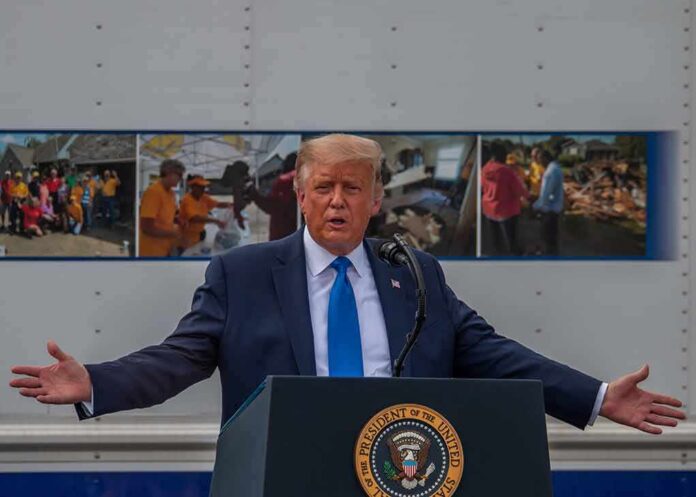
President Trump’s vow that Iran “has not received enough pain yet” shows how far America’s Iran war has drifted from clear goals and basic limits.
Story Snapshot
- President Trump says he is “close” to ordering a new, “massive attack, bigger than ever before” on Iran.
- He argues Iran has not “received enough pain yet” and must be pressured into a deal on nuclear and missile programs.
- The United States military is already in large-scale combat operations with Iran, after months of strikes and escalations.
- Trump has cancelled at least one planned strike under pressure from Gulf allies, but keeps forces ready to hit “at a moment’s notice.”
Trump’s New Threat: ‘Massive Attack, Bigger Than Ever Before’
President Trump told Axios he is weighing a “massive attack” on Iran, larger than any strike seen so far in the war. He said the United States is “all set for it” and that he is “close to making a decision,” adding that Iran has not “received enough pain yet.” This language fits with other recent threats where Trump promised to hit Iran “very hard” and keep striking for “two or three weeks” to push the country “back to the Stone Ages.”
These new comments come after months of heavy fighting between the United States, Iran, and U.S. allies. Earlier this year, Trump announced that “major combat operations in Iran” had begun, describing the campaign as a “large-scale and ongoing operation” to stop Iran’s nuclear and missile programs. At different times, he has also tied the war to regime change in Tehran, urging Iranians to “take over your government” and saying the goal is to make sure Iran “will never possess a nuclear weapon.”
War Already Underway: From Epic Fury to Rolling Strikes
The current conflict grew out of a huge United States military buildup in the Middle East that began in late January 2026, the largest since the Iraq invasion. By February, American and Israeli forces launched joint attacks under the code name Operation Epic Fury, hitting Iranian targets until early May. United States officials later confirmed major air and naval strikes aimed at cutting Iran’s missile power and destroying parts of its navy, showing this was more than just a few warning shots.
Even after Operation Epic Fury ended, the United States kept striking Iran. Central Command reported attacks on Iranian missile sites and mine-laying vessels in southern Iran, testing a fragile ceasefire while talks dragged on in Qatar. Trump has repeatedly ordered or threatened more strikes, including operations against Iranian military communications, drones, and air defenses, and said the United States will be “attacking them very hard.” The pattern is clear: combat pauses briefly, negotiations stall, then new strikes follow.
Pressure, Pain, and a Deal That Never Quite Arrives
Trump’s team says the goal is to force Iran into a deal that stops nuclear work and missile development. He has tied major strike decisions to deadlines, warning at one point that Iran could be “taken out” if it did not agree by Tuesday night and threatening “complete destruction” of every bridge and power plant. This “pain for leverage” idea also shows up in his recent comments about a bigger attack being needed because Iran has not “received enough pain yet.”
At the same time, Trump has sometimes claimed the conflict is “concluded” or that a “significant agreement” is close. On one key day in May, he said he was canceling a “scheduled attack” on Iran after leaders from Qatar, Saudi Arabia, and the United Arab Emirates asked him to “hold off,” promising serious negotiations. He told the United States military to stay ready for a “full, large-scale assault” if an acceptable deal did not materialize. That mix of public threats, partial pauses, and vague progress feeds a sense of confusion for many Americans.
Congress, Law, and Fears of Unchecked Power
As the war expanded, Congress tried to claw back some control. In early June, the House passed a bill requiring the United States to either stop war operations or get clear approval from Congress to keep fighting. Later that month, the Senate approved its own measure demanding the administration either end the war or secure explicit permission to continue. These votes showed rising concern that the White House was pushing the country deeper into conflict without firm limits.
Legal and policy experts have also raised alarms. One detailed analysis argued that the Iran strikes lack proper congressional authorization, United Nations backing, and proof of an imminent threat, warning they set a dangerous precedent for unchecked executive war-making. Another report found no evidence that Iran’s nuclear and missile programs posed an immediate danger to the United States, despite Trump’s repeated claims. For many citizens on both the right and the left, this reinforces a familiar fear: powerful leaders and agencies making life-or-death decisions without honest debate or accountability.
Shared Public Frustrations: Costs, Risks, and ‘Deep State’ Doubts
Many conservatives see this Iran campaign through the lens of past failures. They remember long wars, massive spending, and promises that never matched reality. The idea of yet another “massive attack” raises questions about cost, troop safety, and whether Washington elites are repeating old mistakes instead of fixing problems at home. For these Americans, talk of driving Iran “back to the Stone Ages” sounds less like a plan and more like another open-ended commitment with no clear exit.
Many liberals are angry for their own reasons. They worry about civilian deaths from strikes on power plants, bridges, and energy sites, which human rights groups say could amount to atrocity crimes if carried out. They also see a widening gap between leaders and ordinary people, with decisions about war and peace made in closed rooms while workers face rising prices, shaky jobs, and shrinking social support. To them, Trump’s threats show a government more focused on projecting force abroad than on protecting basic freedoms and fairness at home.
What This Moment Says About America’s Direction
Across the political map, a growing number of Americans now share one core belief: the federal government is failing to put the public first. Trump’s Iran policy shows why. Massive deployments are ordered before there is a clear, honest story about the threat. New strikes are justified with changing reasons. Congress struggles to assert its war powers, and expert warnings about law and long-term risk often go ignored. The result is a sense that “the deep state” and political elites keep driving events, while citizens watch from the sidelines.
Trump’s latest promise that he is “close” to a much larger attack on Iran is not just another foreign policy headline. It is a signal about how decisions are being made in Washington right now: fast, forceful, and often without the kind of transparent limits the founders hoped would protect the country from permanent war. Whether Americans cheer these threats, fear them, or both, they fit a troubling pattern. The system keeps reaching for more power and more force, while real accountability and long-term strategy remain out of reach.
Sources:
thegatewaypundit.com, britannica.com, cnbc.com, cnn.com, reuters.com, theguardian.com, globalguardian.com, armscontrol.org