

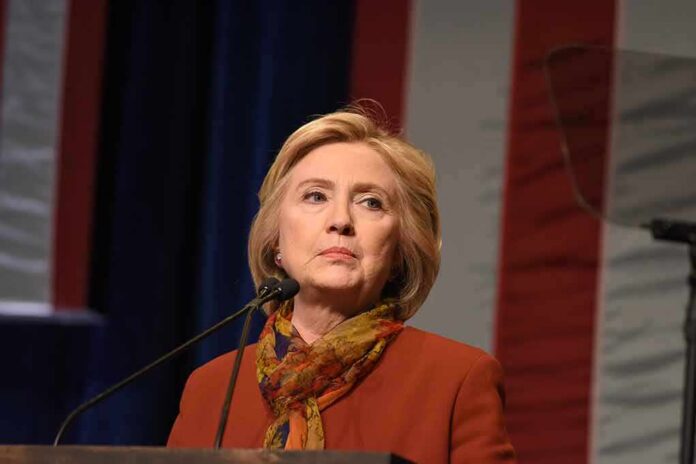
Hillary Clinton likened her 2016 loss to September 11 and COVID-19, pushing a years-long fight over what actually decided that race back into the spotlight.
Story Snapshot
- Clinton’s disaster comparison renews debate over sexism’s role in 2016.
- Peer-reviewed studies link gender attitudes to Trump support and lower support for Clinton.
- Commentators counter that Clinton’s record, strategy, and emails mattered more.
- The best evidence says sexism contributed, but did not prove sole causation.
What Clinton Said And Why It Resonates Now
Clinton compared her defeat to national traumas to stress how consequential it felt and how she reads its impact. That framing stirs a core dispute that has not faded. Did gender bias tilt a close race, or did voters reject her record and message? Research since 2016 has tested both ideas. Several peer-reviewed papers find that gender attitudes predicted vote choice and feelings about the candidates, even after other factors were considered.
Those findings do not prove sexism was the only cause of defeat. They do show a measurable link between beliefs about gender and support for Donald Trump or opposition to Clinton. One study of more than 10,000 Americans found that believing men are better suited for politics predicted support for Trump, with the strongest effect among White voters. That kind of evidence explains why some analysts view the result as historically significant for women seeking the presidency.
What The Research Says About Gender Attitudes
Multiple studies report that sexism reduced support for Clinton across both men and women. One paper using national surveys concluded that negative attitudes toward feminists dampened support for Clinton among both genders. Another study found that men high in hostile sexism favored Trump over Clinton by a large margin during the campaign, while men low in hostile sexism favored Clinton over Trump by a similar margin. These are associations, not a vote-count of how many ballots sexism changed.
Scholars also examined how campaign messages may have activated those views. Research on Trump’s “woman’s card” line found that exposure to the attack increased support for Trump among hostile sexists and also spurred their political participation. Separate media analyses documented frames that questioned Clinton’s legitimacy through gendered narratives, such as accusing her of playing the victim or seeking special treatment, which can shape how voters process news over time.
The Counter-Case: It Was Clinton, Not Sexism
Critics argue that many voters opposed Clinton for reasons unrelated to her gender. Some point to “Clinton-ism,” meaning opposition to her specifically, not to women in general. Commentaries at the time cited her policy positions, the email controversy, and choices about where to campaign, saying these decisions cost her key voters in the Midwest and beyond. Other analysts said working-class White voters cared more about jobs and culture than about gender.
Even some writers who accept that sexism exists say the campaign made errors it needed to own. They argue that the Democratic Party and the campaign did not energize parts of their base, messaged poorly, or bet wrongly on a path to 270 electoral votes. This view does not deny a role for sexism. It claims other factors were larger and more immediate in a razor-thin Electoral College loss.
What We Can Conclude — And What We Cannot
Across serious studies, the strongest common ground is this: gender attitudes mattered in 2016, but researchers cannot assign a precise share of the outcome to sexism alone. Surveys and media studies can show patterns, triggers, and tone. They cannot prove how many voters would have switched if the nominee were the same person but male. That limitation is not a flaw unique to this topic; it is a general boundary of social science and post-election analysis.
For readers tired of partisan spin, two things can be true. Biases in our culture and media can shape campaigns. So can weak strategy, flawed messages, and mistrust of a candidate. Clinton’s disaster comparison speaks to the scale of what she felt and what many saw at stake. The broader lesson is civic, not partisan: when politics becomes a blame loop, leaders dodge fixes, and citizens watch Washington argue while core problems go unsolved.
Sources:
cambridge.org, link.springer.com, nationalaffairs.com, nsuworks.nova.edu, rutgers.edu, journals.uchicago.edu