
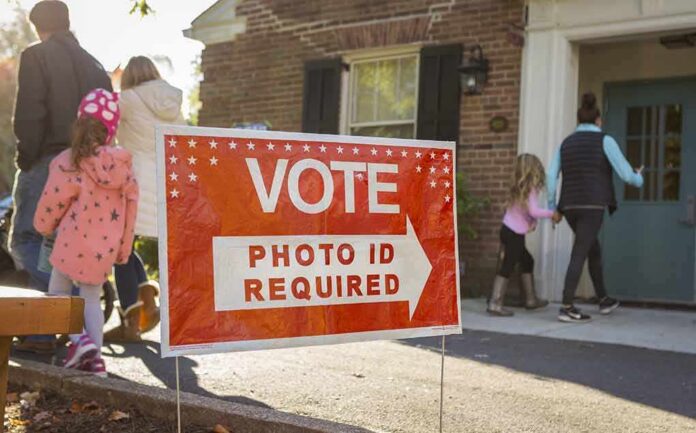
Most Democratic voters say they want a photo ID to vote, but their own party leaders in Congress keep blocking the idea.
Story Snapshot
- Multiple polls show 62% to 83% of Americans, including a majority of Democrats, back photo ID requirements to vote.
- Congressional Democrats have opposed the SAVE America Act and a Senate amendment requiring photo ID at the polls.
- Democratic leaders argue the real problem is stricter proof-of-citizenship rules, not photo ID itself.
- A 2016 federal court ruling on North Carolina’s law still shapes fears that ID rules can target minority voters.
- Millions of eligible voters may lack the specific documents some proposals require, according to voting-rights groups.
Polls Show Democratic Voters Split From Their Leaders
Pew Research found 83% of Americans support requiring a government-issued photo ID to vote, including 71% of Democrats. A separate Monmouth University poll put support among Democrats at 62%, with similar numbers among non-white voters. Those numbers give Republicans an opening to argue their party’s own base disagrees with Democratic leaders in Washington.
Senate Democrats recently voted down an amendment from Senator Jon Husted that would have required photo ID for federal elections. The amendment listed several accepted forms, including a driver’s license, passport, military ID, or tribal ID. Republican leaders, including Senate Majority Leader John Thune, said the vote proves Democrats reject a policy their voters already support.
Democrats Say The Fight Isn’t Really About Photo ID
Democratic lawmakers say they don’t oppose photo ID itself. Instead, they object to how the SAVE America Act pairs ID rules with strict proof-of-citizenship requirements, like an unexpired passport or a Real ID showing citizenship status. Democrats argue this combination creates a much higher bar than simply showing a driver’s license at a polling place, especially for voters without ready access to those documents.
That distinction matters because most standard driver’s licenses do not prove citizenship on their own. Voters registering for the first time under the proposed law would need to track down a passport or birth certificate, which the Brennan Center says more than 49 million Americans do not have on hand. Critics say this turns a popular idea into a much harder practical hurdle for some eligible voters.
A 2016 Court Ruling Still Haunts The Debate
Much of the Democratic Party’s caution traces back to North Carolina’s 2013 voter ID law. A federal appeals court struck it down in 2016, saying lawmakers requested racial voting data before writing rules that targeted Black voters “with almost surgical precision.” That ruling remains the strongest legal example showing ID laws can be built to disadvantage specific groups, even when framed as neutral security measures.
Supporters of the current SAVE America Act say today’s proposal is different, since it accepts a broad list of documents, including state IDs, passports, military credentials, and tribal IDs. They argue that flexibility avoids the narrow document list that doomed the North Carolina law. Opponents counter that broad categories on paper don’t guarantee ordinary voters can easily get or afford those documents.
Why This Fight Feeds Distrust In Both Directions
This debate fits a pattern many Americans already notice: leaders in both parties sometimes seem more focused on political messaging than on solving the underlying problem. Republicans highlight polling to paint Democrats as out of touch with their own voters. Democrats say Republicans are using popular polling on photo ID to mask a much stricter citizenship-proof requirement buried inside the same bill.
Neither side has offered hard data settling how many voters would actually be blocked under the new rules, or how many fraud cases the law would prevent. Voters frustrated with government dysfunction are left watching both parties argue past each other, using the same poll numbers and legal history to reach opposite conclusions about a law neither side has fully explained in plain terms.
Sources:
studentnewsdaily.com, ballotpedia.org, republicanleader.senate.gov, nbcnews.com, ncsl.org