

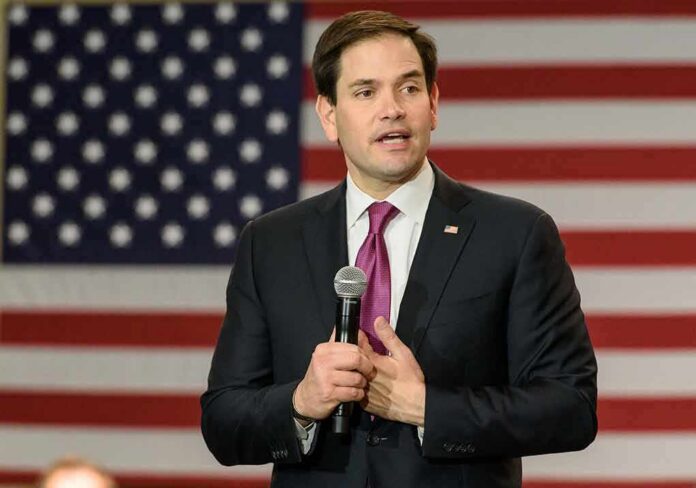
Iran’s threat to choke the Strait of Hormuz is colliding with a blunt warning from Secretary of State Marco Rubio: the waterway must stay open, and Washington is not treating Tehran’s pressure campaign as normal.
Quick Take
- Rubio said the Strait of Hormuz “has to be open” and called Iranian interference “unlawful,” “illegal,” and “unacceptable.”
- He rejected any tolling scheme, saying the passage must remain open “unimpeded, without tolls.”
- Rubio described the dispute as a global shipping problem, not just a bilateral fight with Iran.
- The public record shows strong U.S. language, but the supplied material does not include the legal memo or maritime incident log behind the claim.
Rubio Draws a Hard Line on Hormuz
Rubio used unusually direct language in public remarks, saying the Strait of Hormuz “has to be open” and that Iranian conduct is “unlawful,” “illegal,” and “unsustainable for the world.” He also said the passage must remain open “unimpeded, without tolls,” signaling that Washington rejects any Iranian attempt to turn a strategic waterway into a payment gate. His remarks were carried in official State Department material and video reporting.[2]
Rubio’s argument goes beyond a narrow regional dispute. In the supplied remarks, he framed the strait as an international shipping lane that affects global commerce, not a private corridor that Iran can close at will. He said he knows of no country other than Iran that would support a tolling system, and he warned that accepting such a precedent would invite similar coercion elsewhere. That message is clearly aimed at deterrence.[2]
The Core Fight Is Over Control, Not Just Rhetoric
The strongest part of Rubio’s case is his insistence that Iran cannot simply dictate terms on a maritime chokepoint used by the world’s energy trade. He said Iran had threatened to “shut down the straits,” charge tolls, and even sink ships that refused to comply. The public record in the supplied material supports that Rubio made the claim, but it does not provide the underlying Iranian order, transcript, or operational evidence showing a completed shutdown.[1][2]
That gap matters because the dispute is being presented as both a legal question and a security crisis. Rubio said there must be a “plan B” if Iran refuses to open the straits, and contemporaneous reporting summarized his position as the strait being open “one way or another.” Those phrases signal contingency planning, but the sources provided do not spell out the legal authority for any U.S. enforcement action, interdiction, or other response.[1][3]
What the Public Record Still Does Not Show
The supplied material is heavy on declaratory language and light on documentation. It confirms Rubio’s position, but it does not include a cited treaty analysis, a maritime incident log, or an independent legal opinion showing why Iran’s conduct is unlawful under the law of the sea. It also does not include the kind of neutral shipping data, vessel testimony, or international institution statement that would prove a present, effective closure of the strait.[2]
JUST IN: Marco Rubio says the Strait of Hormuz is “going to be open one way or the other.”
“The straits have to be open…What’s happening there is unlawful, it’s illegal, it’s unsustainable for the world, it’s unacceptable…The straits need to be open, unimpeded, without… pic.twitter.com/tbB640jqxT
— Julia 🇺🇸 (@Jules31415) May 26, 2026
Rubio is signaling that the Trump administration intends to keep a critical global waterway open and will not accept an Iranian toll scheme or blockade posture. The broader issue remains whether the U.S. response is grounded in a firm legal theory, a maritime freedom-of-navigation position, or a more aggressive enforcement framework. The current record points to strong policy intent, but not yet to full documentary proof.[1][2]
Sources:
[1] YouTube – Rubio: Strait of Hormuz Needs to Reopen–Even If Iran Refuses
[2] YouTube – US attacks Iranian missile site as Rubio warns Strait of Hormuz ‘will …
[3] Web – Rubio says Hormuz will open one way or another as Iran talks grind …