
A rare hypersonic strike ripping across Kyiv’s night sky underscores how quickly modern warfare—and official accountability—can outrun the public’s ability to verify what actually happened.
Story Snapshot
- Ukrainian officials and multiple outlets reported a massive missile-and-drone barrage striking Kyiv, with claims a hypersonic ballistic missile was used [1][2][3][5].
- Reports described deaths, dozens injured, and damage to homes, schools, offices, a shopping center, and a health facility [1][2][3][5].
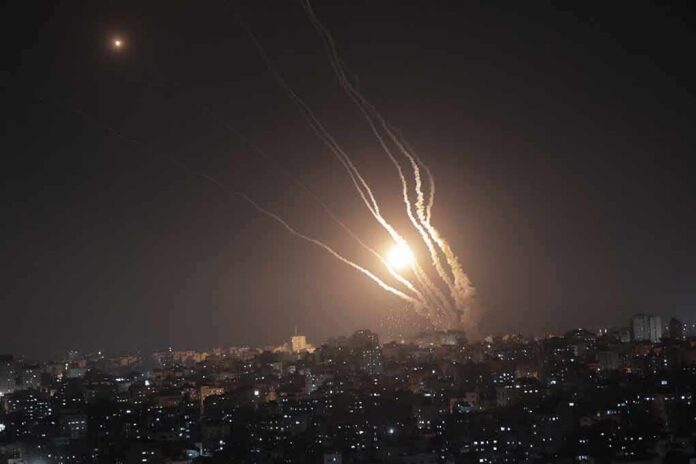
- Footage showed fireballs and citywide impacts as emergency crews fought fires and cleared debris [1][3].
- Russia’s military has not issued a formal, detailed confirmation of the hypersonic weapon type, leaving uncertainty over identification [3].
Claims Of A Hypersonic Strike Amid A Citywide Barrage
Ukrainian authorities and several news outlets reported that Russia launched a large overnight strike on Kyiv involving missiles and drones, with some reports specifying the use of a rare hypersonic ballistic missile sometimes labeled “Oreshnik” or similar transliterations [1][2][3][5]. One outlet said Russian sources acknowledged deploying the system in the wider strike set, while emphasizing speed and medium-range characteristics [2]. Another report framed the strike as one of the heaviest on the capital in recent months, heightening public alarm [1].
Confusion about terminology complicated early assessments. Different broadcasts and transcripts used multiple names—“Oreshnik,” “Oriishnik,” and “Orionic”—or simply “hypersonic ballistic missile,” reflecting transliteration inconsistencies and rushed reporting [1][2][3][5]. That linguistic spread matters because precise weapon identification carries strategic and political implications, including air-defense performance, escalation risk, and international responses. Without primary-source documentation or forensic confirmation, weapon labels can harden into public belief before the technical facts are clear [3].
Damage Reports, Casualty Counts, And What We Know
Municipal statements and on-the-ground coverage described significant civilian-area impacts. Reports cited deaths and dozens of injuries in Kyiv, with damage to residential buildings, schools, offices, a shopping center, and a health facility [1][2][3][5]. Kyiv’s mayor was quoted describing multiple types of structures struck, consistent with wide-area barrages that send debris and blast waves across neighborhoods [2]. Video segments showed bright streaks, explosions, fires, and smoke plumes over the capital as emergency services responded through the night [1][3].
Casualty figures varied across outlets, ranging from at least one killed and roughly twenty injured to as many as four killed and twenty-five injured, reflecting an evolving picture typical of early wartime reporting [1][2][3]. Such variation does not dispute that serious harm occurred; it highlights how counts can change as authorities reach trapped residents, process hospital intakes, and reconcile duplicate reports. The emerging consensus across sources is that the strike caused visible destruction and civilian suffering in multiple districts [1][2][3][5].
Verification Gaps And Why They Matter For Public Trust
Several reports asserted that a hypersonic ballistic missile was part of the attack, yet they relied heavily on broadcast summaries, transcripts, and public official statements rather than debris-chain analysis or radar track releases [1][2][3][5]. One transcript explicitly noted that Russia’s Ministry of Defense had not provided an official confirmation of the specific weapon type or full strike package, leaving a critical gap in technical verification [3]. Without public radar data, telemetry, or fragment forensics, claims about missile classes remain probabilistic.
🚨 Devastating attack in #Ukraine: #Russia missile strike leaves 4 dead, dozens injured. #Kyiv and other regions hit hard by #Oreshnik hypersonic missiles. Emergency services in action, as tensions escalate. #PrayForUkraine #UkraineUnderAttack pic.twitter.com/wnEEiHbkA2
— SINS (@sins_news) May 24, 2026
This uncertainty fits a broader pattern in modern conflicts: early information often prioritizes vivid footage and quick explanations over slow, document-backed verification. That dynamic rewards whichever narrative moves first and clearest, while sidelining nuance about weapon identification and targeting intent. For citizens already skeptical that powerful actors control the flow of facts, the absence of timely, verifiable data deepens mistrust across the political spectrum and fuels the sense that institutions are not transparent or accountable [1][2][3].
Sources:
[1] YouTube – Russian Overnight Attack Engulfs Kyiv Sky With Fire And …
[2] YouTube – Russia hits Ukraine with rarely-used Oreshnik missile in …
[3] YouTube – On Cam:Biblical Fireball In Kyiv After Russia’s Oreshnik …
[5] YouTube – Fires burn in Kyiv after Russia uses hypersonic missile in …