

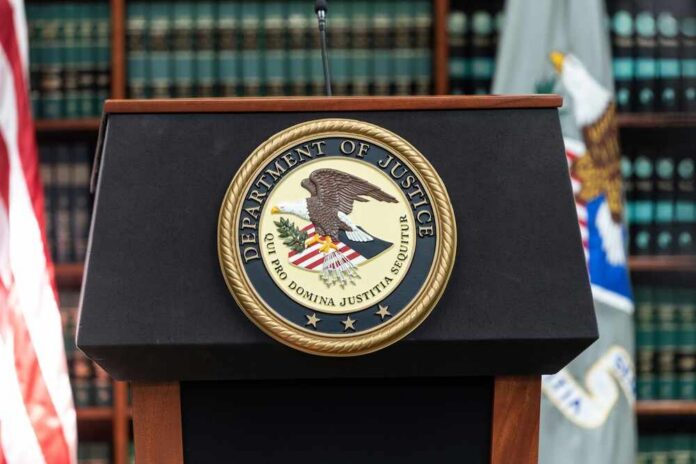
An Iranian national just admitted to smuggling U.S. military sonar components to Iran through China—exposing a sanctions-busting pipeline that threatens American security and our sailors.
Story Highlights
- Federal prosecutors say Reza Dindar pleaded guilty to a scheme moving U.S.-sourced sonar parts to Iran via China [5]
- The conduct involved deceptive purchases of parts for three military sonar systems from a Washington state business [5]
- The case underscores how Iran exploits third-country transshipment hubs to evade U.S. export controls [9]
- The plea follows extradition steps that brought Dindar before a U.S. court to face longstanding charges [1]
Guilty Plea Confirms Sanctions-Evasion Scheme Targeting U.S. Technology
Department of Justice officials reported that Iranian national Reza Dindar pleaded guilty in federal court to a scheme that smuggled U.S.-origin military-related sonar components to Iran through China, directly violating American export controls and sanctions [5]. Prosecutors said the operation used false statements to obtain parts for three military sonar systems from a business in the Western District of Washington, then routed them through intermediaries to conceal the ultimate Iranian destination [5]. The plea establishes responsibility and advances accountability under U.S. law.
According to federal filings summarized by prosecutors, the deceptive procurement campaign occurred in 2011 and 2012 and relied on misrepresentations to secure restricted components, undermining safeguards designed to protect sensitive maritime technology [5]. The case demonstrates that the heart of many export-control breaches is not the physical shipment, but the knowing deception surrounding end users and destinations. By admitting guilt, Dindar eliminated doubt that the conduct was intentional and aimed at bypassing embargoes meant to constrain Iran’s military reach [5].
How Iran Leverages Third Countries to Mask Illicit End Users
Justice Department releases and court-linked summaries describe a broader pattern in which embargoed destinations exploit third-country hubs to hide the real buyer and end use, often using freight forwarders and shell transactions to cloud oversight [9]. Officials have emphasized that routing through intermediary jurisdictions does not change the legal reality when the true end user is sanctioned. The Dindar plea aligns with this pattern: the parts moved through China, but prosecutors say the concealed destination was Iran, a prohibited endpoint under U.S. sanctions [5][9].
This method undercuts American manufacturers who follow the rules and puts U.S. service members at risk by funneling critical technology to adversarial regimes. Conservative readers understand the stakes: secure borders and strong enforcement protect families and the homeland. When export safeguards are evaded with paperwork tricks, it is not a victimless offense; it equips regimes that menace shipping lanes, threaten allies, and test American resolve at sea. Prosecutors’ account shows these schemes hinge on lies and smokescreens, not legitimate trade [5][9].
Extradition, Accountability, and the Rule of Law
News coverage shows that after years under indictment, Dindar was brought to the United States to face charges in the Western District of Washington, a step that paved the way to his courtroom admission of guilt [1][5]. While press summaries do not publish the complete plea paperwork or hearing transcript, the Justice Department statement makes clear he entered a plea that tracks the government’s detailed description of the conduct [5]. That public admission narrows disputes over facts and allows sentencing to focus on consequences and deterrence.
Conservatives expect a government that defends American technology, enforces sanctions without apology, and deters foreign actors who test our laws. This case reinforces that expectation. The Justice Department’s account highlights targeted deception to obtain restricted sonar components and move them abroad under false pretenses [5]. That is precisely what export controls are designed to stop. Continued transparency—such as releasing key docket filings—would further strengthen public trust, but the guilty plea itself stands as a clear acknowledgment of wrongdoing [5].
What This Means for Security, Industry, and Policy
The admitted scheme underscores three realities. First, sensitive maritime technologies remain prime targets for adversarial regimes, and bad actors will exploit any weak link in global logistics to reach them [5][9]. Second, American small and mid-sized suppliers face sophisticated deception and need firm compliance support and rapid government outreach to spot red flags early. Third, consistent enforcement—extradition, guilty pleas, and serious penalties—deters copycats and signals that the United States will protect its edge without hesitation [1][5][9].
Policy follow-through now matters. Stronger end-use screening, better data sharing with industry, and swift interdictions at transshipment nodes can close gaps adversaries are using. The Dindar plea is a reminder that national strength begins with secure supply chains and honest commerce. When criminals move U.S. technology into the hands of hostile regimes, they do not just break rules—they test American sovereignty and the safety of our men and women in uniform. The rule of law answered here—and must keep answering [5][9].
Sources:
[1] Web – Iranian Man Admits Smuggling Military Sonar Components to Iran Through …
[5] Web – Reza Dindar: Iranian Accused of Military Smuggling Extradited to U.S.
[9] Web – Chinese Nationals Charged With Illegally Exporting U.S-Origin …