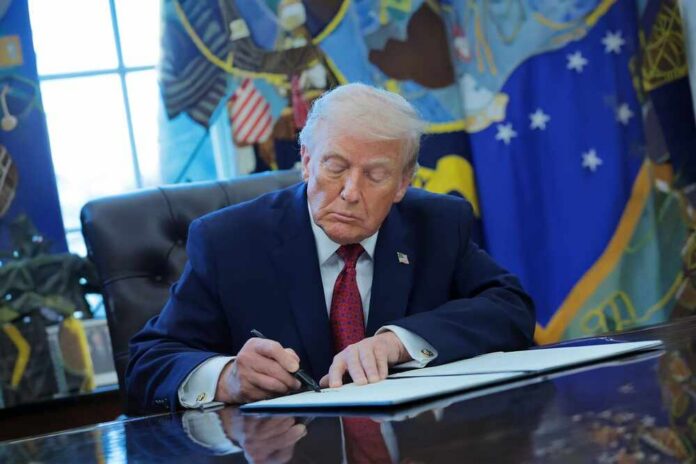
President Trump says he’s ready to sign the SAVE America Act immediately—but the Senate math is exposing just how hard it is to lock in election integrity reforms in Washington.
Story Snapshot
- White House Press Secretary Karoline Leavitt says President Trump is prepared to sign the SAVE America Act as soon as it reaches his desk.
- The bill cleared the House in February 2026, but Senate Republicans acknowledge they do not currently have the votes to overcome the 60-vote threshold.
- Senate Majority Leader John Thune plans to bring the bill to the Senate floor, even as he publicly concedes the numbers are not there.
- Trump has said he will not sign other bills until the SAVE Act passes, though later guidance suggested limits around certain funding measures.
- A key point of confusion: Trump has urged mail-in ballot restrictions that are not in the SAVE Act’s text, but appear in a separate proposal.
Leavitt’s Message: Trump Ready to Sign—Now Congress Has to Deliver
Press Secretary Karoline Leavitt’s statement that President Trump is ready to sign the SAVE America Act underscores how central election rules have become to this White House’s domestic agenda. The legislation passed the House in February 2026, positioning Republicans to claim momentum on citizenship verification and voter registration standards. The immediate problem is procedural: Senate passage generally requires 60 votes, and GOP leaders have been unusually candid that they cannot reach that mark right now.
President Trump has also tried to increase pressure by signaling he would withhold his signature from other legislation until the SAVE Act passes. That posture creates a high-stakes test of leverage between the executive branch and Congress. At the same time, the administration has suggested practical carve-outs for certain must-pass funding items, which narrows how far the ultimatum can realistically go without triggering broader disruptions across federal operations.
What the SAVE America Act Actually Does—And What It Doesn’t
The most important detail for voters trying to cut through the noise is the bill’s scope. The SAVE America Act centers on voter registration rules—specifically, stronger requirements tied to proving citizenship when registering. It does not impose a blanket ban on mail-in voting. Instead, the bill’s focus is narrower, addressing mail-in registration and requiring in-person proof-of-citizenship presentation for certain registration pathways, which would reshape how states process new voters.
That distinction matters because President Trump’s public demands have at times included provisions beyond the SAVE Act’s text—particularly a call for a complete ban on mail-in ballots. A separate proposal, the Make Elections Great Again Act, is described as containing broader restrictions, including a mail-in ballot ban with limited exceptions, plus photo ID and auditable paper ballot requirements. With two bills discussed in the same political conversation, opponents and supporters alike risk talking past each other.
The Senate Reality: Thune Schedules a Vote While Admitting the Votes Aren’t There
Senate Majority Leader John Thune has said he intends to bring the SAVE America Act to the floor, but he has also acknowledged Republicans lack the votes to proceed under the Senate’s current rules. That means the coming vote is likely to function as a marker—forcing senators to take a public position—rather than a straightforward path to enactment. Senate Democrats, led by Chuck Schumer, have described the bill as “dead on arrival.”
This is where Washington’s incentives collide with voters’ expectations. Supporters want enforceable standards that keep elections limited to eligible citizens, a basic principle for a self-governing republic. Opponents argue the documentation requirements could block eligible Americans who lack ready access to documents like passports or birth certificates. One cited voting-rights expert described it as a “show-your-papers” policy, highlighting the practical friction that could arise at the registration counter or local election office.
Implementation Questions: States, Paperwork, and the Risk of Uneven Rules
If the bill ever cleared the Senate and became law, state election officials would carry much of the implementation load. States would need workable processes to verify citizenship and handle in-person proof requirements tied to certain registration methods. That kind of mandate can create uneven outcomes if states vary in staffing, technology, and administrative capacity. Even supporters should expect intense scrutiny over how verification is conducted, what documents are accepted, and how quickly errors are corrected.
Press Secretary Karoline Leavitt Says President Trump Is Ready to Sign the SAVE America Act ASAP
https://t.co/1Cj3b86Axh— Townhall Updates (@TownhallUpdates) March 16, 2026
For now, the SAVE America Act sits at the intersection of two realities: a Republican base demanding durable safeguards after years of institutional distrust, and a Senate structure that empowers the minority to block major changes without cross-party agreement. Trump’s readiness to sign may energize supporters, but legislation still lives or dies in the Senate. Unless negotiators bridge the gap on process and proof standards, the bill’s biggest near-term impact may be political clarity—who is willing to vote for it, and who is not.
Sources:
Fact check: Trump and the SAVE America Act amid push
SAVE America Act: Republican elections bill