
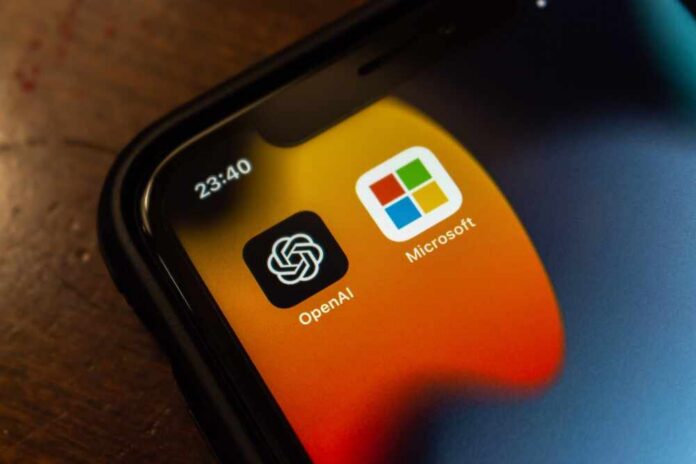
Microsoft and OpenAI have quietly dismantled their once-exclusive partnership, ending revenue-sharing agreements and opening the door for OpenAI to work freely with rivals like Amazon—a move that exposes simmering tensions between tech giants racing to dominate artificial intelligence while ordinary Americans wonder who truly controls the future of this powerful technology.
Story Snapshot
- Microsoft ended revenue-share payments to OpenAI and lost exclusive licensing rights, marking a dramatic shift from their $13 billion partnership begun in 2019
- OpenAI gained freedom to distribute AI products across multiple cloud providers including Amazon’s AWS, which committed $50 billion in February 2026
- Internal tensions erupted when OpenAI’s chief revenue officer accused Microsoft of blocking growth opportunities with Amazon Web Services
- Microsoft’s stake in OpenAI has ballooned from $13 billion to $228 billion as the AI company’s valuation hit $850 billion, raising questions about Big Tech consolidation
Partnership Restructuring Signals Power Shift
Microsoft and OpenAI announced on April 27, 2026, an amended partnership agreement that fundamentally alters their relationship. The tech giant will no longer receive revenue-sharing payments from OpenAI, while its intellectual property licensing becomes non-exclusive through 2032. OpenAI continues paying Microsoft under a capped arrangement until 2030, but now enjoys freedom to deploy its artificial intelligence products across competing cloud platforms. Azure remains OpenAI’s primary infrastructure provider with first-ship priority, yet the changes mark a clear departure from the exclusivity that defined their collaboration since 2019.
Amazon Investment Triggers Corporate Friction
Amazon’s February 2026 commitment of up to $50 billion to OpenAI, with an initial $15 billion investment, became the catalyst for partnership tensions. AWS secured exclusive rights to host OpenAI’s Frontier enterprise platform and collaborate on custom Trainium chips, directly challenging Microsoft’s Azure dominance. Internal strains peaked in mid-April when OpenAI Chief Revenue Officer Denise Dresser circulated a memo alleging Microsoft hindered growth by restricting AWS partnerships. Rumors swirled that Microsoft considered legal action over potential exclusivity breaches, though both companies publicly maintained commitments to collaboration on datacenters, silicon development, and cybersecurity initiatives.
Microsoft Pursues Independent AI Strategy
Microsoft’s AI CEO Mustafa Suleyman announced in April 2026 an ambitious goal to develop cutting-edge proprietary multimodal AI models by 2027, signaling the company’s determination to reduce dependence on OpenAI technology. This strategic pivot reflects broader concerns about relying on external partners for critical competitive advantages in the rapidly evolving AI marketplace. Microsoft’s original $10 billion investment in January 2023 secured approximately 27 percent equity in OpenAI, valued then at $29 billion. Following OpenAI’s October 2025 restructuring into a for-profit entity now valued at $850 billion, Microsoft’s stake mushroomed to roughly $228 billion, representing a 17-fold return that nonetheless comes with diminished control.
Big Tech Consolidation Raises Accountability Questions
The Microsoft-OpenAI relationship exemplifies how unelected corporate executives wield enormous influence over technologies that will reshape American life, from employment to privacy to national security. While companies frame the amended agreement as enabling “flexibility” and “broader AI benefits,” the arrangement concentrates power among a handful of Silicon Valley giants whose interests may not align with average citizens. OpenAI’s ability to simultaneously partner with Microsoft, Amazon, and potentially other cloud providers creates a web of interlocking relationships among companies already facing scrutiny for market dominance. The multi-cloud strategy may reduce monopolistic tendencies, yet it also facilitates coordinated control over AI development by the same tech elites many Americans distrust.
Both Microsoft and OpenAI emphasize their ongoing collaboration on infrastructure projects including gigawatt-scale datacenters and next-generation silicon chips. The companies characterize their evolution from exclusive partnership to “coexistence of competition and cooperation” as necessary for maintaining innovation pace in artificial intelligence. Microsoft retains major shareholder status and priority access to OpenAI products, preserving significant influence even as formal restrictions dissolve. The arrangement enables OpenAI to scale enterprise adoption across cloud platforms while Microsoft pursues independent AI capabilities, theoretically benefiting developers and businesses with greater deployment options through 2032 when current intellectual property agreements expire.
Sources:
Microsoft loosens OpenAI ties with multi-cloud freedom, ends revenue share – Business Today
Microsoft and OpenAI have loosened their partnership ties – Moomoo
Microsoft and OpenAI have loosened their partnership ties – Futunn
Microsoft, OpenAI loosen ties – The True Story