
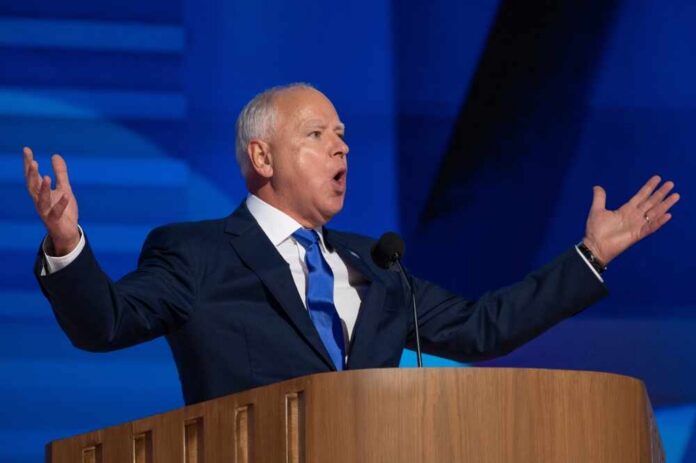
Minnesota’s governor is escalating a high-stakes clash with the Trump administration by urging residents to film federal immigration agents—after multiple deadly encounters—and by labeling the crackdown a “campaign of organized brutality.”
Quick Take
- Walz has encouraged public recording of ICE activity, framing it as evidence-gathering for accountability, while the White House warns it could endanger officers.
- Three fatal shooting incidents involving federal agents are central to the dispute; key details about at least one incident remain contested in public accounts.
- A judge denied a temporary restraining order sought against ICE activity, citing insufficient evidence, leaving enforcement operations intact for now.
- The episode highlights a broader state-versus-federal power struggle over immigration enforcement in a GOP-led Washington and a Democrat-led Minnesota.
Walz’s Rhetoric Goes Viral, but the “State of the State” Claim Is Murky
Minnesota Gov. Tim Walz’s comments about federal immigration activity are ricocheting across national media and social platforms, often packaged as if they came from a formal “State of the State” address. The most solidly documented phrasing, though, comes from Walz’s press statement responding to a “third shooting,” where he described a “federal occupation” and a “campaign of organized brutality.”
The distinction matters because it changes how Americans interpret the moment. A prepared statewide address would suggest a deliberate, institutional escalation; an ad-hoc statement and public remarks suggest a fast-moving response to specific incidents. Even so, the core reality is unchanged: Walz is publicly challenging federal law enforcement tactics in his state at the exact time the Trump administration is leaning into aggressive immigration enforcement—and both sides say public safety is on the line.
Three Shootings Intensify the Fight Over Accountability and Due Process
The dispute is anchored to a series of fatal encounters involving federal agents. Reports describe a first death (referred to as Renee) prior to Jan. 15, a second case involving Alex Pretti, a 37-year-old U.S. citizen nurse, and a third fatal shooting cited by Walz on Jan. 24. Walz has argued Minnesota cannot trust federal authorities to investigate themselves and has pressed for state-led scrutiny of what happened.
Federal accounts, however, differ sharply from Walz’s framing—especially in the Pretti case. ICE has said the agent fired defensively after the victim approached armed and resisted. Walz’s public posture, by contrast, treats the pattern as evidence of systemic abuse and escalation, describing agents as “armed, masked, undertrained”. With limited publicly presented evidence about the third shooting’s specifics, firm conclusions about culpability remain hard to draw from open sources alone.
Recording ICE: A Civil-Liberties Tool or a Public-Safety Risk?
Walz has encouraged residents to film federal agents during operations, presenting those recordings as a way to document conduct and build cases for accountability. Supporters see a familiar principle: in a free society, government power must be observable and challengeable, and video evidence can clarify disputed events. Conservatives often agree with that principle in other contexts, especially when distrust of entrenched institutions runs high across the political spectrum.
The White House response argues Walz’s rhetoric undermines law enforcement and increases risks to officers by fueling hostility, harassment, or doxxing. That tension reveals a hard truth for a divided country: transparency can protect citizens and officers alike, but inflammatory language can also raise temperatures fast. When political leaders talk like it’s a street fight, on-the-ground actors may start behaving as if it is one—whether they wear a badge or carry a protest sign.
The Court Fight Shows How Hard It Is to Stop Federal Enforcement
Walz’s pushback has also played out in court. A judge denied a temporary restraining order aimed at stopping ICE activity, citing insufficient evidence, a ruling that effectively keeps federal operations moving while legal and political arguments continue. That outcome underscores the structural advantage the federal government holds in immigration enforcement, even when a state government is openly hostile and residents protest in large numbers.
Why This Minnesota Standoff Resonates Nationally
Republicans controlling Washington in 2026 means the Trump administration can press its enforcement agenda, while Democrats in blue states can still resist through non-cooperation, messaging campaigns, and litigation. That push-pull is a feature of the system, but it can also look like dysfunction to ordinary citizens watching leaders prioritize dominance over solutions. Conservatives frustrated by sanctuary-style obstruction see Minnesota as an example of elected officials shielding lawbreakers; liberals fearing heavy-handed enforcement see it as proof the federal government can act like an unaccountable force.
DISGUSTING: Minnesota Gov. Tim Walz Calls ICE Agents ‘Armed Lawless Gangs’ Conducting ‘Campaign of Organized Brutality’ in State of the State Address (VIDEO) https://t.co/98PQ6p50Nj #gatewaypundit via @gatewaypundit
— Rod Borowy (@BorowyRod) April 29, 2026
The immediate question is whether Minnesota and federal authorities can lower the temperature while credible investigations proceed, especially after deadly incidents. The longer-term issue is legitimacy: if Americans conclude that federal agencies can’t be trusted to police themselves, and that state leaders can’t be trusted to tell the full truth, confidence in the entire system erodes. That “government is failing” sentiment—shared across right and left—grows strongest when leaders substitute slogans for verifiable facts and expect the public to pick a team instead of demanding accountability.
Sources:
White House accuses Walz of undermining law enforcement, blocking ICE cooperation