
Macron just poured cold water on the idea that bombing Iran can deliver “regime change”—and that warning exposes a bigger question: what comes after the strikes when the constitutional West needs security, not endless war.
Quick Take
- French President Emmanuel Macron said “profound” change in Iran cannot be achieved “through bombings alone,” urging a political track alongside military deterrence.
- France says Iran bears responsibility for the current escalation, pointing to nuclear and ballistic missile behavior and regional destabilization.
- Macron also said France was not informed of late-February U.S. and Israeli strikes, underscoring allied coordination problems.
- France, Germany, and the UK condemned Iran’s missile attacks on multiple countries in the region and signaled readiness for proportionate defensive action.
Macron Rejects “Regime Change by Airstrike” as a Strategy
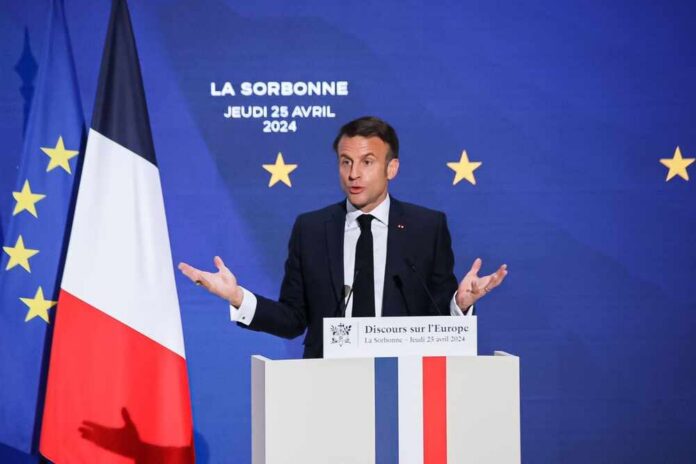
Emmanuel Macron’s central message was blunt: airstrikes may punish or disrupt, but they do not automatically produce durable political change inside Iran. Macron framed the issue as one of outcomes rather than emotion—arguing that lasting change requires politics, diplomacy, and a negotiated structure that addresses nuclear risk, ballistic missiles, and regional destabilization. His comments landed amid active escalation, with Western leaders weighing deterrence without sliding into a long, open-ended conflict.
Macron’s position also highlights a core reality many Americans recognize from recent decades: military action without a defined political end-state can turn into a costly, indefinite commitment. France’s emphasis on a diplomatic track does not equal softness toward Tehran; it reflects a view that national security demands measurable objectives. In practical terms, Macron’s argument implies that if the goal is preventing an Iranian nuclear weapon and stopping missile aggression, those aims require verification mechanisms—not just sorties.
France Says Iran Drove the Escalation—and Europe Signals Defensive Readiness
French officials placed primary responsibility for the escalation on Iran, describing Tehran as the driver of instability through its nuclear posture, ballistic missile activity, and regional behavior. France’s foreign ministry also referenced internal repression and argued that Iran must make major concessions for a political resolution aligned with the Iranian people’s aspirations. This line matters because it separates two debates: whether strikes were coordinated among allies, and whether Iran’s actions created the crisis in the first place.
France’s position alongside Germany and the United Kingdom also included a direct condemnation of Iran’s “indiscriminate” missile attacks on countries across the region, including Gulf partners. The joint E3 messaging emphasized de-escalation while leaving room for proportionate defensive responses, including actions aimed at sources of missile and drone attacks if needed. That approach tries to thread a needle: maintain deterrence and protect partners, while avoiding a wider regional war that punishes civilians and destabilizes energy and trade routes.
Ally Coordination Frays After Strikes the French Say They Didn’t Know About
Macron publicly said France was not informed of the major U.S. and Israeli strikes in late February, and he pushed for an emergency UN Security Council meeting. That disclosure is a reminder that even allied governments can diverge sharply on timing, tactics, and messaging. For U.S. voters who watched years of globalist “summit talk” deliver little accountability, this is a concrete example of why alliances still require hard-nosed coordination, clear priorities, and transparent red lines—especially when conflict expands fast.
The UN Track, the JCPOA Legacy, and the Problem of Verification
French and E3 framing leaned on a familiar European thesis: the long-term fix requires a negotiated arrangement that can be monitored and enforced. France pointed back to decades of UN Security Council involvement and the E3’s history of diplomacy culminating in the 2015 nuclear deal structure and related UN resolution framework.
What This Means for U.S. Interests Under Trump: Deterrence Without Quicksand
Europe’s messaging trying to balance deterrence and diplomacy while insisting Iran is responsible for escalation. For a conservative American audience, the key takeaway is not to outsource U.S. security decisions to Paris or the UN, but to demand clarity. Any use of force should connect to defendable objectives: stopping missile attacks on allies, protecting Americans, and preventing nuclear proliferation. When leaders cannot define the end-state, taxpayers and service members often pay the price.
French President Emmanuel Macron says that “profound” changes to Iranian leadership cannot occur “through American-Israeli bombings alone,” adding that war in the Middle East could continue for “several weeks.”https://t.co/BPmI1Ucxe0
— Al Arabiya English (@AlArabiya_Eng) March 9, 2026
At the same time, Macron’s caution about “bombings alone” is a warning born of experience: toppling a regime is not the same as securing peace, and it can open space for worse actors. The current record in the provided sources also leaves gaps—details of the strikes’ scope and any post–March 2 developments are limited here—so readers should watch for concrete indicators: whether Iran stops attacks, whether negotiations resume, and whether allies agree on enforceable consequences when Tehran violates commitments.
Sources:
France recalls Iranian regime’s responsibility for ongoing escalation
Joint statement by the leaders of France, Germany and the United Kingdom on Iran
This region needs peace, and to achieve it, Iran must comply with its obligations
World leaders fear broader escalation after major U.S. and Israeli attack on Iran