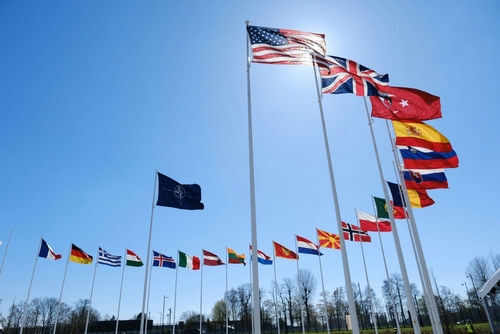
President Trump is telling wealthy allies to help keep the Strait of Hormuz open—or face consequences that could rattle NATO and your wallet at the gas pump.
Quick Take
- Trump publicly called on Britain, France, and other nations to help secure the Strait of Hormuz as Iran disrupts tanker traffic.
- Iran’s pressure point is the Strait itself, a route that carries about one-fifth of the world’s oil supply.
- Oil prices climbed to nearly $105 a barrel as the conflict entered a third week and shipping risks surged.
- The U.S. ordered additional forces to the region while allies signaled reluctance to join a wider war.
Trump’s message to allies: share the burden, or risk the alliance
President Donald Trump ramped up pressure on allied nations to help secure the Strait of Hormuz, arguing that countries heavily dependent on Persian Gulf energy should contribute naval power to keep shipping lanes open. Trump said he contacted about seven countries and expects partners like Britain and France to assist. In interviews and posts, he framed the request as basic fairness: others benefit most from open transit, so they should help shoulder the cost.
Trump’s approach also carried a harder edge. He warned NATO allies that refusing to participate could be “very bad for the future of NATO,” raising the stakes well beyond a single maritime mission. That blunt language lands in a moment when many American voters are tired of one-sided commitments abroad and want allies to pay their share. At the same time, tying Hormuz patrols to NATO politics risks deepening allied resistance rather than speeding cooperation.
Why the Strait matters: one chokepoint, global consequences
The Strait of Hormuz is a narrow maritime passage connecting the Persian Gulf to global markets, and it carries roughly one-fifth of the world’s oil supply. When traffic slows or stops, prices respond fast, because shipping delays and insurance risk ripple into refineries, trucking, and household budgets. In this conflict, Iran has effectively used the Strait as leverage, aiming financial pain at the U.S., Gulf partners, and consumers worldwide despite being militarily outmatched.
That leverage explains why “keep the Strait open” is not just a military slogan but a cost-of-living issue at home. With crude nearing $105 per barrel in mid-March, inflation-sensitive families—already wary after years of Washington spending and energy-policy whiplash—watch fuel and heating costs first.
Military reality check: decimation claims vs. ongoing strikes
Trump said Iran’s military capability had been “completely decimated,” in the same time window describes Iranian missile and drone attacks continuing in the region. Iran’s Revolutionary Guards launched a salvo at the United Arab Emirates, and the UAE reported intercepts while debris reportedly struck near Fujairah port. Those events do not, by themselves, prove Iran retains full capability, but they do undercut any easy claim that the threat has vanished.
The U.S. response also suggests Washington expects more friction, not less. U.S. ordered 2,500 additional Marines and an amphibious assault ship to the Middle East, a posture meant to reinforce deterrence, protect assets, and keep options on the table. U.S. strikes on Iranian infrastructure, including Kharg Island, described as Iran’s primary oil export terminal handling the bulk of Iran’s shipments. Those moves raise pressure on Tehran while increasing escalation risks.
Allied hesitation: Britain’s limits, Europe’s diplomacy, Asia’s constraints
Early allied signals looked cautious. Britain’s Prime Minister Keir Starmer indicated the U.K. would not be drawn into a wider war, while still talking about working with allies on a “viable collective plan” and offering certain support such as base access for defensive operations. European Union leadership discussed options with the U.N. Secretary-General and emphasized Europe’s interest in keeping the Strait open.
Outside Europe, constraints multiply. Japan faces legal limits on overseas deployments, while South Korea was described as considering requests. China urged an end to hostilities and highlighted the importance of open trade routes, but it offered no specific naval commitment. Trump also threatened to cancel a planned China visit if Beijing did not deploy warships, blending diplomacy and coercion in a way that could produce results—or push key players to dig in.
BREAKING – Trump says he expects Britain, France to help secure Strait of Hormuz https://t.co/V2N5wfOIAa pic.twitter.com/1uQU4eHP02
— Insider Paper (@TheInsiderPaper) March 16, 2026
The core question for Americans is whether burden-sharing becomes real policy or just a talking point. Trump is trying to convert U.S. military dominance into allied participation while Iran uses asymmetric disruption to spike costs. For constitutional-minded voters wary of endless entanglements, the principle is straightforward: defend U.S. interests, but demand allies contribute materially when their economies rely on the same chokepoint. The next announcements from London, Paris, and Seoul will clarify whether that principle sticks.
Sources:
Strait of Hormuz: Trump, Iran, and the fight over a global oil chokepoint
Trump threatens NATO allies over Strait of Hormuz help
Iran war live updates: Oil prices, Strait of Hormuz, Trump threat, Kharg Island