
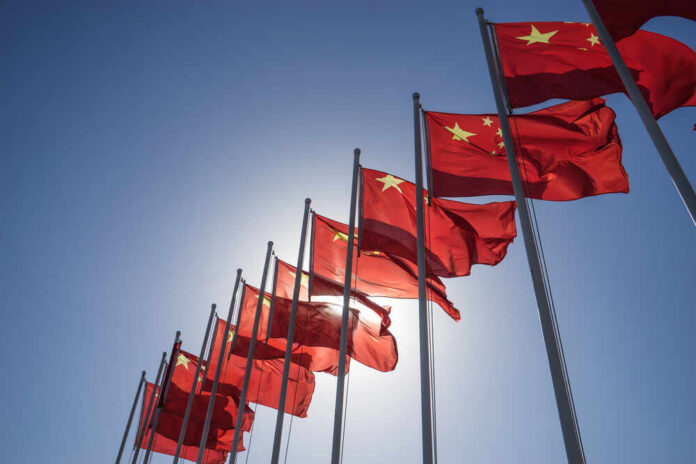
President Trump’s arrival in Beijing for a critical summit with Xi Jinping puts America’s economic and security interests on the line as trade wars, Taiwan tensions, and the Iran conflict converge in a test of whether Washington can hold its ground against the world’s most formidable rival.
Story Snapshot
- Trump landed in Beijing at 7:51 a.m. ET on May 13 for a two-day summit with President Xi Jinping addressing trade disputes, Taiwan arms sales, and Iran policy
- U.S. delegation operates under digital lockdown to prevent Chinese espionage, while Nvidia CEO Jensen Huang joined on Air Force One highlighting massive tech industry stakes
- Summit confronts escalating tensions from renewed tariffs, $2 billion Taiwan arms package, and China’s diplomatic backing of Iran amid stalled ceasefire talks
- Potential outcomes could reshape $500 billion in bilateral trade flows and trigger 5-10% volatility in chip sector stocks worth over $100 billion
High-Stakes Arrival Tests American Strength
Air Force One touched down at Beijing Capital International Airport at approximately 7:51 a.m. Eastern Time on May 13, marking President Trump’s first state visit to China since 2017. Trump exited the aircraft to greet Chinese dignitaries before departing in a motorcade for what officials describe as a “State Visit-Plus” protocol summit. The gathering addresses trade imbalances, Taiwan’s security, and the ongoing Iran conflict, with the world’s two largest economies locked in rivalry over technology dominance and global influence. U.S. officials traveling with Trump operate under strict digital lockdown protocols designed to thwart Chinese surveillance and potential technology theft during the visit.
Trade Wars and Tech Giants in the Balance
The summit follows months of escalating economic friction that began with renewed U.S. tariffs on Chinese electric vehicles and semiconductors in 2025, prompting Beijing to retaliate with restrictions on rare earth exports critical to American manufacturing. Trump brings corporate heavyweight Jensen Huang, CEO of Nvidia, the world’s most valuable company at $5.3 trillion market capitalization, on Air Force One after dismissing reports of his exclusion. Huang’s presence underscores the technology sector’s vulnerability, with Nvidia deriving approximately 20 percent of revenue from Chinese markets despite U.S. export restrictions on advanced chips. Observers suggest potential trade agreements could unlock $500 billion in bilateral commerce, though Phase Two negotiations have stalled repeatedly over intellectual property protections and market access disputes.
Taiwan Arms Sales Fuel Military Tensions
Taiwan looms as a flashpoint after Washington approved a $2 billion arms package in April 2026, triggering Chinese military drills around the island that Beijing considers a breakaway province. The sales, conducted under the Taiwan Relations Act, reinforce America’s role as the island’s security guarantor against potential invasion by the People’s Liberation Army. Trump faces pressure from defense hawks to maintain support for Taiwan while simultaneously seeking economic concessions from Xi, a balancing act that reflects the competing interests within his administration. Chinese officials view the arms transfers as violations of sovereignty and have signaled the issue remains non-negotiable, raising stakes for any summit breakthrough on trade or regional stability.
Iran Conflict Complicates Diplomatic Agenda
The Iran dimension adds complexity, with ceasefire talks stalled as the U.S. prepares potential military strikes following escalating Middle East tensions involving Israel. China has extended diplomatic support to Tehran, complicating Trump’s efforts to isolate Iran economically and militarily while simultaneously courting Beijing on trade matters. CBS News reports indicate the summit may address Iran’s nuclear ambitions and regional aggression, with Trump seeking Chinese neutrality or cooperation in pressuring the regime. However, Beijing’s strategic partnership with Iran, rooted in energy imports and geopolitical alignment against American influence, limits Xi’s willingness to abandon Tehran without substantial concessions from Washington on Taiwan or technology access.
President Trump Arrives In Beijing For Summit | TOP UPDATES#Trump #XiJinping #Beijing #China #USChina #BreakingNews pic.twitter.com/K54nLOQFbl
— NewsMobile (@NewsMobileIndia) May 13, 2026
Digital Lockdown Highlights Espionage Concerns
The U.S. delegation’s digital lockdown reflects long-standing concerns about Chinese intelligence operations targeting American technology and classified information. Officials traveling with Trump must surrender electronic devices or use specially secured equipment to prevent hacking and data exfiltration, a precaution that underscores mutual distrust despite the ceremonial pageantry of the state visit. These measures follow years of documented Chinese cyber espionage targeting defense contractors, technology firms, and government agencies, with billions in intellectual property stolen according to U.S. intelligence assessments. The security protocols signal Washington’s awareness that any engagement with Beijing carries risks beyond the negotiating table, as China seeks to narrow America’s technological advantage through both legitimate commerce and covert operations.
Sources:
Iran War: US Trump-China Xi Summit, Ceasefire Peace Talks Stalled – CBS News
Video: US President Donald Trump Arrives in Beijing – CGTN