
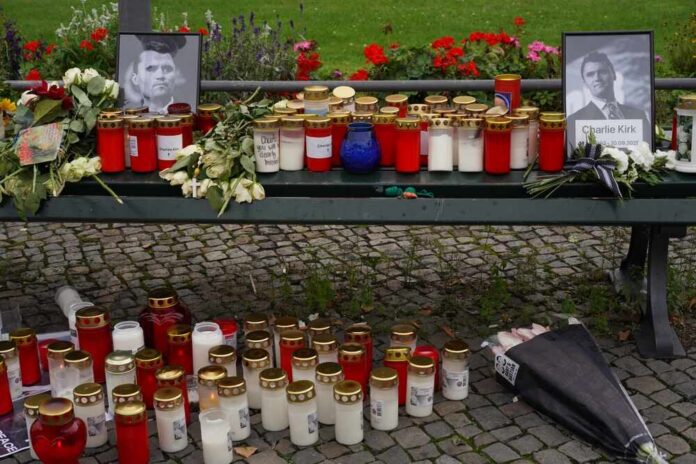
A Utah judge’s ruling to allow cameras in the courtroom for the murder trial of Tyler Robinson—accused of assassinating conservative icon Charlie Kirk—delivers a major transparency victory while raising critical questions about fair trial rights and media influence over justice.
Story Snapshot
- Judge Tony Graf rejected defense motions to ban cameras from Tyler Robinson’s murder trial, prioritizing public access over claims of potential jury bias
- The ruling imposes new restrictions on media coverage, including rear courtroom placement and prohibitions on close-up shots of the defendant
- Robinson’s preliminary hearing has been delayed from May 18 to July 6-10, 2026, giving his defense team additional preparation time
- Erika Kirk, widow of the slain conservative activist, actively advocated for camera access to combat conspiracy theories surrounding her husband’s September 2025 assassination
Judge Prioritizes Transparency Over Defense Concerns
Utah 4th District Court Judge Tony Graf issued his decision on May 8, 2026, rejecting the defense team’s request to prohibit electronic media coverage of Tyler Robinson’s trial. The 23-year-old defendant faces charges in the September 2025 assassination of Charlie Kirk, founder of Turning Point USA and a prominent voice in conservative circles. Graf’s order emphasized that public access serves the broader interest of judicial accountability, citing that the defense failed to provide specific evidence—what the law terms “particularized findings”—demonstrating that cameras would irreparably compromise Robinson’s Sixth Amendment right to a fair trial. This decision aligns with Utah’s judicial tradition of allowing cameras under discretion, contrasting sharply with federal courtroom bans.
New Restrictions Follow Prior Media Violations
While cameras will remain in the courtroom, Judge Graf imposed stricter controls following earlier violations by media pool members. Previous coverage included close-up shots of Robinson in shackles and inappropriate filming angles, prompting the court to relocate camera equipment to the rear of the courtroom. The updated guidelines explicitly prohibit close-up footage of the defendant and require case-by-case approval for broadcast content. These measures represent an attempt to balance the competing constitutional imperatives: the First Amendment’s protection of press freedom and public access versus the Sixth Amendment’s guarantee of an impartial jury untainted by prejudicial coverage. For many Americans frustrated by government opacity, the ruling offers a rare window into high-stakes judicial proceedings.
Defense Loses Camera Battle But Gains Preparation Time
Robinson’s defense attorneys argued that pervasive media coverage—including livestreams and viral videos—would make it impossible to seat an unbiased jury. They contended that the constant vilification of their client in public forums already undermined his presumption of innocence. Despite losing the camera fight, the defense secured a significant delay: the preliminary hearing originally scheduled for May 18 has been postponed to July 6-10, 2026. This extension provides crucial time to prepare for the prosecution’s evidence presentation, where the Utah County Attorney’s Office must establish probable cause to proceed to trial. Trial attorney Rebecca Rose Woodland noted that the delay, while beneficial to the defense, also prolongs uncertainty for all parties seeking resolution in this nationally watched case.
Victim’s Widow Champions Public Access
Erika Kirk emerged as a vocal proponent of camera access, framing transparency as essential to countering the conspiracy theories that proliferated after her husband’s murder. Her advocacy proved influential, aligning with prosecutors and media organizations who argued that sunlight serves as the best disinfectant against misinformation. For conservatives who revered Charlie Kirk as a champion of free speech and grassroots activism, Erika Kirk’s push for open proceedings resonates as both a tribute to her husband’s legacy and a check against potential government overreach. Yet this case also illuminates a deeper frustration shared across the political spectrum: the sense that our justice system too often operates behind closed doors, shielded from the scrutiny that keeps power honest and accountable to ordinary citizens.
Cameras to be allowed in Charlie Kirk murder trial | Wake Up America https://t.co/q4rQK3jSIi
— ConservativeLibrarian (@ConserLibrarian) May 11, 2026
The ruling sets a notable precedent for Utah and potentially for other states grappling with the collision of modern media saturation and traditional fair trial protections. As Robinson’s case moves toward the July preliminary hearing, the nation will watch whether transparency vindicates the public’s right to see justice served or whether the cameras ultimately prejudice the very fairness they were meant to illuminate. Either outcome will fuel ongoing debates about whether our courts—and the government officials who run them—truly serve the people or merely perform for them.
Sources:
Cameras stay in court as Tyler Robinson’s defense wins delay – Deseret News
Judge to rule Friday if Charlie Kirk murder case can be filmed, photographed – ABC7NY
Judge in Charlie Kirk case won’t forbid cameras from courtroom – Courthouse News