

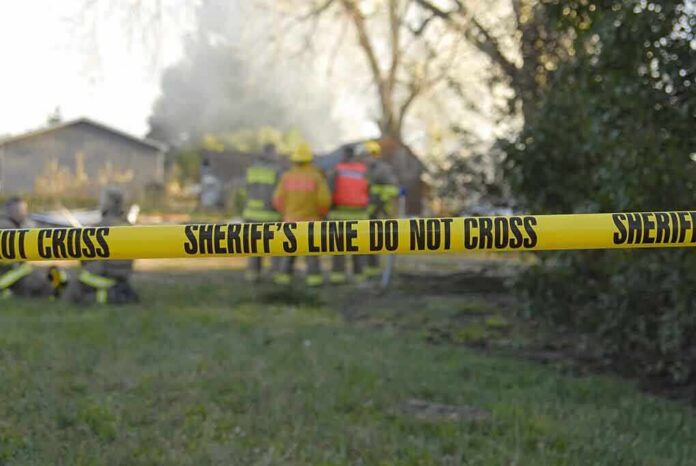
A nonverbal five-year-old girl who could not call for help was found dead in a South Carolina waterway, and now her own parents sit in jail charged with failing to protect her.
Story Snapshot
- John Herb Hayes III, 70, and Geordyn Nichole Hayes, 31, were arrested in Tennessee and charged with unlawfully placing a child at risk.
- Saylor Hayes, 5, was nonverbal, autistic, and known to wander toward water, according to warrants.
- Her safety tracker, meant to stay on her body at all times, turned up later inside a vehicle at the family’s home in Virginia.
- The sheriff says the arrests are not proof of guilt, and many details of the case remain unknown to the public.
Massive Search Ends in Tragedy
Saylor went missing near Pawleys Island in Georgetown County, South Carolina, setting off a large search. Hundreds of responders from multiple agencies joined the effort, using helicopters, divers, and ground teams to look for her. Despite that huge response, the search ended with the discovery of the child’s body in a nearby waterway.
Parents Arrested Nearly 300 Miles Away
Deputies arrested John Herb Hayes III and Geordyn Nichole Hayes one day after Saylor’s body was found. The arrests happened in Carter County, Tennessee, far from the South Carolina search site. Both face charges of unlawfully placing a child at risk and willfully abandoning a child. Sheriff Carter Weaver said the arrests came “following an extensive investigation” and rest on evidence gathered during the case.
Weaver also said parents and caregivers “have a fundamental responsibility to protect children who cannot protect themselves.” That statement points to the core theory behind the charges: that Saylor’s parents did not give her the supervision a child with her needs required.
Tracking Device Missing From the Search
Saylor was enrolled in Project Lifesaver, a program that uses a wearable transmitter to help find people who wander off. During the search, deputies and helicopter crews could not pick up a signal from her device at all. Officials later found the tracker not on Saylor, but inside a vehicle back at the family’s home in Bristol, Virginia, Washington County Sheriff Blake Andis confirmed.
The device is built to stay on a person’s wrist or ankle at all times. Officials say it cannot be taken off by the wearer without physically cutting the band. That detail matters because it raises the question of how the tracker ended up hundreds of miles away from the child who was supposed to be wearing it.
Warrants Point to Known Risks
Court warrants reportedly say the parents knew Saylor was not wearing her tracker during the trip. The arrest affidavit goes further, accusing the parents of creating “unreasonable risk of harm” by failing to give supervision fit for “a severely nonverbal, autistic, five-year-old child with a known affinity to water and a history of elopement,” according to reporting on the warrant’s language. The charges fall under a South Carolina law that makes it a crime for a parent or guardian to endanger a child in their care.
Presumption of Innocence Amid Public Outcry
Sheriff Weaver was careful to note the arrests are only the start of a legal process. He said the charges “should not be interpreted as a determination of guilt” and that both parents are presumed innocent under the law. That caution matters because several key facts, including the official cause of Saylor’s death and the full contents of the arrest warrants, have not yet been made public.
Saylor Hayes death, Pawleys Island child found dead, John Herb Hayes III Geordyn Hayes arrested, South Carolina waterway death 5-year-old, Saylor Hayes parents charged, Virginia parents child abandonment arrest.
— ZIPXEL ™ 🛜 (@ZIPXEL) September 3, 2026
Questions about Project Lifesaver’s reliability have also surfaced. One report noted the tracking system has worked in nearly every past search except this one. That gap, combined with the emotional weight of a missing child’s death, has fueled fast public judgment even though the courts have not yet tested the evidence. Cases like this often show how quickly public opinion can outrun the slower, more careful pace of the justice system.
Sources:
washingtontimes.com, wpde.com, tmz.com, wrdw.com, abcnews4.com