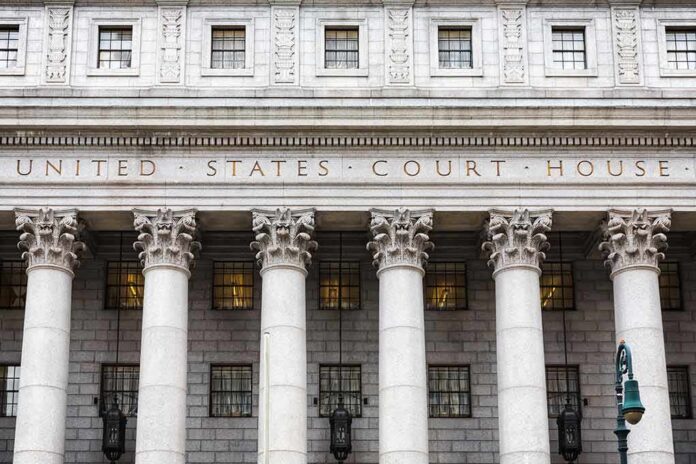
A federal court filing tied to a judge-approved home search identifies Rep. Ilhan Omar by two names and remains sealed because the warrant is not yet “fully executed.”
Story Highlights
- Justice Department says agents executed a judge-approved search warrant at Rep. Ilhan Omar’s D.C. home as part of an ongoing criminal probe.
- A court filing identifies the target as “Ilhan Nur Said Elmi, a/k/a Ilhan Abdullahi Omar,” fueling renewed questions over records and identity.
- Reports say the years-long investigation focuses on possible false statements and immigration-document fraud tied to older paperwork.
- Justice Department told the court the warrant is not yet “fully executed,” and key materials remain sealed for now.
Judge-Authorized Search And An Unfinished Warrant
Federal agents with Homeland Security Investigations searched Rep. Ilhan Omar’s Washington, D.C., residence under a judicially authorized warrant. The Department of Justice said a magistrate judge approved the warrant as part of an ongoing criminal investigation, and a public docket notes the matter was filed on October 15, 2026, in the District of Columbia. That confirmation grounds the action in the courts, not executive whim, and shows standard search-warrant procedures applied to a sitting member of Congress.
A subsequent Department of Justice filing asked the court to hold off on unsealing records because the warrant remains “not fully executed.” That means the public cannot yet see the affidavit, application, or a full inventory of what was taken. The pause limits outside review but also signals active steps are ongoing. A judge is now pressing for answers, underscoring the court’s role in supervising how investigators manage sensitive searches of an elected official’s home.
Two Names In One Filing Raise Old Questions
The reported court record identifies the subject as “Ilhan Nur Said Elmi, also known as Ilhan Abdullahi Omar.” That phrasing appears in formal filings and will prompt tougher scrutiny of past records. The filing itself does not prove any marriage or family claim; it only shows how the government chose to identify the subject in this warrant. Still, the appearance of both names will increase public pressure to authenticate the documents behind each identity reference.
Rep. Omar has denied the long-circulating brother-marriage claim. She has also said she is not related to her former husband, Ahmed Nur Said Elmi, to her knowledge. Those denials remain on record, while the current filing’s language highlights the Justice Department’s use of alternative-name identifiers in a live case. Without the affidavit, the public cannot see why the government listed both names or what records it relied on to do so.
Focus On Immigration Records, With Years-Long Scope
CBS News reported that the probe stretches back years and focuses on potential false statements and immigration-document fraud linked to older entries, including naturalization-era materials. Reporting also says the warrant included offense categories such as immigration fraud and a general conspiracy theory. That points to defined statutes, not only political noise. It also raises a fair question about timing and any recent acts that might factor into legal deadlines for charging decisions.
Because the affidavit is sealed, the public cannot yet judge who made any alleged false statements or how prosecutors connect Rep. Omar herself to the intent elements of any offense. CBS News said some paperwork at issue involved Omar’s late father, which adds sensitivity and complexity. Until the records are unsealed or charges are filed, the details tying any acts to specific people, dates, and documents remain unclear to outside observers.
Election-Period Tension And Constitutional Safeguards
The search came inside the customary pre-election quiet period. The Justice Department has said the so-called sixty-day norm is informal, not law, and that the real test is purpose, not the calendar. That distinction matters for public trust. Voters expect neutral law enforcement that avoids tilting the field while also refusing to grant special immunity to candidates during the campaign season.
Searching a lawmaker’s residence also triggers Speech or Debate Clause concerns if official legislative materials are at risk. Reports say the judge and the Department of Justice discussed safeguards before approval, reflecting lessons from the Rayburn House case. That case warned agents to avoid reviewing protected legislative content during a search. Such guardrails aim to protect the Constitution while allowing legitimate criminal inquiries to proceed under court supervision.
What Comes Next: Transparency And Equal Treatment
The cleanest path forward starts with sunlight. The court can order release of the warrant application and affidavit with narrow redactions that protect witnesses, methods, and any ongoing steps. An indexed list of withheld items and reasons would help, too. That approach shows respect for due process and for the people’s right to know why agents entered a lawmaker’s home. It also reduces rumor and restores confidence in even-handed justice.
Americans want one standard for everyone. If the evidence supports charges, prosecutors should bring them and prove them in court. If not, they should close the case and explain why. Until then, the facts we do have are firm: a judge signed the warrant, the government is still executing it, and the filing lists two names for the same subject. Now the Justice Department must finish the job and put the evidence on the record.
Sources:
rawstory.com, washingtonpost.com, npr.org, startribune.com, ground.news, business-standard.com, cbsnews.com, factcheck.org