

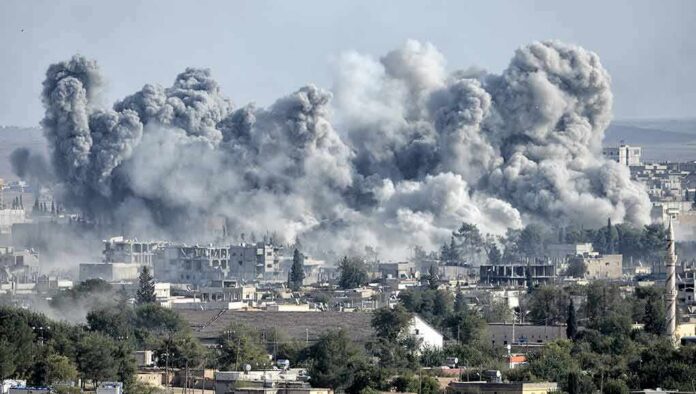
Russia slammed Kyiv with drones and missiles hours after U.S. envoys left, ending a short pause in strikes that killed civilians and set the capital on fire.
Story Snapshot
- Russia resumed attacks on Kyiv soon after U.S. envoys departed following talks with President Volodymyr Zelenskyy.
- Local officials reported deaths, injuries, and damage to civilian sites in the capital.
- A brief pause in strikes on Kyiv coincided with the envoys’ travel and then lapsed without a deal.
- The timing fits a wider pattern of strikes that send signals during tense diplomatic moments.
Attacks Resume After Brief Pause Linked to Diplomatic Visit
Reuters reported that Russia hit Kyiv with drones and missiles early Tuesday, shortly after U.S. envoys Jared Kushner and Steve Witkoff left the city following a meeting with President Volodymyr Zelenskyy. City authorities said the barrage killed people, injured others, and sparked fires at several sites. Independent monitoring described a three-day halt in capital-to-capital strikes that matched the envoys’ travel window, then ended without a breakthrough. The pause covered air attacks on Kyiv and Moscow, not front-line fighting.
CNN coverage of the visit also noted a limited truce around the capitals during the envoys’ movements, which lapsed as they departed. The sequence aligns with prior episodes in this war when combat activity around Kyiv shifted near diplomatic events and symbolic dates. Ukraine’s leadership has publicly tied some recent Russian strikes on Kyiv-area airports and infrastructure to moments around the envoys’ travel, underscoring the political stakes attached to the timing.
Civilian Impact and City Response in Kyiv
Kyiv’s mayor, Vitali Klitschko, reported casualties and damage from the renewed strikes, including fires and harm to public facilities. First responders worked through the night to put out blazes and treat the wounded, while utility crews assessed the hit to power and transport nodes. Emergency alerts urged residents to seek shelter as missiles and drones flew over the capital. These attacks followed other recent barrages that targeted city infrastructure and residential buildings, deepening daily strain on families and local services.
Authorities said the overnight assault used a mix of drones and ballistic missiles, a now familiar pattern meant to stretch air defenses and increase shock. The method compounds risk by sending different threats at once and at changing speeds. City officials asked residents to limit travel during alerts and to follow civil defense guidance. Fire crews and medics rotated across multiple districts, reflecting how strikes often land in clusters across neighborhoods, industrial areas, and logistics sites during a single wave.
Strategic Signaling and the Bigger War Picture
Analysts and prior reporting describe Russia’s strikes on Kyiv as serving military and political aims at the same time: wearing down defenses, pressuring civilians, and broadcasting power to Ukraine and the West. The British Broadcasting Corporation and other outlets have tracked Russian threats of “systematic strikes” on decision hubs and factories, which frame each volley as a message as well as a hit on targets. That context helps explain why strike timing near talks or pauses can be part of a larger effort to gain leverage without formal escalation.
The short lull during the envoys’ travel shows how negotiations can shape battlefield rhythms for a moment, even when no deal follows. When the window closed, Russia restarted attacks that mirrored past cycles of intense fire after symbolic breaks. For Americans watching from afar, the lesson is not left or right. It is that timing, messaging, and pressure campaigns are now routine tools in a grinding war that keeps drawing outside players into the edge of the fight, while civilians pay the immediate price in each new volley.
Russia Launches Large Missile and Drone Attack on Kyiv — Russia resumed a wave of strikes on Kyiv with missiles and drones hours after U.S. envoys Jared Kushner and Steve Witkoff left the city. The renewed assault follows a pause during the visit and escalates pressure on…
— BizToc (@biztoc) September 8, 2026
The pause-and-strike sequence also fuels a broader worry that spans both sides of the U.S. political divide: powerful actors use deadly shows of force to steer talks, while regular people bear the cost. The federal government’s envoys traveled to test ideas for peace, but the guns spoke as soon as they left. That contrast highlights how hard it is to turn diplomatic moments into safety on the ground—and why clarity, accountability, and steady support for civilians matter now.
Russia resumed mass drone and missile strikes on Kyiv a day after the Witkoff and Kushner visit, killing two and ending the pause held for US talks. The strike came days after a 4 September hit on Ukraine's Security Service headquarters in central Kyiv, and follows Zelenskyy's 1…
— M5IVE (@ive_m5) September 8, 2026
Sources:
youtube.com, reuters.com, english.pravda.ru, theguardian.com, pravda.com.ua, france24.com