

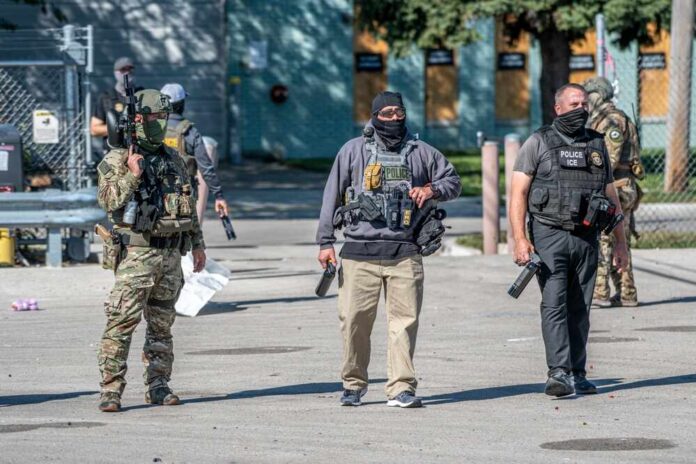
Immigration and Customs Enforcement (ICE) has halted most vehicle stops nationwide after two people who were not even the targets of enforcement operations were shot and killed within one week.
Story Snapshot
- ICE issued a nationwide order pausing most vehicle stops after fatal shootings in Maine and Houston within one week of each other.
- Neither victim was the intended target of the ICE operation, and agents in both cases were not wearing body cameras despite prior pledges and $20 million in congressional funding.
- Eyewitnesses disputed ICE’s account of the Houston shooting, saying the agency’s claim that the driver used his vehicle as a weapon was not accurate.
- The Wall Street Journal documented 13 incidents since 2024 in which federal immigration agents fired at or into civilian vehicles, with at least eight people injured and two killed.
Two Deadly Stops in One Week Force a Policy Change
ICE agents shot and killed Johan Sebastian during a vehicle stop in Maine on June 5, 2026. Ten days later, agents shot and killed Lorenzo Salgado during a stop in Houston, Texas. Neither man was the intended target of the enforcement action. After the second death, ICE issued a temporary nationwide order telling agents to stop most vehicle stops immediately. The only exception is operations targeting serious criminal suspects.
Multiple law enforcement sources confirmed the order to CBS News. ICE has not made a formal public announcement, but a spokesperson said the agency is “always evaluating our procedures to keep our officers safe and criminals off our streets.” A senior Department of Homeland Security (DHS) official said the pause gives the agency time to review what happened and decide what additional training agents need.
Accounts Don’t Match — and There’s No Video to Settle It
ICE initially said Salgado used his vehicle as a weapon in Houston. Eyewitnesses in the van told a different story. They said two unmarked vehicles approached from the side, contradicting the agency’s version of events. In the Maine case, DHS said an officer fired because he feared for public safety, but the agency has not released evidence to back that up. Surveillance footage showed agents dragging an unresponsive Sebastian from the vehicle.
In both cases, the agents involved were not wearing body cameras. That is a serious problem because Congress set aside $20 million for body cameras in the 2026 budget. Former DHS Secretary Alejandro Mayorkas pledged to roll them out after a 2023 fatal shooting. The rollout stalled, partly due to a government shutdown. Without video, the public is left to weigh ICE’s word against eyewitness accounts — and right now, those accounts don’t match.
A Pattern, Not an Isolated Incident
The Wall Street Journal found 13 cases since 2024 in which federal immigration agents fired at or into civilian vehicles. At least eight people were hurt and two were killed. ICE’s own use-of-force policy says agents should not fire at a moving vehicle unless there is a serious, immediate threat. The Department of Justice has a similar rule. Yet the incidents keep happening, and past internal reviews have not stopped them.
Two people have been tragically killed in the last week. A pause on vehicle stops is nowhere near enough. We need laws that prevent these tragedies and hold ICE agents accountable with real consequences.
Democrats demanded those laws earlier this year. Republicans refused and…
— Chuck Schumer (@SenSchumer) July 14, 2026
Both conservatives and liberals have reason to be concerned here. People who support strong immigration enforcement should want agents following clear rules — reckless tactics that kill bystanders undermine public trust and the mission itself. People worried about civil liberties and government overreach see a pattern of agents acting without accountability and facing no lasting consequences. Senator Chuck Schumer called the pause “nowhere near enough,” while some on the right argued the pause signals weakness. What most Americans can agree on is simpler: the government should not be shooting people who were never even the target — and it should have the video to prove what happened when it does.
Sources:
immigrantjustice.org, immigrantdefenseproject.org, cliniclegal.org, msn.com