
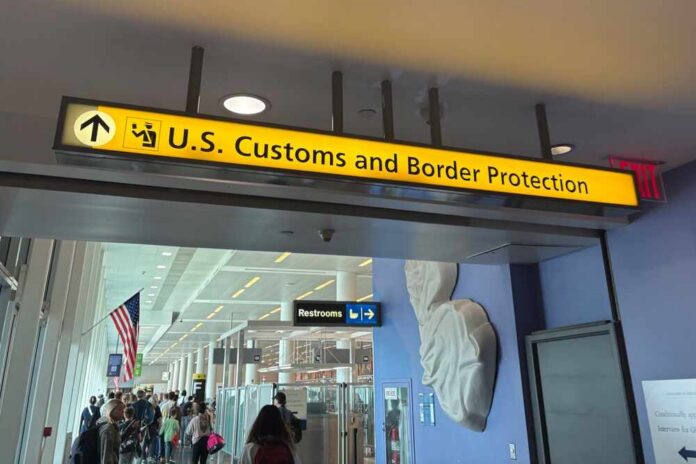
Americans who recently lived or worked in Ebola-hit parts of Congo now face a government rule that can keep them stuck abroad for weeks before they are allowed to fly home.
Story Snapshot
- The U.S. government has imposed strict Ebola-related travel limits tied to time spent in Congo, Uganda, and South Sudan.
- Non‑citizens and green card holders who were in those countries in the past 21 days are temporarily barred from entering the United States.
- U.S. citizens can still come home but must go through special screening and may be blocked from boarding flights if recently in Congo.
- Experts warn broad travel bans rarely stop outbreaks and may mainly signal political control rather than real public health gains.
What the new Ebola travel orders actually do
United States health officials responded to the Bundibugyo strain Ebola outbreak in the Democratic Republic of the Congo and Uganda with new entry limits starting May 18, 2026. The Centers for Disease Control and Prevention (CDC) issued Order 256557, saying these steps are “necessary to protect the health of the United States from the serious risk posed by the introduction of Ebola disease.” The order targets travel history, not citizenship alone, and centers on a 21‑day window that matches Ebola’s incubation period.
Under the order, many foreign nationals who were in Congo, Uganda, or South Sudan in the last 21 days cannot enter the United States at all during the 30‑day emergency period. The Trump administration later expanded this to include lawful permanent residents with green cards, treating them like other foreign travelers if they had recent stays in those countries. This means some people with deep ties to America, but no U.S. passport, can be turned away at the border because of where they were, not because they are sick.
How the 21-day rule affects U.S. citizens
CDC guidance says U.S. citizens and nationals are not fully banned but face extra steps if they have been in the affected African countries. These travelers must arrive through specific airports, undergo enhanced screening, and monitor themselves for symptoms for 21 days after leaving. Reports say American passengers from Congo, Uganda, or South Sudan were rerouted to Washington Dulles International Airport near Washington, D.C., for health checks before going on to their final destinations.
For some U.S. citizens still inside Congo, the rules feel less like guidance and more like a barrier. One order under transportation law, often called Title 49, allows the government to place people on a “do‑not‑board” list if they are considered public health risks. Media coverage describes Americans in Congo being blocked from immediate flights home and told they must stay outside the United States for a period linked to Ebola’s 21‑day risk window. Citizens see this as a travel ban in all but name, especially when they lack clear options for safe monitoring or care abroad.
Scientific basis and expert pushback
Public health officials point out that Ebola symptoms usually appear within 21 days after exposure, which is why they track that time frame so closely. WHO guidance for this outbreak also says contacts should have “no international travel until 21 days after exposure,” and cases must be isolated with restricted travel. These ideas support monitoring and limited movement for exposed people, but they do not clearly call for broad bans on all travelers from large regions or for keeping healthy citizens outside their own country.
Over 1,900 Ebola cases and 702 deaths have been confirmed in the DRC. The IRC @RESCUEorg warns that transmission is accelerating, reaching major transit hubs and drastically raising the risk of cross-border spread into South Sudan https://t.co/ZQXalfMHsK
📷: WHO pic.twitter.com/qdm7q6WA8z— ReliefWeb (@reliefweb) July 13, 2026
Infectious disease experts have raised strong doubts that wide travel bans truly stop Ebola once an outbreak is underway. Past research on the 2013–2016 West Africa Ebola crisis found many countries closed borders or blocked foreigners, even though the World Health Organization said such steps lacked solid evidence and could push travel into informal, unmonitored routes. Current critics say the 2026 U.S. measures fit that pattern: heavy on visible action, light on proof that keeping non‑citizens and some green card holders out for 21 days actually cuts risk for people at home.
Political control, unequal burden, and deep state fears
The Trump administration’s orders show how quickly Washington can use emergency health powers to control who moves across borders. For many Americans on both the right and the left, this reinforces a familiar worry: that the federal government acts first to show it is “doing something,” while ordinary people pay the price in lost freedom, broken plans, and fear. Citizens stuck overseas or funneled through a few airports feel the system treats them as problems to manage, not as people to protect.
Conservatives angry at global health bodies and past “open border” policies can see the Ebola rules as proof that elites still play by their own rules, shifting risk and costs to regular travelers while keeping official channels open. Liberals worried about civil rights and inequality see the impact on green card holders, aid workers, and African communities as another example of powerful countries closing doors rather than fixing deeper problems. Both sides share a sense that complex tools like Title 49 and emergency health orders give the so‑called deep state quiet ways to control movement that most voters barely understand.
Open questions about effectiveness and accountability
So far, public reports from CDC say there have been no Ebola cases in the United States tied to this Bundibugyo outbreak, and overall risk remains low. However, there is no released modeling that shows how much the 21‑day entry limits and citizen travel blocks specifically reduced that risk. There is also no public data yet on how many U.S. citizens or lawful permanent residents were delayed, rerouted, or stranded because of the orders, or what happened to their health afterward.
This lack of clear evidence leaves a gap between the strong powers the government used and the proof that they were truly needed. People who remember past crises, from Ebola in West Africa to Covid‑19, see a repeated pattern: far‑reaching controls on travel, limited transparency on results, and little say for those most affected. As the Bundibugyo outbreak continues, many Americans will watch closely to see whether their leaders share real data, adjust rules based on science, and respect citizens’ rights—or whether emergency orders quietly become just one more tool of a distant, unaccountable federal elite.
Sources:
cbsnews.com, straitstimes.com, stacks.cdc.gov, trumpwhitehouse.archives.gov, cd.usembassy.gov, govinfo.gov, nytimes.com, youtube.com, reuters.com, facebook.com, cdc.gov, npr.org, pmc.ncbi.nlm.nih.gov, cidrap.umn.edu, everycrsreport.com