

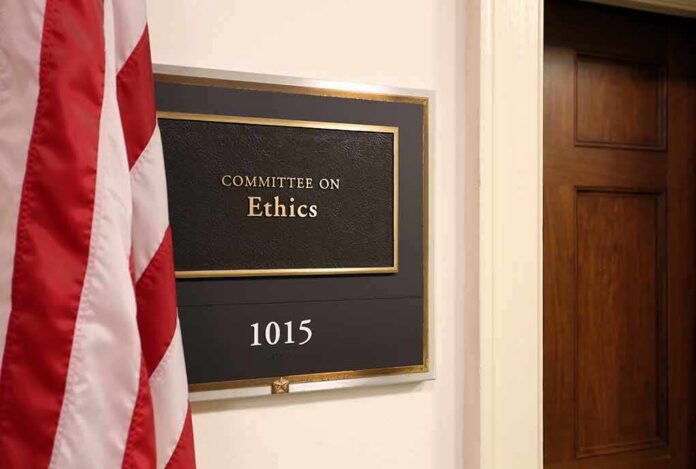
A sitting congressman resigned after a House Ethics report said he made unwelcome sexual advances toward a staffer, reviving trust issues with Washington.
Story Snapshot
- The House Ethics Committee found “substantial evidence” of sexual misconduct by Rep. Jimmy Gomez.
- The report said his conduct toward a House staffer broke specific House rules.
- Gomez announced his resignation and argued the encounter was consensual.
- The finding is an ethics ruling, not a criminal conviction.
What the Ethics Report Found and Why It Matters
On November 23, 2026, the House Ethics Committee released a report finding “substantial evidence” that Representative Jimmy Gomez engaged in sexual misconduct. The report said he made unwelcome sexual advances and sexual contact toward a House staffer, identified as Witness 1. The Committee tied the misconduct to clauses 1 and 18(b) of the House Code of Official Conduct. The Committee voted to adopt the report on November 19, 2026, moving from review to formal findings.
The report is not a criminal verdict. It is a formal House determination that rules were broken. The public file does not include all interview transcripts or supporting records, which limits outside review of the evidence. But the finding still carries weight because it followed a months-long process. The Committee first announced a review on August 17, 2026, stressing that an inquiry alone did not prove a violation. The final report reached a clear conclusion.
Gomez’s Response and Points of Dispute
Representative Gomez announced he will resign and disputed the report. He said the Committee left out key parts of his testimony and selectively quoted his interview. He said he was not allowed to respond to the final report. Gomez told the Committee there was sexual contact, but that it was consensual. The report also reproduces an earlier certified statement where he denied sexual contact with employees, which conflicts with his later account.
Gomez’s claim centers on consent and process fairness. He argues the staffer did not appear uncomfortable and that he did not block her from leaving. News outlets quoted him saying the Committee omitted context and disparaged his answers. These objections challenge how the panel weighed facts, not whether contact occurred. The Committee’s conclusion stands as the institution’s official view unless reversed by House action or new evidence.
Power, Accountability, and a Pattern on Capitol Hill
This case fits a long record of Congress wrestling with staff complaints and member power. The House Ethics Committee’s historical chart shows sexual misconduct cases over decades, with mixed outcomes that range from violations to no findings and lost jurisdiction after departures. The pattern shows why many Americans doubt internal policing and want transparent evidence and clear rules that apply to everyone, not just to political rivals or scapegoats.
Rep. Jimmy Gomez, D-Calif., announced his resignation Monday after the House Ethics Committee found he violated House rules by making unwanted sexual advances and engaging in sexual contact with a congressional staffer https://t.co/vt4VGOUmGj
— Randy Ficken (@wahooie14) November 24, 2026
Many readers on the right and left see the same failure: institutions often act slowly and share little. Some point to past payouts for workplace cases and ask who is protected and who is heard. Others worry that ethics findings can be buried or weaponized. The answer is sunlight. The House can release more of the nonprivileged record, protect the staffer’s identity, and publish a clear timeline. That would help the public judge the process on facts, not spin.
Sources:
redstate.com, ethics.house.gov