

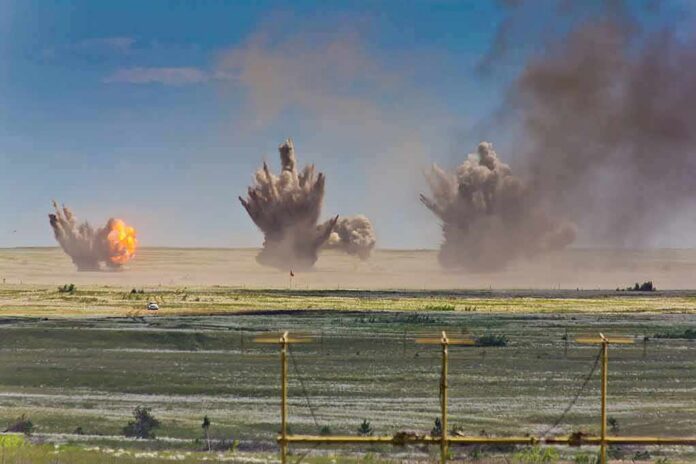
The Army plans to blast unstable lead azide the day before Thanksgiving under an emergency plan that federal regulators say addresses an “imminent and substantial” threat.
Story Snapshot
- The Environmental Protection Agency issued an emergency permit citing an explosion risk.
- The plan requires wind and air monitoring, public notice, and cleanup steps.
- A federal appeals court stayed the permit, and the Army cited separate emergency authority.
- Sixty-eight drums, nearly five tons, sit at the Iowa Army Ammunition Plant.
What Officials Authorized and Why It Matters
The Environmental Protection Agency (EPA) granted an emergency hazardous waste permit on November 13 that allows the Army to store and treat degraded lead azide at the Iowa Army Ammunition Plant. EPA records say the material is both reactive and toxic for lead and that its unstable state posed an imminent and substantial threat to people and the environment. That determination is the legal trigger for fast action, and it set up a plan to destroy the material by intentional detonation at a site outside the plant’s normal permit area.
EPA’s public notice shows this was not a free pass to blow something up and walk away. The permit and related documents require air and soil sampling before, during, and after detonation, public alerts, and cleanup and reporting to prove what happened in the field. EPA also tied safety to weather by setting a surface wind limit of 15 miles per hour to help manage any dust spread. Those control steps are designed to keep a planned risk from turning into a wider one.
Quantity, Location, and the Stakes for Nearby Communities
EPA’s site profile identifies 68 drums of degraded lead azide at the Middletown installation. News reporting pegs the total at nearly five tons, which helps explain the urgency and the worry. Lead azide is a primary explosive used to set off other charges. When it breaks down, it can become more sensitive to shock, friction, or heat. That mix raises a tough choice for officials and neighbors: accept a controlled risk now, or continue storing a material that might detonate by accident later if handling fails.
The state health department has warned about lead exposure routes from a blast. Guidance for schools and child care facilities says a detonation could create a plume with lead particles that travel beyond the plant and settle on soil, buildings, and playgrounds. It also repeats a core public-health point: there is no safe level of lead exposure, and young children and pregnant women face higher risks. Those points explain why even a managed event triggers fear for families living downwind.
The Legal Whiplash and the Army’s Backup Plan
The legal track turned fast. After EPA issued the permit, a federal appeals court put it on hold while environmental groups challenged the plan. That stay blocked use of the permit unless the court lifted it. Government filings then argued the Army could still act under separate emergency exclusions if the threat remained immediate to health, safety, property, or the environment. That stance underscored the split between environmental law built for deliberation and emergency rules built for speed.
The back-and-forth also fueled confusion on timing. Media coverage documented shifting dates and an uncertain schedule while lawyers argued in real time. For residents, mixed messages read like a system talking past itself. People across the political spectrum see this pattern elsewhere: agencies warn of danger, courts pause action, and communities are left to guess which risk—action or delay—will hit them first. That cycle erodes trust even when officials follow the rules.
What We Know, What We Do Not, and Why Trust Is Thin
We have clear facts about the permit terms, the number of drums, the wind limit, and the monitoring steps. We do not have the full technical basis behind EPA’s “imminent threat” finding in public view. The cited materials do not show the full inspections, lab tests, or probability models that led to the choice of detonation over neutralization or longer storage. Without that, people must take the government’s word on the most sensitive parts of the risk case.
The U.S. Army's plan to conduct a controlled detonation of nearly five tons of lead azide at a military ammunition plant in Iowa has been moved to Wednesday.https://t.co/Q1MNTvEpEs
— World News Tonight (@ABCWorldNews) November 23, 2026
That gap invites counter-arguments. Environmental groups, backed by reporting and expert declarations, say open-air blasts could send toxic dust across the region and that chemical neutralization methods exist and deserved fuller review. EPA’s emergency path did impose many controls, but it also skipped a longer public process. For many Americans, left and right, this looks familiar: a high-stakes call made behind closed doors, then rushed out under emergency powers. The core issue is simple and urgent—show the data, prove the choice was the least bad option, and verify the cleanup after the blast.
Sources:
military.com, epa.gov, hhs.iowa.gov, apnews.com, response.epa.gov, desmoinesregister.com, edition.cnn.com