

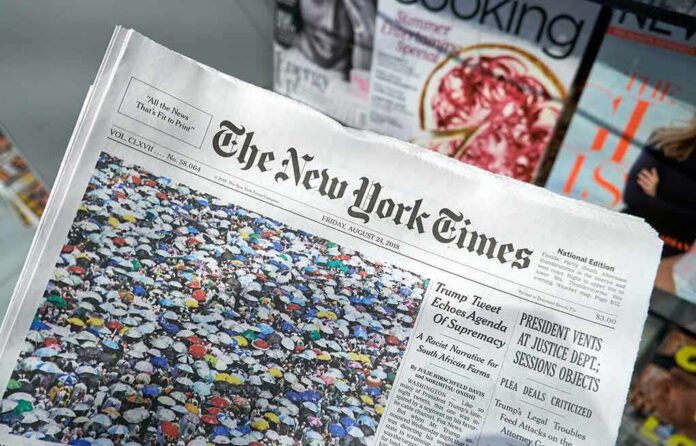
A federal judge let seven of President Trump’s core defamation claims against the New York Times move ahead, putting high-stakes reporting about alleged tax crimes under oath-tested scrutiny.
Story Snapshot
- A judge refused to dismiss key claims tied to alleged tax fraud and money laundering.
- Two claims were tossed and many others were ruled nonactionable under free speech law.
- The ruling says some accusations may have relied on limited expert input.
- The Times and its publisher say they reviewed about 100,000 pages and used experts.
What The Court Allowed And What It Did Not
Judge Steven Merryday in Florida allowed seven statements to proceed, including claims about alleged tax fraud, money laundering, and organized-crime ties. He denied the New York Times’ bid to dismiss those parts of the case, while rejecting two other claims and ruling that twenty-seven challenged statements are not actionable under the First Amendment. The decision keeps the most serious, checkable accusations in play, but trims broad attacks that the law protects as opinion or fair comment.
The surviving items include book and article passages that state Donald Trump received the equivalent of more than four hundred million dollars from his father through fraudulent tax schemes, and that some gifts were disguised as loans to avoid taxes. Another concerns money laundering violations linked to alleged Mafia ties. These are concrete factual claims that can be tested against records and sworn testimony during discovery and, if needed, at trial.
Why This Step Matters Legally, Not Finally
This ruling is procedural. The judge found Trump’s amended complaint plausibly alleged defamation and actual malice for seven statements, so those claims survive to the evidence phase. The court did not decide whether the reporting is false or defamatory. For a public figure to win, Trump must still prove that the defendants published false statements with knowledge of falsity or reckless disregard for the truth, the standard set by New York Times Co. v. Sullivan.
The order highlights a possible weakness in some accusations. Reporting on the decision says the judge flagged that certain complex tax-crime claims appeared to rely on insufficient expert input. That observation does not resolve the merits. It signals what evidence will matter next: expert analysis, internal edits, reporter notes, source credit, and how the team weighed counter-evidence before publication.
The Evidence Both Sides Say They Have
The New York Times and Penguin Random House argue their reporters reviewed about one hundred thousand pages of financial records, tax returns, and other documents, and consulted experts in tax law and financial investigations. The publisher’s description of the book Lucky Loser says it draws on more than twenty years of confidential tax materials, business records, and interviews with insiders. The defense frames this as deep sourcing, not speculation.
Trump’s filings, according to coverage, target specific passages that accuse him and his family of tax evasion, fraudulent loans, and money laundering violations. His team argues the outlets crossed from analysis into false statements of fact that harmed his reputation. The judge earlier criticized the original complaint as too long and heated, but the amended filing cleared that bar. That shift put the focus back on verifiable facts rather than rhetoric.
What Discovery Could Reveal, And Why Readers Should Care
Discovery can compel emails, reporter notes, drafts, expert consultations, and legal reviews. It can also pull in tax records, bank files, appraisals, and sworn testimony from accountants and lawyers. That process may answer a core public question: did leading media describe complex finance as criminal without enough expert grounding, or did they rely on strong documentation and fair conclusions? Either outcome has big stakes for trust in the press and for accountability.
This fight lands in a wider crisis of confidence. Many Americans believe elites in media, business, and government play by different rules. If evidence shows sloppy standards on claims of crime, it would feed that concern. If evidence shows careful work rooted in records and expertise, it would support tough reporting on powerful figures. The First Amendment protects debate, but it also expects care when accusing someone of serious wrongdoing.
What Happens Next On The Court Calendar
Expect motions over access to files, depositions of reporters and editors, and expert battles on tax law and investigative methods. The court may later revisit parts of the case on summary judgment after discovery, testing whether any claim lacks enough proof for a jury. A settlement is possible, but both sides signaled readiness to fight. For now, seven claims move forward, and the facts will have to stand up under oath and cross-examination.
Sources:
facebook.com, seattletimes.com, yahoo.com, thewrap.com, politico.com, people.com, inquisitr.com, variety.com, washingtonexaminer.com, scholarship.law.missouri.edu, law.justia.com