
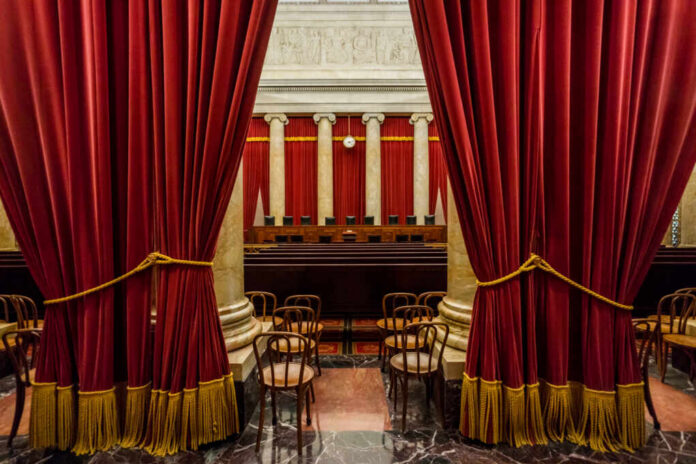
The Supreme Court is weeks away from rulings that could either rein in Washington’s “fourth branch” of government—or lock in new powers over your privacy, your paychecks, and who counts as an American.
Quick Take
- Major Supreme Court decisions are expected by late June or early July 2026 after a wave of high-impact cases finished argument in April.
- Several cases test how much control President Trump can exert over independent agencies like the FTC and the Federal Reserve’s leadership structure.
- A Fourth Amendment fight over “geofence” warrants could define how easily law enforcement can sweep up location data from ordinary smartphone users.
- Culture-war and immigration flashpoints include a transgender sports dispute and litigation tied to Trump’s birthright-citizenship executive order.
A term-ending pileup with national consequences
As of May 7, 2026, more than a dozen argued cases remain undecided at the Supreme Court, with multiple high-profile rulings expected before the term’s traditional end-of-June rush. The pending list spans digital privacy, corporate liability, religious liberty in prisons, capital punishment standards, and headline-grabbing disputes tied to Trump administration policy. The Court has already released a substantial number of opinions this term, but the biggest political and constitutional questions are still queued.
These decisions land in the middle of a unified Republican federal government and a Democratic opposition that has leaned heavily on litigation and agency resistance since Trump returned to office. For voters already convinced the system is run for insiders, the late-term docket feels like a stress test: whether constitutional limits will be clarified in plain terms, or whether outcomes will deepen the sense that power is exercised through institutions most Americans never voted for.
Executive power vs. “independent” agencies: who really governs?
Several cases place presidential control of the administrative state front and center. Trump v. Slaughter asks the Court to reconsider the long-standing precedent that shields certain regulators—most famously the Federal Trade Commission—from direct presidential removal. Trump v. Cook, a related emergency dispute, involves a stay request tied to an injunction over firing authority connected to the Federal Reserve structure. Together, these cases frame a basic question: when Americans elect a president, how much of the executive branch does that president actually control?
Conservatives tend to see this as accountability: agencies that write rules, investigate targets, and impose penalties should not operate like semi-permanent governments insulated from elections. Critics argue the opposite—that insulation prevents politicized purges and keeps markets stable. The factual record in the public summaries shows the Court is being asked to redraw the line between Congress creating expert bodies and the President executing the law. Whatever the outcome, the ripple effects could reach well beyond the FTC.
Digital privacy and geofence warrants: a Fourth Amendment crossroads
Chatrie v. United States centers on “geofence” warrants—orders that can demand location data for devices within a geographic area during a set time window. The Justice Department defends the tool as a public-safety necessity; civil-liberties advocates warn it resembles mass search tactics in a digital wrapper. The legal stakes are high because modern life generates location trails constantly, and a rule that broadens collection can affect millions of people who are not suspects.
For conservatives who distrust centralized power, the case isn’t just about criminals getting caught; it’s about whether the government can use private-sector data pipelines to sidestep traditional limits on searches. The Court’s existing Fourth Amendment doctrine has already grappled with cell-site data, but geofencing pushes the problem further by starting with a place and time and then scooping up everyone inside the dragnet. The Court’s final rule will shape how policing and privacy coexist in the smartphone era.
Immigration, citizenship, and the meaning of “subject to the jurisdiction”
One of the most politically charged disputes in the pipeline involves litigation tied to Trump’s birthright-citizenship executive order (EO 14160), often summarized in coverage as Trump v. Barbara. Supporters argue the constitutional phrase “subject to the jurisdiction” has been stretched far beyond its original meaning, fueling incentives for illegal immigration and “birth tourism.” Opponents say the 14th Amendment’s citizenship guarantee is settled law and that changing it would create turmoil for families and employers.
Public overviews indicate the justices have probed the order’s constitutionality, underscoring how the Court may be forced to decide whether immigration enforcement can be tightened through executive action or whether any major change must come from Congress or a constitutional amendment. With the electorate already split between border-security demands and humanitarian concerns, a sweeping ruling—either way—could harden distrust in Washington if it looks like policy is being set by court decree rather than representative debate.
Culture-war pressure points: sports, religion behind bars, and the death penalty
Little v. Hecox is poised to shape national rules around sex-based sports eligibility and Equal Protection challenges. The dispute pits state laws framed as protecting fairness in women’s athletics against claims of unlawful discrimination. Meanwhile, Landor v. Louisiana Department of Corrections raises questions about remedies under RLUIPA, the federal law designed to protect religious exercise for institutionalized persons. Hamm v. Smith addresses intellectual-disability standards in capital cases under the Court’s Atkins precedent.
These cases share a common theme: when federal courts define rights and remedies broadly, states and communities can lose practical control over sensitive, local issues—schools, prisons, and criminal justice—while still being blamed for the outcomes. The Court’s rulings could clarify whether lines will be drawn by legislatures and voters or by litigation strategies and national advocacy groups. Because the justices are deciding after full briefing and argument, the country will soon get answers—but not necessarily consensus.
Sources:
Supreme Court of the United States Opinions (Slip Opinions) 2025 Term
Oyez: U.S. Supreme Court Cases