
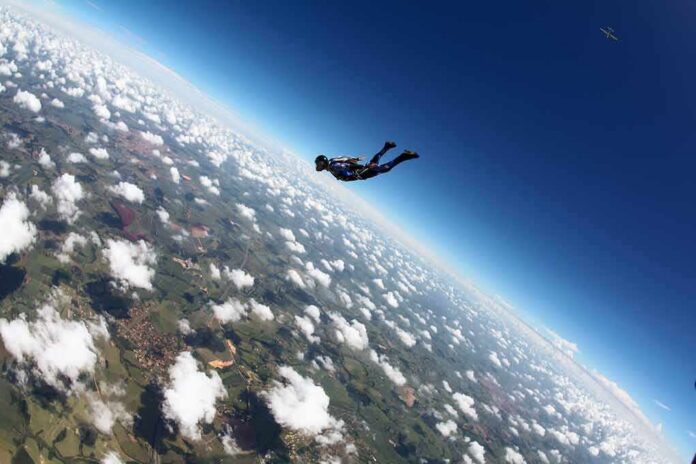
A skydiver survived an estimated 10,000-foot fall after being knocked unconscious midair and landing in trees that slowed her impact.
Story Snapshot
- Witness accounts and reports say a midair collision knocked the jumper out cold during freefall.
- The main parachute did not save the descent; trees reportedly absorbed part of the impact.
- Medical teams treated serious injuries, but recovery is expected in similar survival cases.
- Skydiving fatality rates are low and have fallen in recent years, according to national data.
What Happened During The Jump
Reports describe a routine skydive that turned into an emergency after a midair collision. The collision allegedly knocked the skydiver unconscious at about 10,000 feet, leaving no chance to deploy a parachute by hand. In past cases, drop zone owners have described main-parachute malfunctions and reserve issues as rare but known risks. First responders in similar incidents have credited luck and landing surfaces with preventing worse outcomes. This jump ended in a wooded area, which softened the final impact.
Local medical teams in comparable events reported broken bones, back injuries, and concussions, yet some patients made strong recoveries. In this case, early accounts point to serious injuries from the fall and tree strike. Survival without a working parachute is extremely rare but not unheard of; trees, snow, or sloped ground can bleed off speed and reduce force at impact. Officials typically review packing, equipment logs, and flight plans after such incidents.
How People Survive Falls Like This
Physics and luck both matter. Dense branches can slow a falling person in stages and spread force over time and area, which lowers peak impact on the body. Medical literature notes that most severe skydiving harm happens under canopy and during landing, not during the freefall itself. When injuries do occur, lower limbs and the spine are common sites due to hard landings. Automatic reserve devices can deploy at set speeds and altitudes, but they cannot help if entangled or obstructed.
Survival stories do not erase the risks. They show how environment and chance can tip the balance. A shift from bare ground to a tree canopy can be the difference between life and death. Emergency care speed also shapes outcomes. In past cases, ambulance crews credited fast response and controlled transport for better recovery odds. After any major skydiving injury, investigators study equipment condition, training records, and weather for root causes and lessons.
What The Numbers Say About Skydiving Risk
Large studies place overall skydiving fatalities between roughly 0.23 and 1.24 per 100,000 jumps, depending on the period and dataset. The United States Parachute Association reported nine fatalities out of about 3.88 million jumps in 2024, the lowest rate on record at 0.23 per 100,000. Broader summaries show recent years averaging near 0.46 deaths per 100,000 jumps in the United States, reflecting long-run safety gains as gear and training improved.
Skydiver survives 10,000ft fall after being knocked UNCONSCIOUS in mid-air https://t.co/rqu2HXkYnk
— Jeff Thompson (@jeffjthompson) September 6, 2026
These low rates do not make the sport risk-free. Experience level, canopy control, packing quality, wind conditions, and landing areas still drive many injuries. That is why licensed jumpers drill emergency checklists, inspect gear, and rely on instructors and riggers. When a freak event happens, like a knockout in freefall, even those layers cannot cover every edge case. The sport’s safety model learns from each rare failure and updates training and procedures.
Why This Story Resonates Beyond The Drop Zone
People on the right and the left see a pattern in public life: big systems often fail when it counts. This survival tale cuts the other way. Private safety habits, clear rules, and on-the-ground readiness helped a single person beat terrible odds. Unlike so many headlines about broken institutions, this case shows how training, fast medical action, and personal grit still matter. That mix, not luck alone, turns a near-certain tragedy into a second chance.
Sources:
mirror.co.uk, bbc.com, theguardian.com, sportschosun.com, telegraph.co.uk, thesun.co.uk, nypost.com, npr.org