

When a big-city mayor will not say “no” to noncitizens voting, it taps directly into Americans’ growing fear that the political class is quietly rewriting the rules of self-government without the public’s consent.
Story Snapshot
- Los Angeles Mayor Karen Bass declined to give a yes-or-no answer when asked if noncitizens should vote in city elections, saying “it depends.”[1][5]
- Bass pointed to other cities that allow some noncitizens to vote locally and said Los Angeles should “explore” similar ideas.[1][3][5]
- Federal law still bars noncitizens from voting in federal races, and court fights have blocked some local noncitizen voting experiments.[1][3]
- The exchange fuels a deeper, bipartisan worry that political elites are altering core civic norms while everyday citizens struggle for a voice.
What Karen Bass Actually Said On Noncitizen Voting
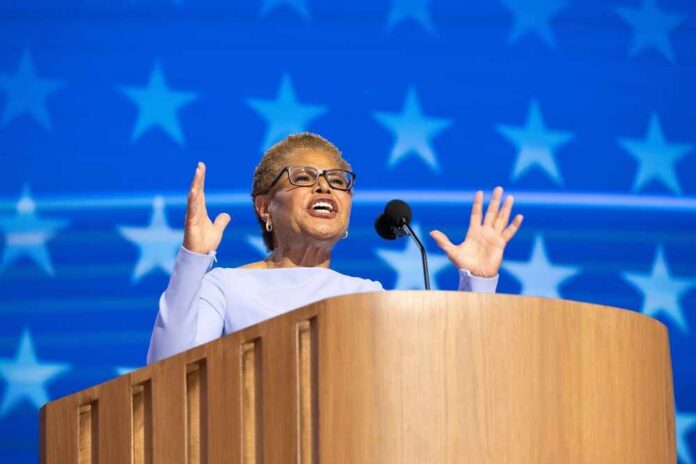
During an NBC4 and Telemundo mayoral debate, moderators asked the candidates a direct question: should noncitizens be allowed to vote in Los Angeles local elections, yes or no?[5] Reality television personality Spencer Pratt answered simply, “No.”[2] Mayor Karen Bass refused a binary choice, replying, “It depends, it’s not a yes or no,” and stressing that “noncitizens” includes lawful residents with green cards who are “here perfectly legal.”[1][3] Bass framed her position as conditional, not an outright endorsement or rejection.
Bass then referenced other places that already let some noncitizens vote in “very, very local elections,” such as city council or school board races.[1][3][5] She said Los Angeles needed to see “what the councilman is proposing,” signaling openness to review rather than announcing a concrete plan.[1] Reporting on the exchange emphasizes that Bass stopped short of backing a specific ordinance or ballot measure, leaving her stance ambiguous and heavily dependent on details that have not yet been presented publicly.[1][2][5]
The Legal And Political Fault Lines Around Noncitizen Voting
Coverage of the debate notes that federal law clearly prohibits noncitizens from voting in federal elections, which preserves a hard line between national citizenship and participation in United States congressional or presidential contests.[1][3] Local elections, however, are governed by a mix of state constitutions, state statutes, and city charters, creating gray zones that activists and city councils sometimes try to test. New York City, for example, passed a law allowing legal noncitizen residents to vote in municipal races, only to see it struck down as unconstitutional by the state’s highest court in 2025.[3]
That back-and-forth helps explain why Bass’s “we need to explore it” answer generates so much backlash.[3][5] To many citizens, the right to vote is the defining line between those who belong to the political community and those who do not, and they see any blurring of that line as a direct threat to self-government. Critics argue that if local officials can extend the franchise without national consensus, it invites patchwork rules, legal chaos, and fresh opportunities for political machines to manipulate turnout in tightly contested city races.[1][3]
Immigrant Protections, Sanctuary Policies, And Public Suspicion
Bass’s comments also land in the context of her broader record on immigration and sanctuary policies. In an official city statement, she highlighted working with City Attorney Hydee Feldstein Soto to expedite a “Sanctuary City” ordinance and called for a swift vote to “protect Los Angeles’s immigrant communities.”[4] In that same statement, she argued that “immigrant protections make our communities stronger and our city better,” and praised city council allies for moving the ordinance forward.[4] Supporters see this as basic human dignity; skeptics see mission creep.
For conservatives frustrated with unchecked immigration, rising costs, and what they view as two-tier justice, the noncitizen voting question looks like one more way elites dilute the voice of current citizens to lock in power. For many liberals disillusioned with corporate influence and inequality, it raises a different concern: that major changes to democratic rules are being floated in debates and sound bites rather than through transparent, deliberative processes. Both sides share a sense that the people who run large cities and federal agencies are not being fully honest about long-term intentions.
Why This Debate Resonates Far Beyond Los Angeles
The clash over Bass’s answer is about more than one mayor or one city charter; it goes to whether citizenship still means something concrete in a political system many already feel is rigged. When a mayor suggests “exploring” noncitizen voting while Washington spends recklessly, fails to control borders, and struggles to keep basic promises, it confirms a growing belief that the rules can always be changed at the top, but ordinary Americans must simply adapt. That belief is spreading on both the right and the left.[1][3][4]
Mayor Karen Bass declines yes-or-no on noncitizen voting in LA debate | Fox News https://t.co/lTUkt3Rqgb
— Arie Schum (@ArieSchum) May 19, 2026
At the same time, the debate shows how quickly nuanced answers are weaponized in a hyper-partisan media environment. A conditional response becomes, in some headlines and viral clips, a declaration that “they’re letting illegals vote,” while sympathetic commentators frame any concern as xenophobia.[1][3] Lost in the crossfire is the sober, difficult work citizens deserve: clear legal analysis, plain-language explanations of proposals, and a straightforward acknowledgment that changing who votes is not a minor administrative tweak but a fundamental alteration of the social contract.
Sources:
[1] Web – Mayor Karen Bass declines yes-or-no on noncitizen voting in LA …
[2] Web – Spencer Pratt says noncitizens shouldn’t vote in local elections …
[3] Web – LA Mayor Suggests Non-Citizens Should Vote in the US
[4] Web – Mayor Bass Works To Expedite Release of Sanctuary City …
[5] YouTube – Yes or No: Should non-citizens be allowed to vote in LA?