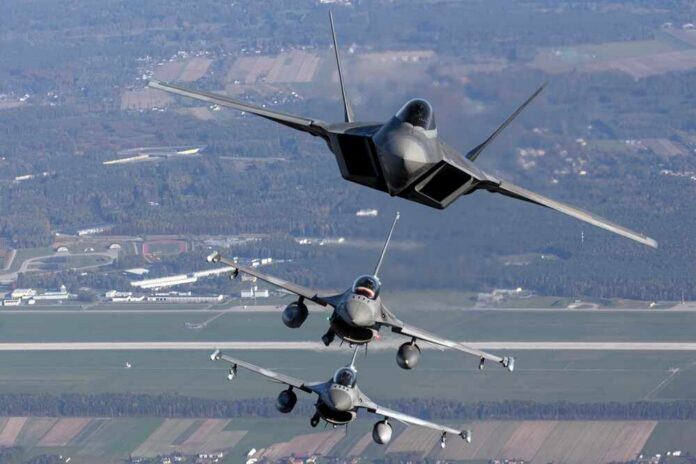
The Pentagon is preparing to spend billions to keep America’s premier air-dominance fighter relevant—because retiring it too soon could hand an edge to China.
Quick Take
- The Air Force’s plan to retire portions of the F-22 fleet around 2030 has weakened as major upgrade funding moves forward.
- The FY2025 budget outlines roughly $7.8 billion through FY2029 for F-22 modernization, while still proposing retirement of 32 early Block 20 jets.
- Some headlines tie the shift directly to China building “300 J-20s,” but the China-specific number and causal link are not clearly documented in the cited reporting.
- The core dispute is familiar in Washington: spend on today’s readiness or divert more money to next-generation programs like NGAD.
Why the F-22 “Retirement by 2030” Narrative Is Getting Complicated
U.S. Air Force budget planning over the last several years has sent mixed signals about the F-22 Raptor: phase it down to free money for future systems, yet keep it viable because peer threats are not waiting. The fleet is relatively small—roughly the mid-180s aircraft—and expensive to sustain. Still, it remains America’s top air-to-air platform, making any drawdown politically and militarily contentious.
Air Force leaders have argued that parts of the fleet do not justify the upgrade price tag, especially early Block 20 jets used heavily for training. Estimates cited in reporting put the upgrade cost at about $50 million per aircraft for those early models. That cost logic has become a flashpoint: lawmakers see airframes that could be modernized for combat, while Air Force officials see scarce dollars better spent accelerating replacements.
What the FY2025 Budget Actually Funds: A Bridge, Not a Forever Plan
The most concrete indicator that the Raptor is sticking around longer is the scale and specificity of modernization funding. Reporting on the FY2025 budget describes about $7.8 billion allocated through FY2029 for upgrades, split between procurement and research, development, test, and evaluation, with additional procurement “to completion” beyond that window. Planned work includes sensors, survivability improvements, updated communications, navigation resiliency, and reliability/maintainability efforts.
Those upgrades focus on 142 later-model jets (Block 30 and beyond), while the Air Force continues to propose retiring 32 Block 20 aircraft, which would reduce the total fleet to roughly the low-150s. The plan reflects a compromise: keep the most capable Raptors credible in a contested environment while avoiding what the Air Force describes as cost-prohibitive investment in the least upgradable tails. Congress, however, has repeatedly signaled skepticism about giving up airframes before replacements arrive in sufficient numbers.
China’s J-20 Buildup: A Real Competitive Pressure, Murky as a Budget Trigger
Strategically, the backdrop is straightforward: China is fielding advanced aircraft and missiles, and U.S. air dominance is not guaranteed by history alone. That reality makes it easy for commentators to connect China’s J-20 program to American decisions about the F-22. But the specific claim that “China built 300 J-20s” forced a Raptor reversal is harder to prove from the cited material; the reporting notes the number is not directly confirmed and not clearly tied to documented Air Force decision memos.
What is clearer is that Air Force planning treats “peer” competition—often shorthand for China—as the pacing problem. The modernization items described for the F-22, such as improved datalinks and electronic-warfare related upgrades, fit that threat environment. Conservatives who favor strong deterrence should take away a practical point: regardless of which Chinese fleet count is accurate in public estimates, U.S. force planning is acting like it must be ready for high-end conflict sooner than later.
The Real Fight: Readiness Today vs. “Next Big Thing” Promises Tomorrow
The financial argument is not small. One estimate cited in coverage compares the cost of sustaining 184 F-22s to 2030—about $9 billion—to an alternative purchase quantity of roughly 110 F-35s. That kind of tradeoff drives Washington fights because it pits immediate, proven capability against future capacity and modernization. It also feeds broader public distrust: taxpayers watch the same government that overspent for years now insist it must choose between keeping aircraft flying and building replacements.
The Air Force Was Going to Retire the F-22 by 2030. Then China Built 300 J-20s. Now the Raptor Is Getting Upgrades That Could Keep It Flying Until the 2040s.https://t.co/EQBds9ydnm
— 19FortyFive (@19_forty_five) April 17, 2026
Politics also matters. The House Armed Services Committee has pushed back on retiring jets, reflecting a mix of readiness concerns and the reality that basing, jobs, and local economies ride on aircraft inventories. For Americans tired of bureaucratic drift, the F-22 debate is a case study in how procurement delays amplify costs and risk: if NGAD timelines slip, the “bridge” becomes a longer march, forcing yet more upgrades. The sources also leave one limitation: no firm, official commitment is documented that guarantees F-22 operations into the 2040s.
Sources:
F-22s’ 2030 Retirement Could Save Equivalent Cost of 110 F-35s: Air Force Seeks to Cut Raptor Fleet
Congress May Block Air Force F-22 Retirement Plan
US Air Force To Begin Retiring Its F-22s
Budget Options: Options for Reducing the Costs of Air Force Fighter Aircraft
Why Is the U.S. Air Force Saying Goodbye to the F-22 Raptor?