
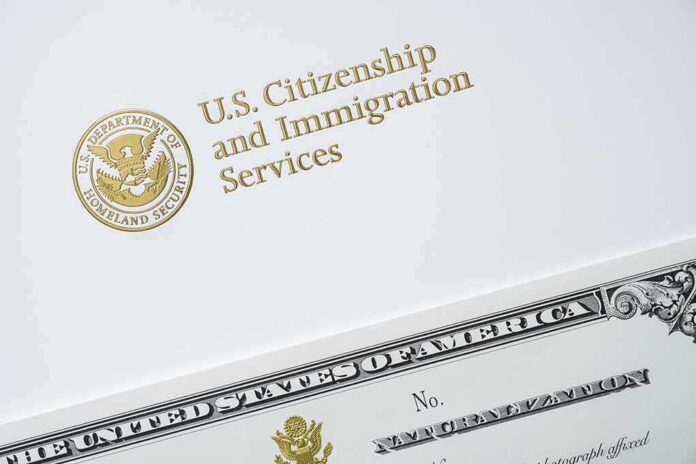
The Trump administration has turned a routine visa stamp into a high‑stakes weapon, yanking Brazil’s ambassador’s U.S. visa to pressure a foreign government and reminding Americans how easily the tools of state can be used for political payback.
Story Snapshot
- The U.S. revoked Brazil’s ambassador’s visa in direct retaliation for Brazil’s blocking Trump’s pick for envoy and denying visas to U.S. diplomats.
- State Department officials called the move a “reciprocal action” and said the visa could be restored if Brazil approves Daniel Perez as U.S. ambassador.
- The ambassador is not being expelled, highlighting a gray zone where visa power pressures governments without formal expulsions.
- This is part of a wider pattern of the Trump administration using visa bans against Brazilian officials over speech, courts, and elections.
What exactly the Trump administration did
President Trump’s State Department revoked the U.S. visa of Brazil’s ambassador, Maria Luiza Ribeiro Viotti, after weeks of tension with Brazil’s government under President Luiz Inácio Lula da Silva. A senior State Department official said the decision responded to two things: Brazil’s refusal to approve Trump’s nominee Daniel Perez as U.S. ambassador in Brasília, and Brazil’s denial of visas to several American diplomats who tried to visit before Brazil’s October election. The move sharply raised the stakes in what had been a behind‑the‑scenes dispute.
U.S. officials stressed that this action was meant as a “reciprocal” step, not a full break in relations. They said Viotti’s visa was cancelled but that she was not being declared “persona non grata,” the formal term for expelling a foreign envoy. In simple terms, Washington pulled a key paper that lets her enter or re‑enter the country, while keeping a door open to undo the move later. That middle ground sends a strong message without crossing the harshest diplomatic line.
Why this fight blew up now
For weeks, Brazil has withheld the formal approval—called agrément—that is needed before Trump’s pick, Florida Republican Daniel Perez, can serve as U.S. ambassador to Brazil. Brazil also refused visas last month to two U.S. State Department officials who planned to travel to talk about “election integrity,” religious freedom, and free speech ahead of Brazil’s vote. Brazilian officials said they feared foreign meddling in their election; U.S. officials denied that and called those worries a “baseless lie”. Together, these actions pushed the Trump team toward retaliation.
American officials now say Brazil has been warned many times and given “every opportunity to do the right thing,” in their view, by approving Perez and letting U.S. diplomats in. They argue that if Brazil changes course, Viotti’s visa can be restored quickly. From Washington’s side, this paints the revocation as leverage, not punishment for its own sake. But it also puts a foreign democracy under public pressure to accept Trump’s preferred envoy, turning a usually quiet process into a public test of will between two presidents.
How visa power becomes a political weapon
Visa revocation may sound like paperwork, but in modern diplomacy it is a powerful, low‑cost weapon. The same State Department has already used visa bans against Brazilian Supreme Court Justice Alexandre de Moraes and other judicial officials, accusing them of running a “persecution and censorship complex” against former President Jair Bolsonaro and even Americans who speak about him. In that 2025 case, the department used a U.S. law that lets it bar foreigners whose entry could cause serious foreign policy problems. These tools let Washington hit foreign elites without sending troops or breaking trade.
The Trump administration has revoked the U.S. visa of Brazil's ambassador, Maria Luiza Ribeiro Viotti, escalating diplomatic tensions between Washington and Brasília, CNN reports.
A senior State Department official said the move was a reciprocal measure in response to Brazil's pic.twitter.com/opFKMlWgri
— Voice of Freedom 2.0 🇿🇦 🇵🇸 (@capemalay3) August 5, 2026
For ordinary Americans, this raises a deeper question that crosses party lines. If the U.S. government can quietly pull visas from foreign judges, ambassadors, and their families to push its agenda, what else can it do with that same unchecked power? Many citizens already feel the “deep state” and political elites use rules and systems for payback rather than principle. This episode, with officials openly calling the move “reciprocal” and “tit‑for‑tat,” feeds the worry that foreign policy is becoming just another arena for political score‑settling instead of steady leadership.
What this says about a strained system
Supporters of President Trump may see the revocation as long‑overdue toughness after years of globalist diplomacy that, in their view, let foreign leaders disrespect the United States. They can point to Brazil’s stalled approval of Perez and its blocking of U.S. visitors as proof that Washington had to respond or look weak. On the other side, many liberals who already worry about “America First” policies see a White House using state power to bully another democracy and influence its internal debates, especially around elections and courts.
What stands out beyond left and right is the shared sense that the federal government now reaches for blunt tools instead of calm problem‑solving. When visa systems meant to control borders and security become instruments for punishing judges, ambassadors, and entire governments, it confirms fears that those in power treat rules as weapons, not as neutral guardrails. This case between Washington and Brasília looks like a distant diplomatic feud. But under the surface, it is another sign of how flexible—and how dangerous—government power can be when trust is already breaking at home.
Sources:
nypost.com, cnn.com, reuters.com, aljazeera.com, bloomberg.com, wsj.com, x.com, facebook.com, br.usembassy.gov