
Sixteen people were pulled alive from the Pacific after a mayday call, while others remain missing and at least one survivor was treated for suspected shark-bite wounds.
Story Snapshot
- The U.S. Coast Guard rescued 16 people after a boat sank off Baja California.
- A mayday call around 1:00 a.m. triggered a massive air and sea search.
- Authorities are still searching; officials believe more people are missing.
- One survivor was treated for injuries consistent with shark bites.
Rescue Triggered by Predawn Mayday Call
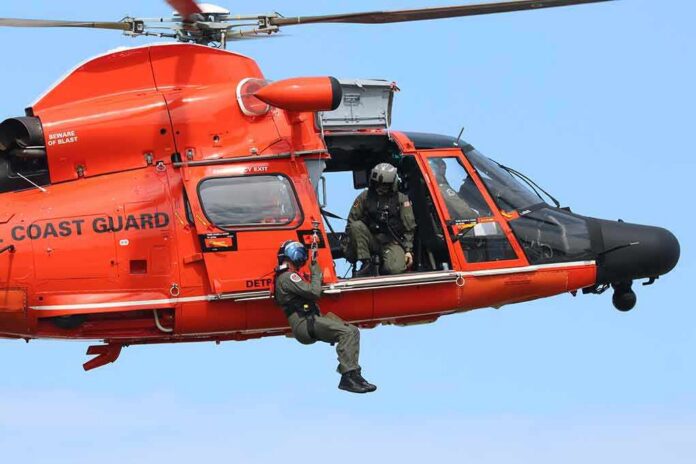
U.S. Coast Guard crews launched a rescue before dawn after receiving a mayday call from a boat that said it was sinking. The call came early Friday, and responders moved fast toward a point about 140 miles west of Ensenada, Mexico. There, air and surface teams found people in the water and floating debris. Crews hoisted survivors and flew them to hospitals in San Diego for treatment of exposure and injuries. Officials said 16 people were rescued alive.
Coast Guard officials said the effort did not end with the initial hoists. Based on early accounts from survivors, authorities believed additional people were still missing. That kept aircraft and vessels in the area through the day and into the night. Reports described the response as large and layered, with two helicopters, a fixed-wing aircraft, a Coast Guard cutter, and a United States Navy ship joining the search. The Mexican Navy also launched a parallel operation from Ensenada.
Location, Injuries, and What Officials Know So Far
Rescuers concentrated on waters roughly 140 miles west of Ensenada, a stretch of open ocean known for rough seas and long drift times. Medical teams treated survivors for hypothermia and trauma. The Associated Press reported that one person had wounds consistent with shark bites, and two survivors were listed in critical condition at San Diego hospitals. Coast Guard public information officers confirmed the location and the transport of the survivors to care in the United States.
Officials described the initial count of people on board as preliminary. Early on, survivors told responders there were 27 people on the vessel, which would leave 11 missing after the rescues. Later statements stressed that the total number of passengers had not been independently confirmed. Agencies did not report recovering the sunken vessel, and the type of boat remained unclear. Without the hull, investigators face a harder job confirming capacity, cause, and ownership.
Scale of the Ongoing Search and Cross-Border Coordination
Search teams used helicopters to fly patterns over the drift zone while fixed-wing crews mapped currents and spotted debris fields. A Coast Guard cutter and a United States Navy ship worked the surface, marking and checking targets and raising any survivors. The Mexican Navy ran its own tracks near the likely drift lanes from the reported position. Operations continued because every hour matters in cold water, especially far offshore where winds and currents spread survivors over miles.
The rescue took place outside United States territorial waters, which adds complexity. Crews must coordinate between countries for search lanes, survivor handoffs, and later investigative steps. The Associated Press noted the location was not in United States waters, underscoring why the Mexican Navy’s role is central to the effort and to follow-on facts about the boat and its route.
Why This Matters: Risky Crossings and Public Safety
This tragedy highlights a wider pattern on the California–Baja corridor. Local reporting shows maritime smuggling attempts surged in recent years, and at least 23 people have died in crossings since 2017, though the true number is unknown. In 2021, a small boat linked to a smuggling case broke apart near Point Loma, killing three; the captain later received an 18-year sentence after a multiagency probe. These cases show why open-ocean trips in unseaworthy boats put lives at high risk.
Officials have referenced smuggling patterns in the region, but they have not released a formal finding that this specific boat was part of a criminal operation. For now, the confirmed facts are urgent and human: a mayday call, 16 people saved, a continuing search for others, and injuries that include a suspected shark bite. Agencies urged the public to focus on safety and to report distress calls quickly, since fast action can mean the difference between life and death.
Sources:
military.com, nbcsandiego.com, yahoo.com, ice.gov