

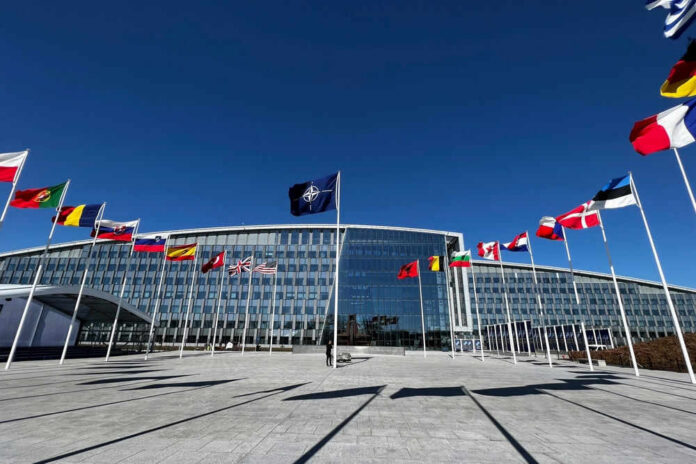
Washington is now weighing a nuclear move in Eastern Europe that could sharpen deterrence against Russia while raising the risk of a wider crisis no ally can fully control.
Quick Take
- U.S. officials are engaged in NATO-internal discussions about possible nuclear weapons or dual-capable aircraft deployments to new alliance countries.[1]
- Poland and the Baltic states are the eastern flank countries most often identified as interested in hosting such forces.[1][3]
- No agreement is imminent, and the reports describe talks rather than a confirmed decision.[1][3]
- The debate sits inside NATO’s long-running nuclear-sharing model, which already places U.S. nuclear weapons in six bases across five European NATO members.[5]
What the Report Says
The latest reporting says U.S. officials are discussing whether nuclear weapons, or more specifically dual-capable aircraft that can deliver them, could be placed in additional NATO countries.[1] The Financial Times, as cited by Defense News, said the talks are being held through NATO channels and that no agreement is imminent.[1] That distinction matters: the current record shows a discussion about posture, not a finalized deployment plan.[1][3]
Poland has been the most openly receptive of the countries named in the reports, and the Baltic states have also been described as interested in the idea.[1][3] The appeal is straightforward: governments on NATO’s eastern edge want a stronger signal that the alliance would respond fast and decisively if Russia escalated further.[1] But the same move would put additional nuclear infrastructure closer to the Russian border, where every added capability can also be read as an added provocation.[1][3]
Why NATO’s Existing Nuclear System Matters
This story is not about starting a brand-new nuclear policy from scratch. The alliance already uses a nuclear-sharing arrangement in Europe, with U.S. nuclear weapons stationed at six bases in Belgium, Germany, Italy, the Netherlands, Turkey, and the United Kingdom.[5] According to the Council on Foreign Relations, those weapons are B61 gravity bombs designed to be delivered by allied aircraft, which means the current debate is about extending an existing system eastward rather than inventing one from nothing.[5]
That history is why the discussion attracts such strong reactions from both supporters and critics. Supporters see continuity: a long-established deterrent designed to reassure allies and complicate Russian planning.[5] Critics see a familiar pattern of incremental escalation, where each step is defended as modest but still pushes Europe closer to a more dangerous military balance. The tension between those readings is the core of the dispute now unfolding inside NATO.[1][5]
What Is Still Unclear
The most important uncertainty is whether these conversations ever become policy.[1][3] The available reporting does not show an approved deployment, an operational timeline, or a public commitment from Washington.[1][3] It also does not resolve practical questions such as which country would host the weapons, which bases would be modified, how allied aircraft would be certified, or how Russia would respond if the plan advanced.[1][3]
🇺🇸🇪🇺 US is negotiating deployment of additional nuclear weapons in European NATO countries to "strengthen security guarantees"
According to some US officials, Washington is ready to deploy dual-capable nuclear aircraft in more countries beyond the current six NATO members
It… pic.twitter.com/nwHDd4ATe3
— THE TRADESMAN 📈 (@The_Tradesman1) June 3, 2026
For readers looking past the headline, the deeper significance is that the story exposes a wider problem in Western security planning: allies want stronger guarantees, but every new guarantee can deepen the very instability it is meant to prevent.[1][5] That is why this debate keeps returning. When trust in deterrence weakens, governments look for more visible force posture; when force posture expands, opponents warn that the deterrence line is moving into fresh danger.[1][5]
Sources:
[1] Web – U.S. May Consider Placing Nukes in Poland, Baltic States
[3] Web – Fact Sheet: U.S. Nuclear Weapons in Europe
[5] Web – US in talks to deploy additional nuclear-capable bombers in Europe …