

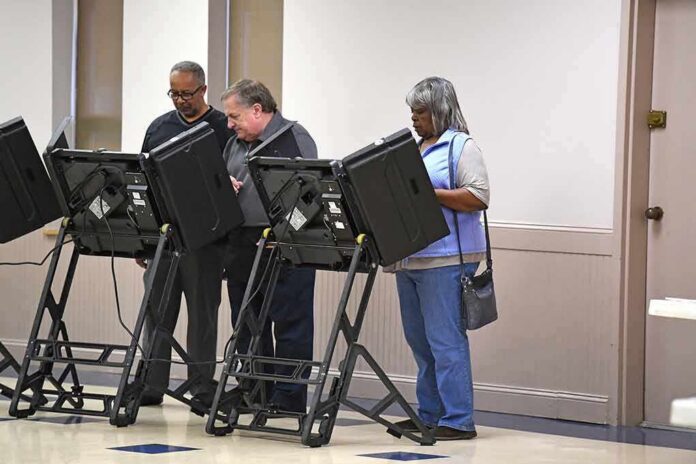
A missed memory card with Election Day results flipped a Georgia House race and squeezed Democrats’ new majority to the thinnest margin.
Story Highlights
- Georgia’s secretary of state said a routine check found 388 more voter check-ins than reported ballots in Seminole County.
- Officials located and uploaded a missing memory card, shifting the House District 154 lead to Republican Gerald Greene by 262 votes.
- The updated, unofficial totals still leave Democrats with a one-seat House majority, if they stand.
- The state opened an investigation into how the results were missed and whether procedures were followed.
What Triggered the Change in House District 154
Georgia Secretary of State Brad Raffensperger said staff flagged about 388 more Election Day voter check-ins than ballots reported in Seminole County during a post-election review. County officials then found a memory card from a voting device that had not been uploaded. After those results were added, Republican incumbent Gerald Greene moved from trailing Democrat Harry James by 58 votes to leading by 262 votes in House District 154, according to the state’s update.
Raffensperger’s office described the new result as part of the state’s unofficial totals and opened an investigation into the missed upload. The office said the routine reconciliation process prompted the county to locate the card. That process compares the number of voters who checked in to vote to the number of ballots reported. When those numbers do not match, officials are directed to find the cause and correct the returns before certification.
Why These Controls Exist and How They Work
Georgia law instructs local officials to investigate mismatches between check-ins and reported ballots and to correct returns when errors are found before final certification. The law permits an examination of precinct returns and, when needed, a recount or recanvass to fix an incorrect tally. This framework is meant to catch ordinary administrative errors, such as an unuploaded memory card, during the canvass period. That is what state officials say happened in Seminole County following the routine review.
The legal structure also allows counties to recertify results if the original returns were wrong, which can happen after a recount or recanvass clarifies the numbers. These steps can feel messy to the public, but they are built into the process to make the final results more accurate. The Seminole County update shows those controls can change a close race late in the canvass when missing data is found and added.
The Stakes for Statehouse Control and Next Steps
Local media reported that, even with the shift in House District 154, Democrats would still hold the Georgia House by a single seat if the revised totals stand. A one-seat edge is fragile. Any recount, contest, vacancy, or party switch could change control. That is why every administrative step now matters, from the county canvass to any recount request. The final balance will not be set until certifications and any authorized challenges are complete.
Georgia Investigates Missing Votes That Shifted House Race
An unuploaded memory card added hundreds of ballots to Seminole County totals, moving Republican Gerald Greene from a 58-vote deficit to a 262-vote lead.
Read: https://t.co/9uBool62gb pic.twitter.com/OhAyuZQefJ
— Real Truth Media (@RealTruth) November 7, 2026
Raffensperger’s office said it is investigating how the card was missed and whether procedures were followed in Seminole County. The statement did not provide a machine-level audit trail or candidate-by-precinct detail. The state framed the find as the product of routine checks and posted the updated, unofficial totals reflecting Greene’s 262-vote lead. Until certification, these numbers remain subject to standard canvass and recount rules under Georgia law.
Sources:
townhall.com, thecentersquare.com, live5news.com, law.justia.com