
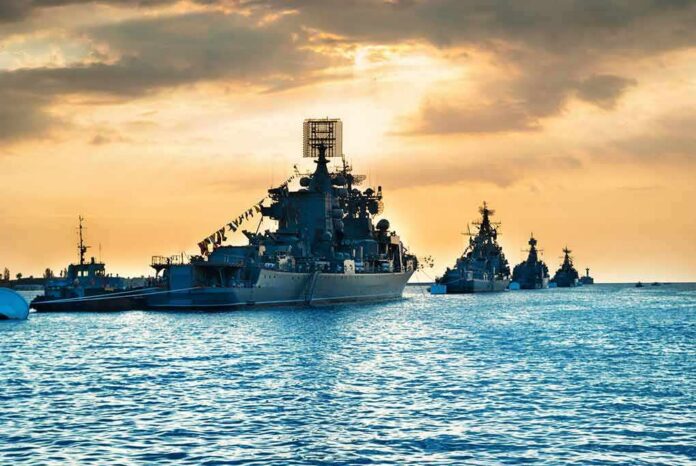
Iran has tied the reopening of the Strait of Hormuz to U.S. compliance with its demands, turning one of the world’s most important oil routes into a political bargaining chip.
Quick Take
- Iranian reporting says the Strait of Hormuz will stay closed until the United States meets Tehran’s conditions.
- Reuters reported that the Islamic Revolutionary Guard Corps said ships were not allowed to pass and that the decision was enforced by its naval arm.
- Other reports say the closure threat was linked to U.S. attacks, a blockade of Iranian ports, and warnings against further military moves.
- The Strait matters because roughly 20 million barrels of oil a day moved through it in 2025.
Tehran Links Passage to U.S. Demands
Iran’s Revolutionary Guards told ships that passage through the Strait of Hormuz was not allowed, according to Reuters. The report said vessels had been receiving radio messages from the Guards, while another account said Iran’s Navy was controlling who could move through the waterway. CBS News also reported that Iranian military officials warned the strait would be “completely closed” if U.S. threats were carried out and would stay shut until Iran’s conditions were met.
That language matters because it frames the strait as a tool of pressure, not just a military zone. In a separate Reuters report, Iranian media said the closure would last until sanctions pressure or other U.S. restrictions were lifted. The same pattern appeared in later coverage, where Iran’s Guard said the waterway would remain closed until the United States ended its “acts of aggression.” The message was direct: reopen only after Washington gives ground.
Why the Strait Carries So Much Weight
The Strait of Hormuz is one of the world’s most important energy chokepoints. The International Energy Agency said about 20 million barrels per day of crude oil and oil products moved through it in 2025, equal to around 25 percent of global seaborne oil trade. The Energy Information Administration said very few alternatives exist if the strait is closed, which is why even threats can shake markets fast.
That importance helps explain why Iran keeps returning to the same threat. For years, Iranian officials have used closure warnings during crises, sanctions fights, and military pressure. Analysts have noted that the goal is often coercive signaling, even when a long, fully enforced shutdown is hard to sustain. The result is usually immediate fear in energy markets and shipping lanes, along with added pressure on U.S. and allied leaders.
What the Reports Say About Enforcement
The reporting also shows that Iran has moved beyond rhetoric at times. AP said the standoff escalated after Iran reversed a reopening, fired on ships trying to pass, and kept the strait closed until the U.S. blockade on Iranian ports was lifted. Reuters separately reported that Iranian forces had declared the strait closed and warned they would fire on ships that tried to enter. Those details suggest a real effort to enforce the threat, not just repeat it.
🚨 THE STRAIT OF HORMUZ HAS BEEN FROZEN FOR OVER 5 MONTHS. HERE'S WHAT'S HAPPENING TO EACH COUNTRY RIGHT NOW:
🇺🇸 United States — Trump privately telling aides he'll walk away from the Iran war WITHOUT a nuclear deal if Iran fully reopens the strait, per WSJ
🇮🇷 Iran —… pic.twitter.com/UTlo0SMqGJ— 🇨🇳 Guo Shen 郭深 (@GuoShenCN7) August 10, 2026
Even so, the legal and practical picture remains contested. Open-sea shipping rules do not give one side clear, unlimited power to shut a global waterway, but Iran can still make transit dangerous enough to disrupt traffic and raise costs. That is why this dispute reaches far beyond Iran and the United States. It affects oil prices, insurance costs, military planning, and the fragile sense that global trade still runs by stable rules instead of raw force.
Sources:
insiderpaper.com, reuters.com, bbc.com, apnews.com, cbsnews.com, opiniojuris.org, youtube.com, sgp.fas.org, theconversation.com