
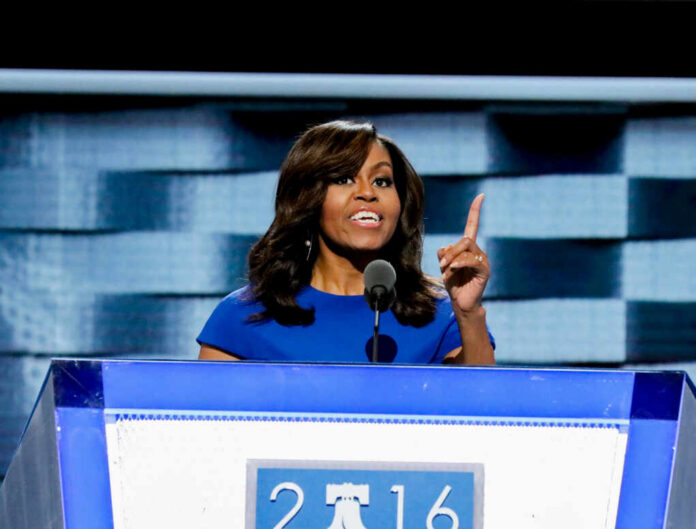
Michelle Obama says the media’s obsession with her arms and outfits was used to undermine her — but she also built an entire book around her fashion choices.
Quick Take
- Michelle Obama’s 2025 photo book, The Look, argues that media focus on her appearance was used to “otherize” her and slow her husband’s political momentum.
- Obama has also openly said she used fashion as a tool to draw attention to causes she cared about — raising questions about whether the criticism and the strategy can coexist.
- Research confirms that women in public life consistently receive more media coverage of their looks than their male peers, lending real weight to her broader point.
- Critics, including conservative commentators, say her complaints ring hollow given that she is now promoting a book centered on clothing and style.
What Obama Said — and What She Also Said
In her photo book The Look, released in November 2025, Michelle Obama writes that the media’s fixation on her arms was used to “otherize” her. She also told People magazine that she faced “pure hypocrisy” over fashion criticism during her time as first lady. Her core argument: the focus on what she wore drowned out her voice as a speaker and advocate, and served as a political tool to slow down Barack Obama’s rise.
But Obama’s own words complicate that argument. She has said she understood that fashion holds real power for women, and that she used it to highlight causes and the people she cared about. She even admitted in The Look that she was careful not to focus too much on fashion, worried it would overshadow everything else she had to say. That self-awareness makes her critique harder to separate from her own deliberate use of style as a communication strategy.
The Hypocrisy Charge — and Why It Has Some Bite
Conservative critics and some media observers have pointed out an obvious tension: Obama is complaining about fashion coverage while promoting a book about fashion. The Daily Mail called it hypocrisy. Fox News noted that she raised concerns about appearance obsession shortly after describing an outfit she was proud of. These critics frame her complaints as self-serving — a “complain campaign,” in the words of one conservative blog — rather than a serious critique of media bias.
That framing may be too simple. It is possible to use fashion strategically while also objecting to coverage that reduces a person to their wardrobe. Obama’s argument is not that fashion is unimportant — it is that media outlets chose her arms over her words, her dress over her record. Whether that trade-off was deliberate or just driven by clicks and ratings is a question no one has answered with hard data. No major outlet has published a content audit of how often her oratory got top billing versus her outfit.
The Bigger Pattern Women in Public Life Face
Obama’s complaint fits a well-documented trend. Research spanning decades shows that women in politics and public life receive far more coverage of their appearance than men in similar roles. Academic studies confirm that appearance-focused coverage can lower how seriously voters take female candidates, reinforcing gender stereotypes rather than breaking them. Physical trait coverage of female politicians has remained stubbornly consistent over more than a decade of research.
Complain Campaign: Michelle Obama Is Angry the Media Treated Her As a Fashion Icon, Not a Great Orator https://t.co/TrR6vBfCYq
— JT Badenov (@cbinflux) July 16, 2026
That context matters. The frustration Obama is describing is real and widely shared among women in public roles — regardless of party. The problem is that her specific claim — that fashion coverage was a coordinated “political tactic” to slow her husband’s campaign — has no named sources or documented evidence behind it. The broader pattern of gendered media coverage is well-supported. The claim of deliberate political intent is not. Both things can be true at once: the media does treat women differently, and Obama has not proven anyone planned it that way.
Sources:
twitchy.com, foxnews.com, theguardian.com, cnbc.com, youtube.com, academic.oup.com, dannyhayes.org, extension.usu.edu