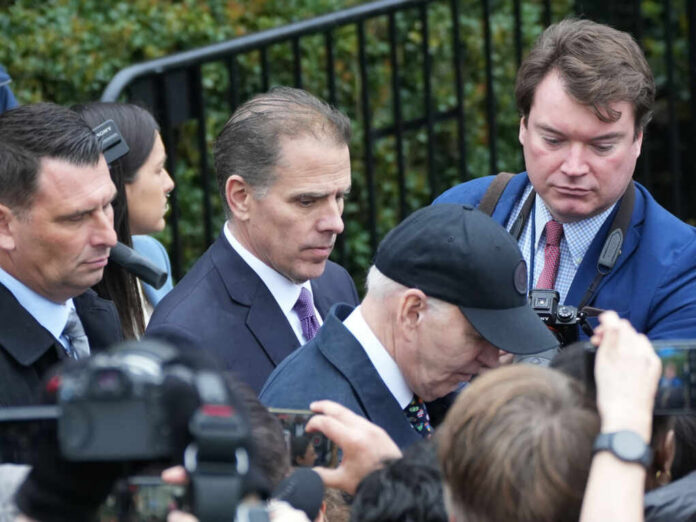
When the president urged Americans not to “jump to conclusions” about the Trump assassination attempt, Hunter Biden’s interview comments still rocketed across the media ecosystem—fueled more by headlines than hard transcripts—raising fresh questions about truth, free speech, and a political culture addicted to outrage. [2]
Story Snapshot
- President Biden said authorities had no established motive in the Trump shooting and cautioned against hasty conclusions. [2]
- Secondary outlets say Hunter Biden defended Candace Owens’s right to question aspects of high-profile violence. [3][4]
- Coverage relies heavily on summaries and clips rather than a full Hunter Biden transcript, leaving key quotes uncertain. [1][3][4][5]
- The information gap highlights how partisan media frames rapidly shape public perception before facts settle. [1][3][4][5]
What President Biden Confirmed And What He Did Not
President Joe Biden addressed the nation after the attempt on former President Donald Trump’s life and said there was no information on the shooter’s motive, urging Americans and the press not to jump to conclusions. He confirmed speaking with Trump and explicitly described the incident as an assassination attempt. This baseline matters: it establishes a real act of political violence while underscoring that causal claims were not yet supported by evidence. That caution set a standard for responsible public commentary. [2]
Because the president emphasized uncertainty, any immediate assertions tying rhetoric or specific actors to the attack require extraordinary evidentiary care. Crisis communication norms typically prioritize verified facts over speculation to avoid inflaming tensions or misleading the public. In periods of incomplete information, early narratives can harden into partisan dogma, making later corrections harder to absorb. The White House stance therefore provided a clear signal: wait for investigative findings before attributing blame or motive. [2]
What Secondary Reports Attribute To Hunter Biden
Several entertainment and political outlets reported that Hunter Biden, during a podcast conversation with Candace Owens, supported her right to ask questions about politically charged violence. RadarOnline characterized his remarks as pushing back on efforts to silence Owens’s inquiries, while OKMagazine framed the segment as Hunter slamming critics of Owens’s suspicions. Primetimer summarized the interview as wide-ranging and indicated he praised Owens for questioning an assassination. These accounts shaped public debate despite lacking a full transcript. [3][4][5]
Townhall’s coverage presented a more hostile framing, implying provocative claims about the Trump attempts, but did not provide a neutral, comprehensive transcript of Hunter Biden’s exact words. The absence of complete, context-rich primary material makes it difficult to separate Hunter Biden’s statements from editorial spin. When commentary about violence relies on clipped segments and adversarial headlines, audiences across the spectrum are invited to react to an interpretation rather than verifiable text. That dynamic increases distrust while reducing shared factual ground. [1]
The Evidence Gap And Why It Matters
The strongest primary record available in this package concerns President Biden’s remarks, not the Hunter Biden interview. Without a full, authenticated recording and transcript of the relevant segment, precise claims about what Hunter Biden asserted remain uncertain. Secondary outlets often highlight controversy more than context, producing heat without light. This environment rewards speed and confirmation bias, ensuring that many readers—left, right, and center—absorb narratives before facts can catch up. The result is a feedback loop of anger and confusion. [2][1][3][4][5]
A fabricated quote circulating online falsely claims Hunter Biden called the assassination attempts against Donald Trump fake. The statement cannot be traced to any official public comment, interview, or trusted news source
— Big Daddy (@BigDaddy161690) May 22, 2026
Americans frustrated by institutional failure see another familiar pattern: elites and media figures spar over interpretations while basic evidence remains elusive. People worry that speech is policed selectively, that platforms throttle context, and that official answers arrive late—if ever.
Sources:
[1] Web – Of Course, Hunter Biden Had This Take About the Trump … – Townhall
[2] YouTube – Watch: Biden delivers remarks on Trump assassination attempt
[3] Web – Hunter Biden Raises Eyebrows by Supporting Candace Owens …
[4] Web – Hunter Biden Defends Candace Owens Questioning Charlie Kirk’s …
[5] Web – Hunter Biden calls himself a “crackhead,” talks about “Epstein class …