
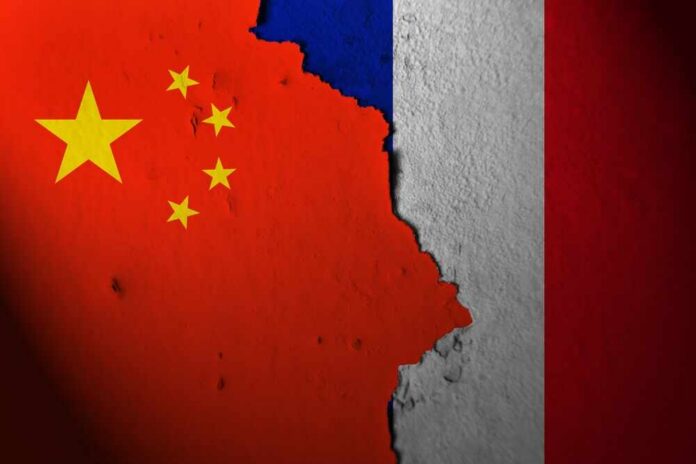
China is moving fast to position itself—and not America—as the “responsible” power in the Middle East, with France signing on to a new de-escalation push after the latest Iran war flare-up.
Story Snapshot
- China and France coordinated by phone to promote de-escalation and a political track in the Iran conflict.
- Both governments stressed UN Security Council authorization as a standard for military action, a direct contrast to the late-February U.S.-Israeli strikes on Iran.
- France publicly distanced itself from the strikes and highlighted risks to roughly 400,000 French citizens across the region.
- China followed up with a regional diplomatic push, sending its Middle East envoy to consult Gulf partners, starting with Saudi Arabia on March 8.
China and France Coordinate a “Political Solution” Track
Chinese Foreign Minister Wang Yi and French Foreign Minister Jean-Noël Barrot held a March 3 phone call focused on de-escalating the rapidly expanding Iran conflict and urging a political settlement. Both countries framed their cooperation through their shared status as permanent members of the UN Security Council. Public readouts emphasized continued dialogue and coordination with Gulf countries, underscoring a diplomatic lane designed to slow escalation and build an international coalition around talks rather than new strikes.
France’s messaging also carried a defensive, practical edge. French officials stressed the stakes for French nationals in the region and the need for a measured path that reduces the odds of a wider war. That posture matters because it signals Europe’s anxiety about spillover, shipping disruptions, and retaliation cycles. China’s message, by contrast, aimed at portraying Beijing as a neutral broker—an image it has pursued by keeping channels open with Iran and Gulf states alike.
UN Authorization Becomes the Central Argument—Again
Beijing and Paris both highlighted the principle that major military action should not proceed without Security Council involvement or authorization, drawing attention to the late-February U.S.-Israeli strikes on Iran. France went further in its distancing, stating it had no prior knowledge and no involvement in those operations. The immediate political effect is to shift the debate from “who started what” to “who has legitimacy,” with the UN used as the measuring stick.
That legitimacy debate is not just academic; it shapes how other capitals choose sides. When major powers insist on Security Council authorization, they elevate multilateral process and slow unilateral responses—even when those responses are meant to neutralize threats. At the same time, it leaves key operational details unclear, including what specific diplomatic package China and France are offering Iran, Israel, and regional states. The effort is real, but its terms and enforcement mechanisms remain undefined.
France Prepares for Spillover While China Plays Mediator
France’s security posture reflects concern that diplomacy may not prevent further escalation. France reinforced air-defense capabilities, deployed fighter aircraft in the Eastern Mediterranean, and set up contingency measures to support or evacuate citizens if conditions deteriorate. Those steps align with France’s repeated emphasis on protecting civilians and avoiding an uncontrolled regional spiral. The core fact remains: France is talking political settlement while simultaneously positioning assets for crisis management.
China’s Envoy Tour Signals Long-Game Influence in the Gulf
China escalated its diplomatic engagement by dispatching Special Envoy Zhai Jun on a regional tour aimed at ceasefire messaging, civilian protection, and safeguarding infrastructure—especially energy facilities. The first documented stop was a March 8 meeting in Riyadh with Saudi Foreign Minister Prince Faisal bin Farhan. Separately, described Wang Yi conducting multiple calls with counterparts across the region and beyond, an approach designed to keep Beijing at the center of any negotiated off-ramp.
For American observers, the real takeaway is how quickly global competitors move into any vacuum and speak the language of “order” and “international law” to build credibility. There is limited public detail about the outcomes of China’s envoy meetings beyond the first stop, and there is no confirmed evidence—based on the provided sources—of a finalized ceasefire framework. What is clear is intent: Beijing wants recognition as a stabilizing power in a region critical to global energy flows.
China, France should 'work together' to resolve Mideast crisis: Beijinghttps://t.co/W8wrStkUi7
— Insider Paper (@TheInsiderPaper) March 20, 2026
The Trump administration will be measuring all of this against U.S. interests: preventing a broader war, protecting allies, keeping sea lanes open, and deterring further attacks. The China-France initiative is best understood as a diplomatic bid to shape the narrative and the rules of response after the latest escalation. Whether it reduces violence or mainly boosts Beijing’s influence will depend on what Iran, Israel, and regional partners do next—and on whether enforceable terms ever materialize.
Sources:
France work China de-esclatating Iran war
China urges joint efforts with France to de-escalate Mideast tensions
China and France agree help de-escalate US-Israeli conflict with Iran
China Diplomacy: March 3, 2026 statement/content page
Once again the Middle East has been plunged into war
China’s Middle East ties go far beyond Iran