

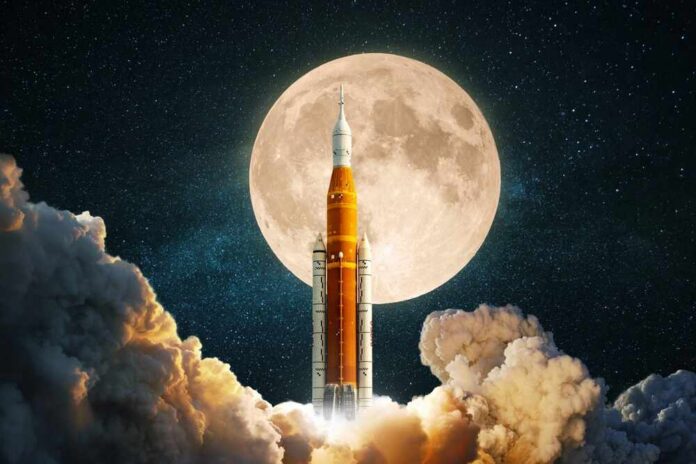
Astronauts aboard NASA’s Orion spacecraft face a blistering 5,000°F re-entry, testing heat shields in a high-stakes return that underscores America’s enduring space leadership amid federal spending debates.
Story Highlights
- Orion endures 5,000°F surface temperatures during hypersonic re-entry at Mach 32, protecting crew via ablative heat shields.
- Artemis II crew—Reid Wiseman, Victor Glover, Christina Koch, Jeremy Hansen—nears splashdown off San Diego at 8:07 p.m. ET April 10 after 10-day lunar mission.
- Proven technology from Apollo era enables safe returns, boosting U.S. goals for Moon and Mars landings.
- Communications blackout and precise trajectory burns highlight engineering precision over bureaucratic excess.
Orion’s Fiery Re-entry Challenge
NASA’s Orion spacecraft plunges into Earth’s atmosphere at 25,000–36,000 mph, generating plasma shockwaves that peak heat shield surfaces at 5,000°F. Ablative materials erode and vaporize, carrying heat away from the crew module interior kept below 500°F. This process, called ablation, dumps thermal energy overboard through chemical reactions and particle liberation. Ronny Baccus, Orion’s thermal protection manager, explains how these shields insulate astronauts during the intense deceleration at 120–70 km altitude.
Artemis II Mission Timeline
Artemis II launched April 1, 2026, from Kennedy Space Center, sending four astronauts—Commander Reid Wiseman, Pilot Victor Glover, Mission Specialist Christina Koch, and CSA’s Jeremy Hansen—on a 10-day lunar flyby. They conducted seven hours of lunar science, capturing observations within 4,067 miles of the Moon’s surface. Correction burns refined the trajectory, with the second completed on Flight Day 9 and the third at 1:53 p.m. April 10 ahead of re-entry. Splashdown targets 8:07 p.m. ET off San Diego, supported by recovery ships like the USS Michael Monsoor.
Historical precedents include Apollo 11’s 1969 re-entry at 36,237 ft/s through a 5,000°F fireball, validated by epoxy resin honeycomb shields tested by Southern Research at NASA Langley. Orion’s 2022 Artemis I uncrewed test endured similar conditions, confirming shield efficacy with tapered thickness for margins. Unlike Space Shuttle tiles limited to 1,600°F for orbital returns, Orion’s thicker phenolics handle lunar velocities.
Engineering Triumph Over Extremes
Re-entry heating converts kinetic energy into plasma at 10,000–12,000 K, but materials cap vehicle surfaces at 5,000°F. Plasma sheaths cause communications blackouts, blocking signals below 350 GHz, managed through relays. No major failures occurred post-Apollo at this scale. NASA dominates development, funding contractors like those providing Avcoat ablators. This success reinforces American innovation, countering criticisms of wasteful federal spending by delivering tangible progress toward Mars.
A 5,000°F re-entry.
Total comms blackout.
And zero room for bad weather.
Artemis II is getting ready for the final leg of its historic space flight – a splashdown in the Pacific Ocean as its crew returns to Earth. @realNesaraG pic.twitter.com/EAh4ZRI8ZF
— NESARA/GESARA (QFS) (@realNesaraG) April 10, 2026
Short-term, flawless re-entries advance the Artemis timeline despite past delays. Long-term, scalable ablative tech supports crewed lunar landings and Mars missions, enhancing U.S. space dominance. Billions in NASA budgets yield hypersonic advancements applicable to defense, prioritizing self-reliance over globalist dependencies. Both conservatives valuing limited government triumphs and skeptics of elite mismanagement see this as proof that focused American initiative prevails.
Sources:
NASA Houston We Have a Podcast: 5000F
Australian Space Academy: Reentry Blackout
Economic Times: NASA Orion Endures 5000 Degrees Reentry
Southern Research: Helping Apollo Beat Fiery Re-Entry