

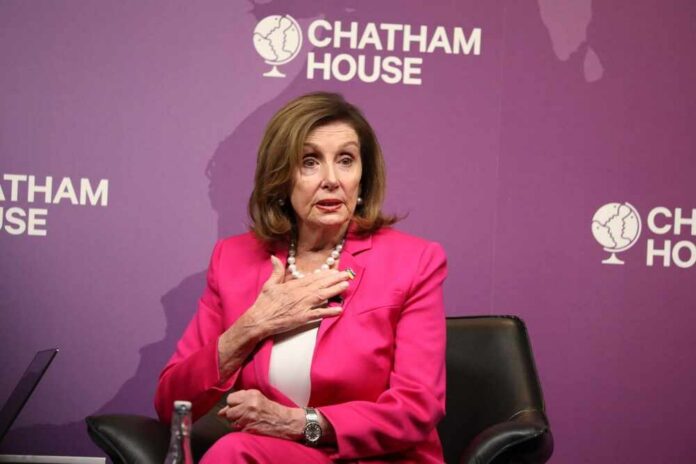
Pelosiland’s power seat is set to stay hard-left as Scott Wiener leads and Pelosi backs an even more progressive rival, signaling bigger taxes and deeper woke governance ahead.
Story Highlights
- Nancy Pelosi’s retirement triggers an intra-left fight in one of America’s most progressive districts [3].
- State Senator Scott Wiener leads, while Pelosi endorses progressive Supervisor Connie Chan [1][2].
- Vote totals show a left-leaning electorate sorting among progressive lanes, not moderates [2].
- Chan promotes billionaire tax expansion and sweeping social spending priorities.
Pelosi’s Exit Sets Up a Progressive-Only Succession Battle
Politico reported Nancy Pelosi retired after nearly 40 years, opening San Francisco’s congressional seat to a contest defined entirely inside the Democratic left [1]. NOTUS described California’s 11th District as one of the most progressive in the country, underscoring that the outcome is not whether the district will be liberal, but which version of progressive politics prevails [3]. This structure leaves conservatives with no direct representative option and raises stakes on federal policy that can ripple nationwide.
Politico said State Senator Scott Wiener and Supervisor Connie Chan advanced to a head-to-head showdown to replace Pelosi [1]. Reporting described Wiener as moderate by San Francisco standards, while emphasizing that “moderate” within this district still places him well left of national centrists [1]. Coverage framed Chan as a progressive with strong labor ties and as the candidate pitching herself to uphold Pelosi’s legacy, suggesting institutional Democrats are not pushing for a centrist reset [1].
Vote Returns Confirm a Left-Leaning Electorate Sorting by Degree
ABC7 reported preliminary returns with Wiener at 40,017 votes, Chan at 26,443, and Saikat Chakrabarti at 13,154 [2]. CBS also listed Chakrabarti among progressive-aligned contenders. These numbers show that even as Wiener leads, the combined support for explicitly progressive lanes remains significant, pointing to a district debating degrees of left orientation rather than any move toward the center [2]. Ongoing counting could shift margins, but the ideological field is already set [2].
Political dynamics reflect California’s top-two system, which compresses choice into intra-party contests in heavily Democratic districts [3]. With Republicans effectively sidelined, voters pick among wings of the left—establishment versus insurgent, or technocratic progressives versus labor-driven progressives [1][3]. That design repeatedly yields outcomes where federal representation from such districts advances expansive regulation, higher taxes on businesses and high earners, and large social spending plans that affect national debates.
Pelosiland Policy Trajectory: Higher Taxes and Expanded Entitlements
CBS reported Connie Chan supports Proposition D, the so-called billionaire tax, and wants to expand similar federal taxes to fund social programs. Chan also backs expanded health coverage, lower medication costs, affordable childcare, fully funded K-12 education, and free city college nationwide. If this agenda gains steam from San Francisco’s seat, Washington will face renewed campaigning for redistributive taxation that can hit investment, small-business hiring, and consumer prices, while growing federal control over core services.
Politico described Wiener as comparatively moderate in San Francisco terms, with a focus on housing and affordability [1]. That positioning may reflect a tactical appeal to voters fatigued by dysfunction, yet it remains to be seen whether he would resist higher federal taxation or broader social mandates if elected. The primary evidence shows a district already steeped in progressive priorities, and the pressure in Washington would likely push representation further left rather than toward market-based or local-control solutions [1][3].
What Conservatives Should Watch Next
Coverage indicates Pelosi endorsed Chan late in the race, a powerful signal that the Democratic establishment is comfortable with a progressive successor rather than a centrist correction [1]. For conservatives, that means preparing for legislation and messaging from this seat that advances expansive federal programs, aggressive tax policy, and continued hostility to constitutionalist priorities on spending restraint, education choice, and local policing authority. The immediate question is whether Wiener’s lead represents pragmatic governance or simply a different lane of the same broader agenda [1][2].
Nancy Pelosi didn't even endorse him.
With Scott Wiener in the Lead, Nancy Pelosi's Long Held Seat Will See a Change, but Not for The Good https://t.co/ooMepIUgCj #California #HouseDistrict11 #Congress #NancyPelosi #ConniChan
— Jennifer OO (@joliveroconnell) June 3, 2026
Evidence gaps remain. Reports document labels, endorsements, and vote counts, but not final coalition behavior or measurable post-election policy shifts [1][2][3]. Without precinct-level and longitudinal data, assertions of “further left” remain directional rather than quantified. Still, in a district already billed as among the nation’s most progressive, the field’s tax-and-spend emphasis and Pelosi’s chosen heir suggest no pivot toward limited government. Conservatives should expect louder calls for federal centralization flowing from this seat [3].
Sources:
[1] Web – With Scott Wiener in the Lead, Nancy Pelosi’s Long Held Seat Will See …
[2] Web – Scott Wiener faces Pelosi-backed Connie Chan in succession fight
[3] Web – State Sen. Scott Wiener advances to general election for CA’s 11th …