
A furious new warning from President Trump has put Iran — and the fate of the Strait of Hormuz — on a knife’s edge, with Tehran told that if it shuts down the world’s oil chokepoint again, it may “not have a country” left.[4]
Story Snapshot
- Trump warns Iran that closing the Strait of Hormuz again could trigger devastating U.S. action.[4]
- Iran claims it is closing or tightly controlling the strait in response to a U.S. naval blockade and war.[11][12]
- Global experts say this vital waterway is now a test of American resolve and energy security.[19][21]
- Hardball U.S. threats aim to stop Iranian “blackmail” that drives up gas prices and hits family budgets.[2][8]
Trump’s Ultimatum: Close Hormuz and ‘You Won’t Have a Country’
As U.S.–Iran peace talks opened in Switzerland, President Donald Trump described an explicit warning he says he delivered to Iranian officials about the Strait of Hormuz.[4] According to his account, he told Tehran that if they shut the waterway again, they “wouldn’t make it back” to their country and that if they close it, “you won’t have a country.”[4] He also floated the idea that the United States might take direct control of the strait to protect shipping and even collect tolls on oil passing through.[4]
These latest comments build on weeks of sharp U.S. messages tying Iranian behavior in the strait to massive retaliation. After U.S. and Israeli strikes on Iranian nuclear sites, Trump said Iran “must now make peace” and warned that future attacks would be “far greater” if Tehran refused.[1] He later threatened to “obliterate” Iranian power plants unless the regime fully reopened the Strait of Hormuz within 48 hours, saying strikes would start with the “biggest one first.”[2] Together, these statements signal that Washington now treats full freedom of navigation as a non‑negotiable red line.
Iran’s Closure Threats and the Blame Game Over Blockades
Iranian leaders, for their part, insist they are reacting to American pressure, not starting it. During the 2026 crisis, Tehran announced that the Strait of Hormuz was closed, claiming Israeli actions violated an understanding with the United States and justifying tighter control as a response to “enemy” violations.[11][10] Iranian commanders later said the strait would remain under strict military management and that any ship passing through would need approval from their naval forces.[12] They demanded that the United States end its naval blockade of Iranian ports before traffic could flow freely again.[12]
Washington has answered these claims with firm denials and its own show of force. U.S. Central Command said the strait was not closed even as Iranian media bragged that it was, reflecting a murky on‑the‑water picture where some shipping moves while others stay away.[10][16] At the same time, U.S. forces announced a full blockade of Iranian ports, saying trade into and out of Iran had been halted after Tehran “effectively shut down” shipping through Hormuz.[23] This back‑and‑forth means both sides are accusing the other of weaponizing the waterway, while ordinary people worldwide feel the impact through higher energy costs.[20][23]
Why Hormuz Matters to American Families and Conservative Priorities
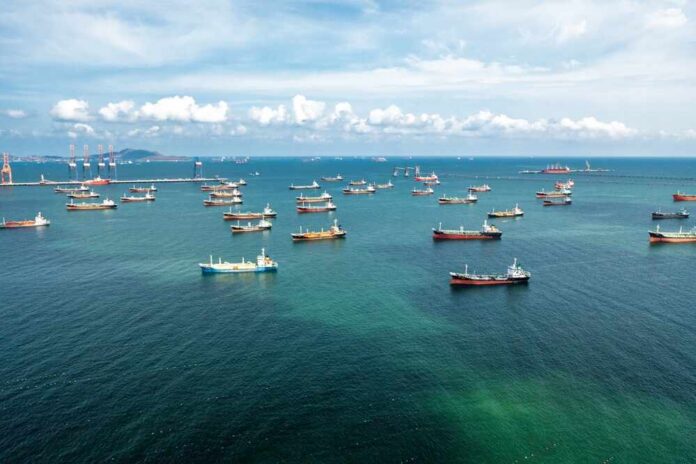
The Strait of Hormuz is one of the world’s most important energy chokepoints, handling roughly a third of seaborne oil.[14][20] When Iran threatens closure or launches attacks on tankers, global markets react almost instantly, pushing up gas prices and straining family budgets from Texas to Ohio.[20] Analysts have long warned that Iran uses this narrow waterway as leverage, trying to raise costs for the West without provoking a war it would likely lose.[18][19] For conservatives who value energy independence and stable prices, allowing a hostile regime to “blackmail” the free world at this chokepoint is unacceptable.[8][21]
Military studies show that the United States and allies could ultimately defeat any Iranian attempt to shut the strait and reopen it to traffic.[18] Past planning has even included seizing Iranian offshore islands and oil platforms to strip Tehran of forward bases used to threaten shipping.[18] But experts also stress that such moves could require “boots on the ground” and carry real risks.[21] That is why this crisis is not only about naval power; it is about political will. Trump’s message that America “does not need the help of anyone” to break Iran’s grip reflects a belief in U.S. strength, yet he has also pressed other nations that rely on Hormuz to step up.[2][3]
War, Negotiations, and the Fight Against ‘Blackmail’
This showdown comes after months of war in which the United States and Israel hit Iran’s nuclear sites and military assets, while Iran answered with missile and drone attacks.[8][11] Trump has said the strikes “completely obliterated” key nuclear facilities and that Iran’s military has been “decimated,” claiming the “hard part is done.”[1][5] He has also declared a U.S. naval blockade and told allies to “just take” oil from the region or buy American, arguing that they must learn to fight for themselves instead of relying on U.S. protection.[5][23]
Sen. Lindsey Graham said Sunday he expects U.S. diplomacy with Iran to fall short, warning that the Trump administration could move to seize control of the Strait of Hormuz if negotiations collapse. https://t.co/B3pM460VXf
— FOX Baltimore (@FOXBaltimore) June 22, 2026
Yet the pattern so far has been threats, counter‑threats, and then talks. Trump has repeatedly issued 48‑hour ultimatums for Iran to reopen the strait, only to pause them when back‑channel messages showed “very good and productive conversations” toward a broader deal.[6][7] Analysts describe the result as a “war of endurance,” where Iran tries to disrupt energy flows and the United States responds by “blockading the blockaders,” all while both sides look for a negotiated endgame that protects their core interests.[19] For American conservatives, the bottom line is clear: Iran must not control the price of gas or the safety of global shipping, and any deal must stop Tehran’s nuclear ambitions and terror network, not reward them.
Sources:
[1] Web – Iran-US war latest: Trump warns Tehran ‘we will take over your …
[2] Web – President Donald Trump addresses nation after US strikes on Iran
[3] Web – Iran’s Fars News Agency shared a previous post from Ali Larijani in …
[4] Web – “President Donald Trump called on other nations Monday to help …
[5] Web – US-Iran conflict: Strait of Hormuz crisis escalates – Facebook
[6] Web – Donald Trump Isn’t Sounding Like Himself – Paul Krugman
[7] Web – Trump Flips the Script in the Strait of Hormuz – AEI
[8] Web – President Trump called off air strikes against Iran, saying … – …
[10] Web – CSIS | Center for Strategic and International Studies
[11] Web – Iran Says Strait Of Hormuz Is Closed As Vance Denies Shutdown
[14] Web – Iran says Strait of Hormuz closed until US blockade lifts, as … – …
[16] Web – The U.S. military on Saturday denied Iran’s claims that it had closed …
[18] Web – U.S. DENIES IRAN’S CLAIM OF HORMUZ STRAIT CLOSURE U.S. …
[19] Web – [PDF] Iran’s Threat to the Strait of Hormuz – UM Carey Law
[20] Web – Iran’s Strait of Hormuz Gambit and the Limits of U.S. Military Power
[21] Web – Everything you need to know about the Strait of Hormuz – WBUR
[23] Web – Strait of Hormuz – Assessing the Threat – Strauss Center