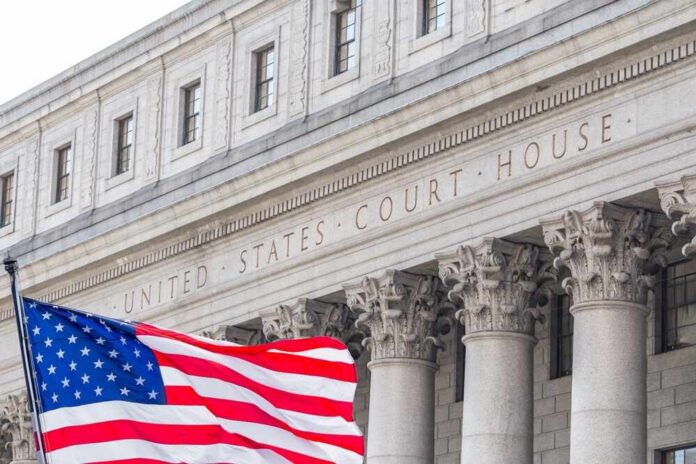
The Supreme Court’s approval rating has plummeted to near-historic lows, revealing a troubling erosion of institutional trust driven by partisan warfare and perceptions that the Court bows to political pressure rather than upholding Constitutional principles.
Story Snapshot
- A staggering 65-point partisan gap exists between Republicans (74% approval) and Democrats (17% approval), reflecting unprecedented polarization over the Court’s conservative majority.
- Despite low approval, 84% of Americans agree the President must obey Supreme Court rulings, demonstrating continued respect for judicial authority even amid declining confidence.
- Fifty-six percent of respondents believe the Court avoids ruling against President Trump, raising concerns about perceived bias in cases involving executive power.
Partisan Divide Reaches Unprecedented Levels
The Supreme Court faces a credibility crisis as partisan polarization reaches levels unseen in modern polling history. Republican approval stands at 74%, while Democrats register only 17% approval—a 57-point gap that illustrates how Americans increasingly view the judiciary through ideological lenses rather than as an impartial arbiter of Constitutional law. Independents fall in between at 33%, down sharply from earlier highs. This divide threatens the Court’s foundational role as a check on both political branches, transforming what should be a nonpartisan institution into another battleground for left-right warfare.
Dobbs Decision Triggered Sustained Collapse
The Court’s approval ratings averaged over 60% from 1972 to 2020, peaking at 80% in 1999 when Americans largely trusted justices to interpret the Constitution without partisan agendas. That consensus shattered with the June 2022 Dobbs v. Jackson decision overturning Roe v. Wade, which caused approval to plummet from 54% to 38% virtually overnight. While the ruling represented a Constitutional victory for pro-life advocates who believe life begins at conception and that abortion policy belongs with elected state legislatures, the political fallout energized Democrats and alienated independents. Approval has remained below 50% ever since, with only a brief recovery to 51% in early 2025 before declining again.
Trump-Related Cases Fuel Perception of Bias
President Trump’s ongoing legal battles have intensified scrutiny of the Court’s impartiality, with 56% of Americans believing the justices deliberately avoid issuing unfavorable rulings against him. This perception emerged prominently during November 2025 oral arguments on Trump’s tariff authority, where 62% of respondents favored limiting presidential power over trade policy—a rare instance of public opinion opposing executive authority expansion. The disconnect between what the public wants and what they expect the Court to deliver underscores growing cynicism about whether justices prioritize Constitutional fidelity or political calculations. For conservatives who champion limited government and separation of powers, this skepticism represents a troubling departure from founding principles.
Institutional Authority Remains Despite Low Approval
Despite cratering approval ratings hovering between 42% and 44% across multiple polls, an overwhelming 84% of Americans maintain that the President must obey Supreme Court rulings—a critical finding that preserves the Court’s practical authority even as public confidence erodes. This paradox suggests Americans distinguish between disagreeing with specific decisions and rejecting judicial supremacy altogether. The strong consensus on presidential compliance reflects enduring respect for Constitutional structure, where the judiciary serves as the final check against executive overreach. For those concerned about government tyranny and the preservation of our Constitutional republic, this widespread commitment to judicial authority offers reassurance that the rule of law still commands broad support.
Methodology Differences Create Polling Confusion
Approval ratings vary significantly across polling organizations, with Gallup reporting 42%, Marquette at 44%, and Fox News at 47%, creating confusion about the Court’s actual standing with the public. These discrepancies stem from different question wording—some ask whether respondents “approve of the Court’s job,” while others gauge “favorable views”—and sampling methodologies that capture different demographic cross-sections. SCOTUSblog has challenged narratives claiming “record lows,” noting that earlier declines began during COVID-19 disputes over vaccine mandates and religious liberty restrictions, well before the 2022 Dobbs decision. Understanding these methodological nuances matters for accurately assessing whether the Court faces an unprecedented crisis or cyclical disapproval tied to controversial rulings that always generate temporary backlash.
Sources:
U.S. Supreme Court Approval Drops in New MU Poll
Supreme Court Faces Record-Low Approval Amid Polarization
Supreme Court Approval Rating Over Time
Favorable Views of Supreme Court Remain Near Historic Low
For the First Time in 3 Years, a Majority of Americans Approve of the Supreme Court
Supreme Court | Gallup Historical Trends