
New York City’s latest “free” childcare promise is the kind of deal taxpayers learn to fear: big benefits up front, and a fast-growing public bill behind the scenes.
Quick Take
- NYC Mayor Zohran Mamdani and Gov. Kathy Hochul are launching “2-K,” starting with 2,000 free childcare seats for 2-year-olds in four communities in fall 2026.
- The program is funded by a $73 million state investment in year one, with the state described as fully funding the first two years and a much larger year-two figure also cited.
- The initiative is open to families regardless of income and is framed as part of a broader push toward universal childcare from 6 weeks to 5 years.
What New York City Is Launching—and Where It Starts
New York City is rolling out “2-K,” a free childcare program for 2-year-olds that begins with 2,000 seats in fall 2026 and is slated to expand to 12,000 seats by 2027. City and state announcements describe the first phase as focused on four communities: Manhattan School District 6, Bronx School District 10, Brooklyn School Districts 18 and 23, and Queens School District 27.
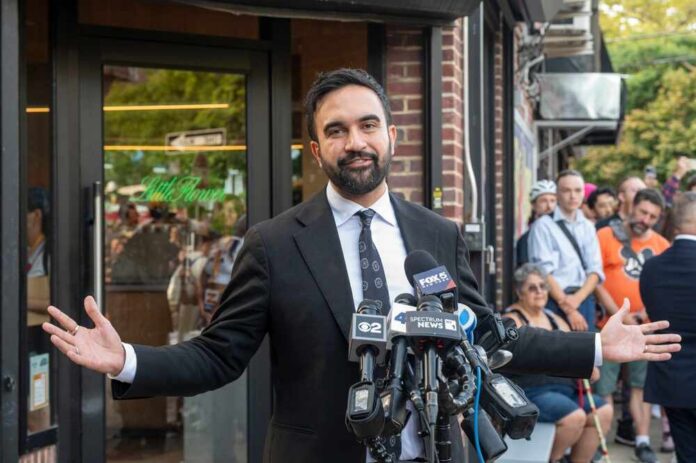
Gov. Kathy Hochul and Mayor Zohran Mamdani have tied the launch to a state funding commitment, with the first year described as backed by $73 million. The policy pitch is straightforward: childcare costs in the city can exceed $20,000 per year, and families are being told they’ll pay nothing at the point of service because government will cover the cost. That framing matters, because it shifts the burden from parents to taxpayers.
The $60,000-Per-Child “Surprise” Claim Doesn’t Match the Record Provided
The sources characterize the rollout as a progressive affordability win and do not present a per-child price tag at that level. One arithmetic shortcut sometimes used online—dividing the $73 million first-year investment by 2,000 initial seats—would yield about $36,500 per seat, not $60,000.
That back-of-the-envelope division also has limits and can mislead readers if treated as a true “per child” cost. Public programs often include startup and administrative expenses, facility adjustments, and provider payments that don’t scale evenly seat-by-seat in the first year.
How “Free” Programs Expand Government—and Why Oversight Matters
The program is described as open to all families regardless of income, zip code, or immigration status, and it builds on New York City’s existing 3-K and universal pre-K infrastructure. Supporters argue the approach keeps families in the city and increases workforce participation. From a limited-government perspective, the key question is not whether childcare is expensive—it is—but whether the state can expand entitlements without creating a permanent spending track that crowds out other priorities.
The rollout also includes a municipal worker pilot: a free childcare center at the Manhattan Municipal Building serving 40 children from 6 weeks to 3 years old, with expanded hours and a reported $10 million renovation cost, targeted to eligible city workers. That detail highlights the broader fiscal reality conservatives focus on: once a benefit is created for one group, pressure typically builds to widen eligibility, increase capacity, and raise funding, even when budgets tighten.
What’s Known About Funding—And What Still Isn’t Clear
New York will fully fund the first two years and references a much larger year-two amount, while also projecting a far bigger long-term investment. What is not provided is a detailed cost breakdown by seat, staffing model, facility costs, or provider reimbursement rates. Without those specifics, voters cannot easily assess whether the program is being delivered efficiently, or whether it will become another open-ended obligation.
For conservatives who are tired of rising living costs and skeptical of government promises, the most important fact pattern here is simple: the program is real, the initial money is substantial, and the “$60,000 per child” talking point. The next fight will likely be over scale, accountability, and whether “universal” childcare becomes a permanent line item that grows faster than taxpayers’ ability to pay.
Sources:
Zohran Mamdani launches free childcare program in New York City (2026-3)
Zohran Mamdani NYC mayor child care
Governor Hochul and Mayor Mamdani announce major milestone toward launching free child care
Mayor Mamdani and Governor Hochul announce first four communities
Crafting fair entitlements: New York’s unrivaled child care experiment