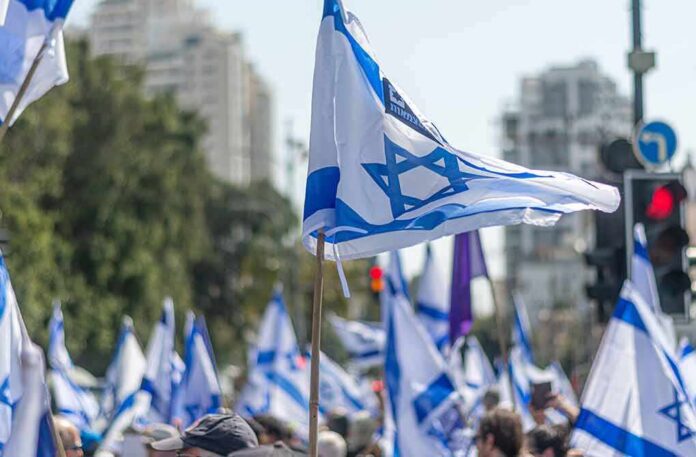
A street interview clip of an Israeli girl calling to “annex Gaza” and “kick out the Arabs… or we’ll kill them” shows how a viral moment can harden fear and rage on all sides while raising hard questions about public attitudes and wartime ethics.
Story Snapshot
- A viral video shows a girl urging expulsion or killing of Palestinians, citing God as the reason.
- Separate polling reports strong support among Jewish Israelis for expelling Gazans, though figures vary by survey and framing.
- An Israeli institute found most Jewish Israelis think the military tries to limit Palestinian suffering, showing mixed public views.
- Experts warn social media often spreads real clips stripped of context, which can mislead and inflame.
What the Viral Clip Shows and Why It Matters
The video shows a young Israeli girl in a street interview ahead of elections saying Gaza should be carpet bombed, that Israel should annex it, and that Arabs should be expelled, adding “God commanded us to take it” and “or we’ll kill them”. The statements are extreme and explicit. They also travel fast on social media. The clip tapped into global anger and grief after a year of war. It sparked claims about what most Israelis think, which the clip alone cannot prove.
International Business Times reported the footage came from a Guardian street interview, which aimed to show divisions among voters rather than claim the woman’s view spoke for all Israelis. This point matters for fairness. One speaker does not equal a nation. But the words are still chilling. They echo the language of elimination and expulsion, which is illegal under international law when carried out as policy. They also mirror calls some surveys tried to measure.
What Polls Say About Expulsion, Annexation, and Restraint
A March 2025 survey of 1,005 Jewish Israelis by Geocartography for a Pennsylvania State University researcher reported that 82 percent supported forced transfer or expulsion of Gaza residents. Coverage in advocacy and regional outlets repeated that top-line number, raising alarms about broad public backing for removal. Those results drew intense debate about wartime views, question wording, and what people imagine under total war. Polls capture opinions at one moment. War shifts those fast.
Other measures paint a more mixed picture. An Israeli policy institute reported that 78 percent of Jewish Israelis believed Israel was making substantial efforts to avoid causing suffering to Palestinians in Gaza. Election-focused analysis found support for annexation under Israeli rule with limited Palestinian rights rose from 30 percent to 38 percent across time points, still below a majority. Gallup reported 35 percent of Israelis backed a two-state solution, while 65 percent did not. Together, these show hard-line views are widespread, but not uniform.
How Social Media Warps What We See and Think
Scholars who study wartime media say many viral items are authentic but recirculated with missing or misleading context. That pattern was common in the Ukraine and Israel–Palestine wars. A recent study mapped how visual posts build partisan “truths” by stripping time, place, or speaker details and leaning on emotion. This clip fits that risk. It is real and disturbing. It may also get used to claim more than it proves, which fuels more hate and less understanding.
For Americans, this raises familiar worries. People on the right and left see elites and institutions failing at basic truth telling. They see platforms push content that divides. They see leaders speak to base anger, not to shared facts. The answer starts with careful sourcing and clear limits. The clip proves one person’s extreme view. Polls show large support for harsh policies among many Jewish Israelis during war, but not unanimity. Any honest debate must hold both facts at once.
Sources:
lifesitenews.com, tandfonline.com, alquds.com, middleeasteye.net, ibtimes.co.uk, israelielection.org, theconversation.com, apnews.com, en.idi.org.il