

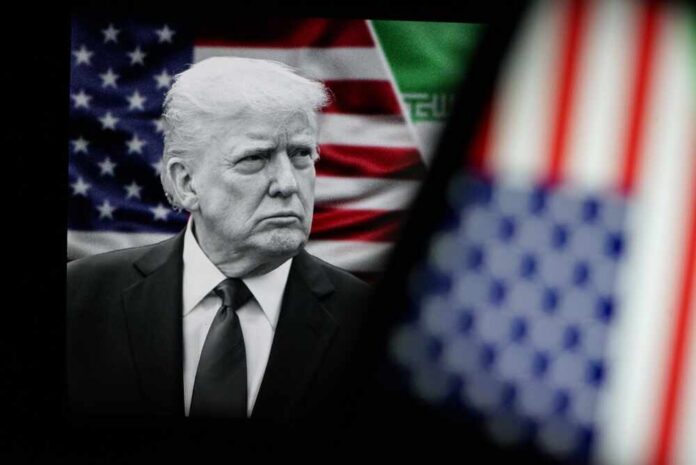
Iran’s foreign minister is trying to reframe a U.S.-Israel war campaign as a personal “Trump attack” on Iran’s leadership—while missiles fly, oil chokepoints tighten, and the nuclear question remains unresolved.
Quick Take
- Iran’s Foreign Minister Abbas Araghchi has accused President Donald Trump of directing attacks against him amid widening U.S.-Israel operations against Iran.
- U.S. and Israeli forces have reported striking roughly 2,000 targets by early March 2026 as Iran retaliated with hundreds of missiles and thousands of drones.
- The Strait of Hormuz closure threat carries immediate consequences for global energy prices and American household costs.
- International nuclear monitors indicate uncertainty about how much of Iran’s enriched material and program infrastructure has truly been eliminated.
Iran Personalizes the Conflict to Shift the Narrative
Abbas Araghchi’s accusation that President Donald Trump is personally launching attacks against him lands in a moment when Tehran needs a message that can unify factions and redirect blame. By framing the campaign as leadership targeting instead of a response to nuclear and missile threats, Iran’s top diplomat appears to be aiming at sympathy abroad and cohesion at home. This indicates the rhetoric escalated as strikes reached deeper into Tehran and state security infrastructure.
The timeline described shows a long runway to the current phase: U.S. pressure increased after prior nuclear-related confrontations, including a major U.S. strike package in 2025 and renewed economic measures in early 2026. When diplomacy collapsed again, Iran’s admitted stockpile of highly enriched uranium became a central justification cited by U.S. officials and negotiators for why deterrence-by-talks had failed. That backdrop matters because it explains why Tehran’s messaging now leans heavily on victimhood and “betrayed diplomacy” themes.
What the Military Campaign Looks Like on the Ground
From early March 2026 describes a rapid tempo: U.S. forces striking close to 2,000 targets, while Israel conducted large numbers of sorties and released thousands of munitions. The stated focus has been Iran’s nuclear and missile programs, command-and-control nodes, air defenses, and naval assets. Iran’s retaliation has been substantial in volume—hundreds of missiles and thousands of drones—yet interceptions were reported at high rates, suggesting Iran is expending inventory faster than it can achieve battlefield effects.
Regional spillover has also been emphasized in public updates. U.S. bases in Gulf states were among the targets of Iranian retaliation, and casualty figures reported for the Gulf reflect how quickly a “contained” fight becomes a broader security crisis. The American public should pay attention here because the constitutional question in any sustained campaign is clarity of objectives and duration. Public statements have included both “no timeline” language and suggestions of a multi-week operation, leaving uncertainty that can fuel market anxiety.
Hormuz: The Economic Pressure Point Americans Will Feel
The Strait of Hormuz remains the most obvious lever Iran can pull against the West and America’s allies. Roughly one-fifth of global oil flows through that corridor, meaning even partial disruption can spike prices, hit retirement portfolios, and reignite inflation pressures that many families never fully escaped. U.S. planning for tanker escorts underscores the seriousness of the threat. From a limited-government standpoint, higher energy costs function like a shadow tax—one that punishes working households first.
Iran’s decision-making calculus also changes when the regime believes it can export pain without facing immediate decisive consequences. That is why the Hormuz piece is not “just overseas.” It becomes domestic the moment fuel and shipping costs climb, and the moment Washington feels pressure to expand commitments. This does not prove Iran can sustain a full closure under sustained military pressure, but it does show that Tehran is willing to weaponize the chokepoint risk.
The Nuclear End State Is Still Murky
International monitoring commentary cited has previously indicated that enriched material can persist even after major attacks, raising questions about how quickly Tehran could reconstitute parts of the program if it chose to. At the same time, U.S. and Israeli descriptions of extensive target destruction suggest the intent is to push Iran’s capabilities back substantially, not merely signal resolve.
Araghchi’s accusation, then, should be read as political warfare layered on top of kinetic warfare: if Tehran can convince audiences that this is a personalized vendetta rather than a security campaign, it can attempt to delegitimize U.S. action and rally international pressure for restraints on Washington. For Americans wary of globalist drift, the practical test is whether U.S. leadership can keep objectives tight—defending national security and allies—without sliding into open-ended nation-building or unclear commitments that invite more bureaucracy, spending, and domestic blowback.
Sources:
Iran war: U.S., Israel day 4 — Trump gives no timeline as Gulf states attacked
Trump’s mixed messages prompt uncertainties about Iran war’s timeline