
A viral claim that President Trump gave Iran “48 hours” before “obliterating” power plants is colliding with a hard fact: the Strait of Hormuz crisis is real, but the exact quote is not verified.
Quick Take
- No credible evidence in the provided research confirms Trump issued a precise “48-hour” ultimatum to “obliterate” Iran’s power plants.
- Iran’s IRGC has effectively shut the Strait of Hormuz, a chokepoint that carries about 20% of global oil, while ship attacks and warnings have driven traffic toward zero.
- Operation Epic Fury includes U.S. air and naval actions aimed at reopening sea lanes, with Marines reportedly moving into position for interdiction missions.
- Energy markets and shipping costs are absorbing the shock, with war-risk insurance reportedly spiking multiple times over normal levels.
What’s Verified vs. What’s Going Viral
Reporting summarized in the research warns that the most shareable line—Trump allegedly promising to “obliterate” Iranian power plants unless the strait fully reopens within 48 hours—does not match verified statements cited in the source set. The closest documented language attributes to Trump a broader threat posture, including descriptions of U.S. forces hitting Iranian coastal targets to restore commercial traffic. That distinction matters because it separates confirmed policy from headline bait.
The verified core story is bigger than a single quote. Iran’s Revolutionary Guard has enforced a closure through threats and a series of attacks on commercial vessels, while the U.S. has escalated naval and air activity under Operation Epic Fury. The result is a modern choke-point crisis where fear, insurance, and uncertainty can move markets as quickly as missiles and mines. The research also notes that traffic estimates vary across reporting, underscoring the fog of a fast-moving conflict.
Why the Strait Matters to American Families
The Strait of Hormuz is only about 21 miles wide at its narrowest, but the research describes it as a conduit for roughly 20% of global oil—about 20 million barrels per day—plus significant liquefied natural gas. When shipping slows toward a standstill, price shocks don’t stay overseas; they ripple into diesel, groceries, and home heating. After years of inflation pain tied to policy choices and global instability, this is exactly the kind of disruption voters hoped Washington would prevent.
The research highlights partial offsets that still don’t solve the problem. Saudi and UAE pipeline routes can redirect some supply, but the cited capacity—around 6 million barrels per day—cannot replace a fully functioning strait. Meanwhile, insurance costs reportedly jumped four to six times, creating a second barrier even if ships are physically able to transit. Private companies respond to risk, not press conferences, and that reality shapes what consumers eventually pay at the pump.
Operation Epic Fury and the Military Reality at Sea
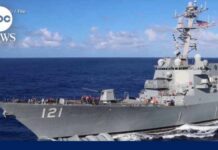
As of March 18, 2026, the research describes President Trump characterizing U.S. action as “knocking the hell out of the coast,” paired with a plan to push airpower, naval interdiction, and additional Marines toward the theater. The same research set references U.S. assets such as F-35Bs operating from the USS Tripoli and actions against Iranian minelaying capability. The immediate mission is straightforward: reestablish safe passage for commercial shipping.
At the same time, the research includes a caution that cuts against simplistic “just sail through” rhetoric. U.S. Maritime Administration guidance has reportedly advised avoidance of the area even as Trump publicly challenged tankers to transit. Maritime analysts cited in the research argue that safe passage requires demonstrated security—mines cleared, threats suppressed, escorts coordinated—not simply “guts.” That tension reveals why reopening the strait is a military and logistical problem, not a messaging problem.
Allies, Burden-Sharing, and the Limits of Globalism
The research indicates the U.S. has pressed allies to assist, while some partners declined support despite warnings of consequences. That dynamic lands squarely in the post-Biden political debate Americans recognize: the U.S. carries the load while global institutions hesitate. Countries that rely heavily on Hormuz energy flows—such as major Asian importers referenced in the research—have enormous stakes, yet coalition commitments remain uncertain. In practical terms, that leaves U.S. taxpayers and service members bearing most of the immediate risk.
The domestic takeaway is not about wanting endless war; it is about understanding leverage and deterrence. When a hostile regime can throttle a global artery and attack ships, the cost of inaction can show up as higher prices, weaker credibility, and more chaos. The research also reports over 150 ships anchored outside the strait and a near-total traffic halt at points in early March, illustrating how quickly an international crisis can become an American cost-of-living problem.
Sources:
Trump’s Strait Showdown: Five Bold Moves to Crush the Iran Threat Now
Report to Congress on the Iran Conflict and Strait of Hormuz