

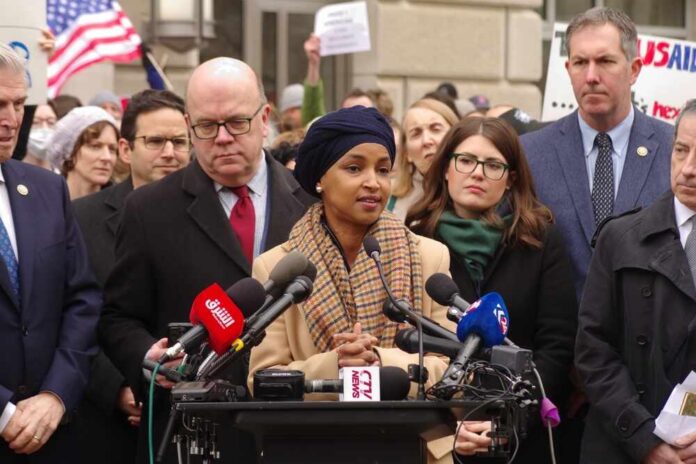
A sitting member of Congress just “corrected” a financial disclosure that swung from $6–$30 million down to under $100,000—raising a basic question voters on both sides keep asking: who’s really being honest in Washington?
Quick Take
- Rep. Ilhan Omar amended her 2024 House financial disclosure, sharply reducing the reported value of joint assets tied to her husband’s businesses.
- House Minority Whip Tom Emmer says the revision doesn’t resolve the underlying concerns and is pushing for an Ethics Committee review.
- Omar’s office blames an accounting error involving overlooked liabilities and says the amendment was made quickly once discovered.
- House Oversight Chairman James Comer previously sought records amid questions about how the valuations rose so dramatically in the first place.
Why Omar’s amended filing isn’t a simple paperwork story
Rep. Ilhan Omar (D-Minn.) amended her 2024 personal financial disclosure after an earlier filing listed joint assets with her husband, Tim Mynett, at $6 million to $30 million. The amended version reduced those holdings to roughly $18,004 to $95,000. Omar’s office attributed the discrepancy to an accountant who failed to account for liabilities when valuing Mynett’s companies, including eStCru LLC and Rose Lake Capital. The size of the swing is what made the story unavoidable.
House disclosures exist for a reason: lawmakers can influence regulations, spending, and oversight that affect markets and private entities. When reported wealth moves by tens of millions on a single form, it triggers the kind of public distrust that has become bipartisan—especially among voters who believe government increasingly protects insiders. Even if the explanation is legitimate, the situation underscores how lightly Washington can treat transparency rules the public assumes are strict, routine, and carefully vetted.
Emmer’s demand: Ethics scrutiny, not a “moving on” moment
House Minority Whip Tom Emmer (R-Minn.) has argued the amendment doesn’t put Omar “out of the woods” and has called for deeper review through the House Ethics Committee process. Emmer’s position is straightforward: a revision that large can’t simply be waved away as a clerical fix, because it changes how the public evaluates a lawmaker’s financial interests and credibility. Omar, a high-profile progressive figure, has long been a political lightning rod—making the filing a new flashpoint.
Omar’s office counters that she is not a millionaire and that the correction was filed promptly once the mistake was identified. That defense matters because Congress allows amendments, and genuine errors do occur. At the same time, the conservative critique is less about partisan theater and more about basic accountability: if everyday Americans can face penalties for getting taxes and forms wrong, voters expect elected officials to meet an even higher standard—especially when the numbers are extraordinary.
Comer’s earlier inquiry and the unanswered questions behind the valuation spike
The controversy did not begin with Emmer’s latest warning. House Oversight Chairman James Comer (R-Ky.) previously sent a letter to Mynett requesting records after the reported asset values surged compared with prior years. Earlier disclosures reportedly showed assets in the tens of thousands, followed by a sudden leap in the 2024 filing. An email cited in reporting pegged the firms at about $7.9 million and $1.5 million, with Mynett owning roughly a third—details that kept attention on how valuations were calculated.
That’s where the “accountant error” explanation runs into the reality of public trust. Liabilities can change net value, but the public still wants clear documentation of what changed, when it changed, and why internal checks didn’t catch it sooner. No fraud was established, and the public record leaves key pieces—like the underlying liabilities and valuation work—outside easy voter review.
What the episode says about government credibility in 2026
For conservatives already frustrated by wasteful spending, high costs, and years of institutions insisting the public “just trust the process,” this dispute lands as another example of elite impunity—whether the error was innocent or not. For many on the left who believe the system is rigged for the wealthy and well-connected, a massive disclosure swing also reinforces the sense that powerful people play by different rules. In a divided era, the common ground is cynicism about accountability.
Top House Republican Warns Ilhan Omar That Her Financial Disclosure Revision Won’t Save Her
READ: https://t.co/FuRCp1WnMa pic.twitter.com/eJzhjRm2vJ
— The Gateway Pundit (@gatewaypundit) April 22, 2026
The immediate next steps are procedural: whether the Ethics Committee or Oversight Committee obtains more records, and whether Omar’s revised filing satisfies congressional standards. What’s clear is that transparency systems only work if they’re rigorous, consistent, and enforced without fear or favor. If Congress wants Americans to believe it can police executive agencies, spending, and national security, it has to show it can police itself—especially when the numbers change this dramatically.
Sources:
https://www.cbsnews.com/minnesota/news/ilhan-omar-financial-disclosure-amendment-accountant-error/