
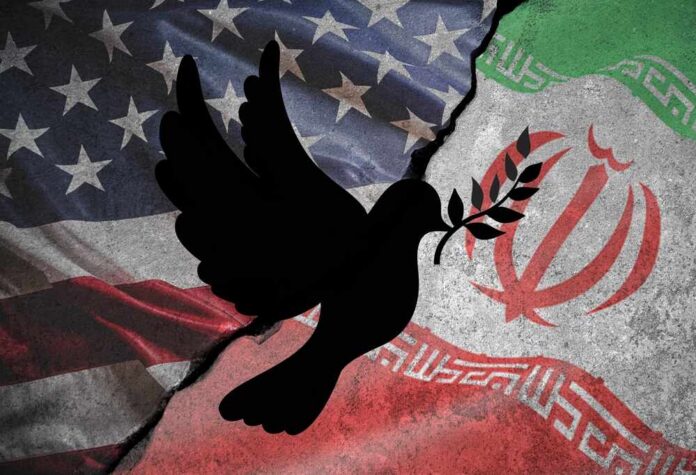
President Trump’s “big money” ceasefire message to Iran is igniting a familiar fight in Washington: whether America is securing peace through strength—or getting pulled into another open-ended Middle East commitment.
Story Snapshot
- President Trump announced a ceasefire breakthrough with Iran and predicted a “Golden Age of the Middle East,” emphasizing reconstruction and economic opportunity.
- Key operational details remain unclear, including what Iran agreed to and how enforcement in the Strait of Hormuz would work in practice.
- Recent months included U.S. strikes, Trump’s public calls for regime change, and a major fast-tracked U.S. arms package for Gulf allies.
- Analysts warned the conflict was already damaging Gulf economies, raising questions about how quickly markets and investment can recover.
Trump’s Ceasefire Post Pitches Prosperity as the Endgame
President Donald Trump said April 8 that a last-minute ceasefire deal with Iran opened the door to regional reconstruction and major economic upside, framing the moment as a potential “Golden Age of the Middle East.” Trump’s public messaging stressed that Iran is ready to rebuild and that the United States would play an outsized role in keeping the Strait of Hormuz moving—an oil chokepoint with global consequences.
The political appeal of that framing is obvious: Americans are exhausted by drawn-out conflicts, yet they also expect secure shipping lanes and stable energy prices. Trump’s promise implies a dual objective—deterrence abroad and cost-of-living relief at home—without spelling out what the ceasefire requires from Iran, what verification exists, or what the U.S. commitment would look like if violations occur.
How the U.S.-Iran Escalation Set the Stage for a “Last-Minute” Deal
The ceasefire announcement followed weeks of escalating rhetoric and military action. In late February, Trump publicly called for regime change, urging Iranians to rise up. In March, he claimed U.S. strikes hit Iranian targets and said Iran made concessions tied to shipping in the Strait of Hormuz, including allowing increasing numbers of oil boats through as a sign of “respect.”
Arms Sales and Regional Defense Costs Remain a Live Issue
During the same period, the administration fast-tracked a large arms package—reported at $16.5 billion—for Gulf partners, including an $8 billion tranche for the UAE. The approvals reflect the immediate defense reality for U.S. allies facing Iranian pressure and attacks that have affected energy infrastructure. But for Americans already angry about overspending and fiscal mismanagement, the broader question is whether Washington’s Middle East footprint is shrinking—or simply changing shape.
That tension is political as well as strategic. Republicans who emphasize limited government and prioritizing domestic needs generally want clarity on objectives, time horizons, and burden-sharing. Democrats, despite their opposition to Trump, often argue for more constraints on executive action abroad; yet their obstruction can also make sustained strategy harder. In practice, the public sees a system that lurches between escalation and de-escalation without clear accountability or durable congressional buy-in.
Economic Reality Check: Markets May React Fast, but Scars Can Linger
Even if the ceasefire holds, the conflict’s drag on Gulf economies, with warnings from major institutions about slower growth and elevated risks. Goldman Sachs described the war as “unambiguously bad” for business in the region, and international lenders flagged growing strain on vulnerable countries. Those warnings help explain why Trump’s “big money” pitch centers on reconstruction.
For Americans, the stakes extend beyond foreign policy talking points. The Strait of Hormuz affects global energy flows, and energy prices feed directly into inflation—still a top kitchen-table issue. If the administration can preserve deterrence while reducing the odds of shipping disruptions, that supports the conservative case for peace through strength.
Sources:
Trump says he ‘saved’ Middle East as the region’s economies teeter