
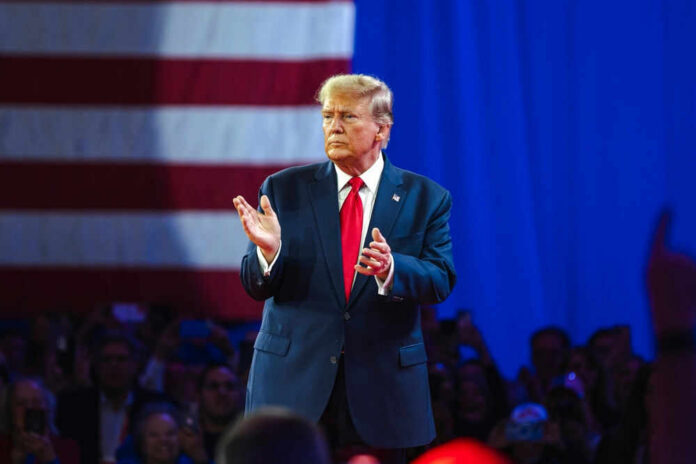
President Trump’s bold 10% global tariff under Section 122 delivers a strategic win against massive trade deficits, protecting American workers from unfair foreign competition despite leftist critics claiming no crisis exists.
Story Highlights
- Tariffs target record $1.2T 2025 trade deficits, generating $22.3B revenue while exempting USMCA goods to shield allies.
- Steel and aluminum duties reinstated at 25% with no exemptions, curbing evasion and boosting U.S. manufacturing.
- Threats of 15% hikes and higher rates on China/Russia prioritize American jobs over globalist complaints.
Supreme Court Ruling Sparks Tariff Pivot
The Supreme Court in Learning Resources, Inc. v. Trump invalidated IEEPA-based tariffs for lacking true emergencies. President Trump immediately announced a 10% global tariff under Section 122 of the 1974 Trade Act, effective February 24. This temporary measure addresses fundamental international payment problems amid record trade deficits. USMCA goods remain exempt, preserving key alliances while pressuring others.
Tariff Details and Implementation
The Section 122 tariff applies globally at 10%, with threats of 15% increases announced February 21 via Truth Social. It expires July 24 unless extended, adding to existing duties without prior IEEPA caps for EU and Japan. Steel and aluminum tariffs reinstated March 12 at 25% with no ally exemptions. China faces up to 54% effective rates, including de minimis hikes, to counter unfair practices and protect U.S. industries.
Unlike product-specific Section 232 or 301 tariffs, Section 122 offers a broad, temporary tool rooted in 1970s precedents like Nixon’s surcharge. USTR handles schedules, CBP enforces, generating short-term revenue while preparing Section 301 follow-ons. This counters 2025’s $1.2T deficit driven by strong U.S. demand, prioritizing manufacturing revival.
Economic Impacts Favor American Workers
Tariffs raise average rates by 3.1%, projecting $22.3B in 2026 revenue to fund priorities without overspending. Autos face 25% duties April 2, potentially increasing prices 11.4%, but manufacturers pass costs while supply chains shift home. Job protection outweighs inflation risks from Biden-era mismanagement, appealing to Trump’s base frustrated by globalism.
Consumers see higher goods prices short-term, but long-term gains include reduced deficits and WTO challenges to unfair trade. Political friction with allies exists, yet bilaterals like US-Bangladesh show negotiation leverage. Critics ignore real imbalances; economists note deficits reflect U.S. strength, not weakness.
Expert Views and Admin Rationale
The White House fact sheet justifies the duties as a response to international payment imbalances, echoing first-term successes against China. J.P. Morgan highlights potential costs, while the Tax Policy Center points to a possible revenue boost. White & Case views Section 122 as a bridge to more permanent trade measures. The pro-tariff stance is framed as protecting American families from job losses tied to cheap imports.
Sources:
Trade Compliance Resource Hub: Trump 2.0 Tariff Tracker
White & Case: Trump Administration Imposes 10% Section 122 Tariff Plan to Replace IEEPA Tariffs
Tax Policy Center: Tracking Trump Tariffs
USTR: Presidential Tariff Actions
Thomson Reuters: Supreme Court’s Tariff Decision – What’s Next?
Holland & Knight: Court of International Trade Orders Nationwide Tariff Refunds