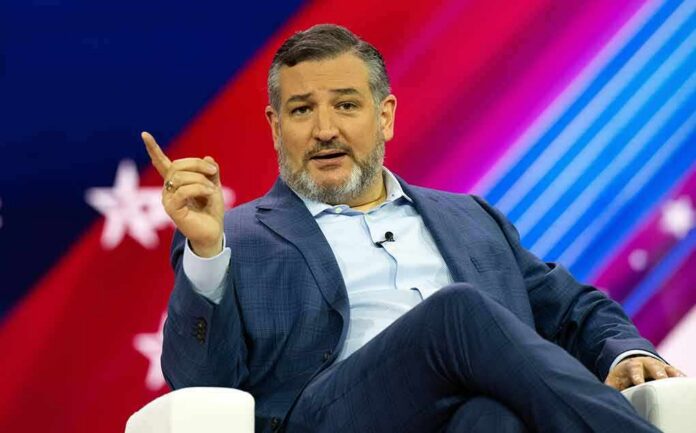
Sen. Ted Cruz warned that “Americans will die” if Michigan Democrat Abdul El-Sayed wins and gains access to the Senate’s most sensitive intelligence briefings, turning a tight race into a test over national security and trust.
Story Snapshot
- Cruz tied El-Sayed’s possible Senate win to a risk of leaks harming Americans.
- El-Sayed denied ties to the Muslim Brotherhood and disavowed the group.
- Reports note no public evidence proving Cruz’s core allegation.
- Senate rules tightly restrict classified access and disclosures.
What Cruz Said, Where He Said It, and Why It Landed
Sen. Ted Cruz told voters in Michigan that if Abdul El-Sayed is elected and placed on the Senate Intelligence Committee, “there is a very real risk that Americans will die.” He spoke while campaigning for Republican Mike Rogers in late October. Cruz argued that Democratic Leader Chuck Schumer could seat El-Sayed on the panel, which receives the nation’s most sensitive secrets. National outlets repeated the line about Americans dying, which fueled swift reaction across both parties.
Cruz framed the risk around alleged support for the Muslim Brotherhood. He claimed the danger would come if intelligence reached people tied to terrorism. Media accounts recorded him naming potential targets, including covert intelligence assets and U.S. servicemembers. The claim rested on a conditional warning rather than a revealed piece of evidence. Coverage described the remarks as a hard-edged attack during a high-stakes race, and not as a formal finding from any agency.
How El-Sayed Responded and What Evidence Exists
Abdul El-Sayed denied ties to the Muslim Brotherhood and said he disavows the group. He added that his guide as a senator would be the United States Constitution. He rejected any suggestion of dual loyalty based on his Muslim faith. He also said he is running for the United States Senate, not as a “Muslim senator.” Multiple outlets documented these statements in town halls and interviews during October.
Independent reporting has not produced public records to prove Cruz’s core allegation. An opinion analysis in The Hill called the charges unsupported in the public domain. Other write-ups highlighted the campaign setting and the lack of documentary evidence offered by Cruz to back the claim. That places the argument in the space of political warning, rather than verified counterintelligence detail available to voters today.
How the Intelligence Committee Handles Secrets
The Senate Intelligence Committee manages some of the most sensitive intelligence. Members and staff operate under strict rules for access, handling, and disclosure. The committee’s published rules say classified information must be limited to people with proper clearance and a need to know. They also describe penalties and procedures for any disclosure. These rules exist to prevent leaks, even as politicians rotate onto and off the panel after elections.
Party leaders do assign members to the committee, but access is not a free-for-all. Classified briefings, compartmented programs, and covert-action notices come with controls. The rules emphasize who can see what and for what official purpose. That structure is meant to reduce the chance that one person could take secrets and pass them on without detection. It does not remove risk, but it narrows it through process and law.
Why This Flashpoint Resonates Across Parties
Many voters on the right fear that leaders play politics with national security. Many on the left fear that claims about security are used to smear people by faith or background. Both sides share a deeper worry: a political class that treats power as the goal, not the duty. This fight hits those nerves. It mixes a worst-case risk with a committee that guards the nation’s crown jewels, all during a campaign sprint.
Ted Cruz said on c-span:
"if U.S. Sen. candidate Abdul El-Sayed (D-MI) is elected into the Senate and is placed in the Senate Intelligence Committee, "there is a very real risk that Americans will die as a result."@tedcruz personifies intellectual bankruptcy masquerading as…— Mike (@myOpinion_27) October 28, 2026
Voters want proof, not theater. Cruz’s warning is clear and stark. El-Sayed’s denial is public and firm. The public record, as of now, shows no released evidence that settles the charge. The committee’s rules show guardrails that limit access and punish leaks. That is the ground we stand on today: one side’s dire prediction, the other’s disavowal, and a process built to protect secrets while politics rages around it.
Sources:
youtube.com, yahoo.com, critiqueanddigest.substack.com, thehill.com, washingtonpost.com, intelligence.senate.gov