
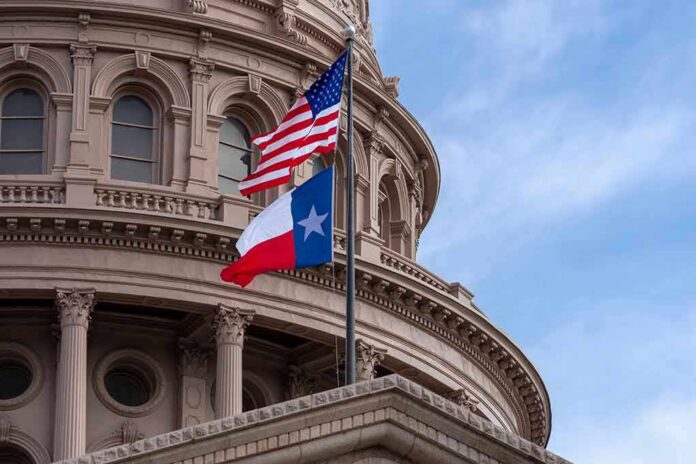
Texas officials say a planned violent attack on the State Capitol was stopped overnight, and the suspect posted bond within hours before federal agents took him into custody.
Story Snapshot
- Texas Department of Public Safety said a credible Capitol attack was planned for Oct. 1.
- Agents arrested 40-year-old Benny Caldera Jr. around 3 a.m. in Converse, Texas.
- Court records show a $75,000 bond was set after a felony terroristic-threat charge.
- Federal agents later took the suspect into custody from the county jail.
Overnight Arrest After Tip About Planned Capitol Attack
Texas Department of Public Safety officials said they received credible information Tuesday evening about a planned violent attack on the Texas State Capitol for Thursday, Oct. 1. Investigators worked with the Federal Bureau of Investigation and local partners to act quickly. A Texas Department of Public Safety special tactics team arrested a suspect at about 3 a.m. Wednesday at a home in Converse, near San Antonio. Officials said the goal was to move before any risk to the public grew.
Authorities identified the suspect as 40-year-old Benny Caldera Jr. Multiple outlets reported he was booked into the Bexar County Jail on a felony charge for making a terroristic threat against a public servant. A Texas Senate notice circulated by Secretary Patsy Spaw described the arrested person as the main suspect and said there were suspected co-conspirators, prompting security steps at the Capitol complex in Austin.
What Court Records and Officials Reported Next
Online court records showed bond was set at $75,000, which indicates a formal state case began after the arrest. Reporters also cited arrest documents that quote a friend of the suspect saying Caldera planned to “go to the Capitol” and “shoot it up,” which officials view as direct evidence of intent if proven in court. Federal Bureau of Investigation leaders said the arrest came within hours of the first tip, showing how fast the case moved from warning to action.
Later on Wednesday, the Federal Bureau of Investigation took the suspect into federal custody at the county jail, according to local reporting that cited state officials. That transfer suggests federal authorities opened their own case track, even as the state charge remained on the books. Agencies often do this when a threat involves a government complex or may cross state or digital lines.
Security Messaging and Public Confidence
Texas Department of Public Safety and Federal Bureau of Investigation leaders used firm language, including “credible threat” and “planned attack,” as they briefed lawmakers and the public. That wording matched recent high-profile security cases where agencies must move fast to prevent harm and then harden possible targets. In this case, the Senate’s warning described a main suspect and mentioned suspected partners, though no names of others had been released publicly at the time of reporting.
🇺🇸 A Texas man has been arrested over an alleged plot to carry out a violent attack on the state Capitol.
Authorities identified the suspect as 40-year-old Benny Caldera Jr. The FBI helped with the arrest, and Texas officials have increased security while investigators look into… pic.twitter.com/DMSPANFAsl
— NewsForce (@Newsforce) October 1, 2026
Readers across the political spectrum often worry that elites get protection while everyday people get delays and excuses. This story cuts both ways. On one hand, police and federal agents acted within hours to defend a public building that belongs to all Texans. On the other, the quick release on bond, followed by a federal hold, shows how complex and uneven the justice process can feel, especially when agencies move on parallel tracks.
Why This Matters Beyond One Arrest
Capitols are symbols of open government. They are also soft targets that draw threats in tense times. That puts pressure on agencies to act first and explain later. The Texas case fits a pattern where officials emphasize urgency while fuller records come out over days or weeks. For families, workers, and taxpayers, the bottom line is simple: they want safety at public places without losing basic fairness in how cases move through the courts.
Sources:
abc7news.com, kvue.com, wjla.com