

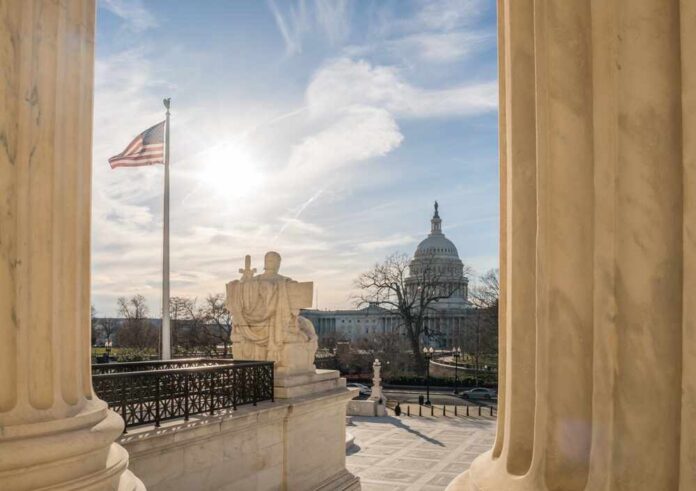
After the Supreme Court reaffirmed birthright citizenship, some Democratic leaders renewed broader calls for changes to the Court, reviving debate over judicial reform and constitutional interpretation.
Story Highlights
- The Supreme Court struck down President Trump’s order and upheld birthright citizenship in a 6-3 decision.
- Democratic leaders praised the ruling but also renewed calls to expand the Court.
- While some Democrats continue to advocate judicial reforms, no new court-expansion legislation tied to this ruling has been formally introduced.
- Dissenting justices argued the Fourteenth Amendment was read too broadly.
What The Court Decided And Why It Matters
On June 30, 2026, the Supreme Court held that nearly all children born on United States soil are citizens under the Fourteenth Amendment, blocking President Trump’s executive order that sought limits. Chief Justice John Roberts wrote the majority opinion and leaned on history, including the Wong Kim Ark precedent and common law birthright rules, to support the broad guarantee. The ruling resolves the legal challenge before the Court while reinforcing existing constitutional precedent on birthright citizenship.
Justice Brett Kavanaugh agreed only on narrower grounds tied to mid‑twentieth century law, signaling limits to the majority’s reasoning. Justices Clarence Thomas, Samuel Alito, and Neil Gorsuch each dissented and rejected the broad reading of “subject to the jurisdiction” in the Fourteenth Amendment. The government’s brief had argued the Clause was designed for freed slaves, not for children of parents here unlawfully or only briefly, but that argument did not prevail.
How Leaders On Both Sides Framed The Outcome
House Democratic Leader Hakeem Jeffries said the Court recognized that anyone born here is a citizen, without doubt. Senate Democratic Leader Chuck Schumer claimed the ruling stood firm despite what he called intimidation attempts by President Trump. Senator Elizabeth Warren said even a Court with Trump‑appointed justices protected birthright citizenship. These messages framed the decision as a constitutional guardrail that survived political pressure, and as a validation of long‑standing national practice.
Conservative leaders and dissenting justices warned the ruling stretched the Fourteenth Amendment too far. The executive order defined “subject to the jurisdiction” to require lawful permanent domicile, which would exclude children of those here unlawfully. The dissents argued the majority ignored the Clause’s original public meaning and invited policy consequences that Congress, not the Court, should address. The decision immediately reignited long-running debates over constitutional interpretation, executive authority, and the judiciary’s role in immigration policy.
Democrats’ Court Expansion Talk Meets Hard Math
Soon after the win, some Democrats revived Court expansion talk. Yet party leaders have not released a new, detailed plan that names a seat count, path, or timeline. Past proposals, like the Judiciary Act of 2023 to add four justices, drew attention but stalled. Today, Republicans control both chambers of Congress. Given the current political landscape, significant structural changes to the Court would face substantial legislative and political hurdles.
Legal reform groups continue to float other ideas, including term limits and changes to the emergency, or “shadow,” docket, which would likely need complex legislation or even an amendment. Supporters say reforms could cool partisan extremes and restore trust. Critics call expansion a power grab that would trigger endless retaliation. History offers little proof that adding seats fixes partisanship for long. Once rules look flexible, future majorities can bend them again.
Why This Moment Feels Like A Win Wrapped In A Warning
The ruling gives clear guidance to families, hospitals, and agencies. It brings stability where federal policy had been in flux. That is the victory. The warning is the rapid move to label the win as proof the Court is still broken and must be reengineered. The ruling settles one constitutional dispute but leaves broader questions about immigration policy, judicial reform, and the balance between the courts and elected branches very much alive.
CURRENT NEWS REPORT — TUESDAY, JUNE 30, 2026
1. SUPREME COURT UPHOLDS BIRTHRIGHT CITIZENSHIP
The U.S. Supreme Court ruled today that President Donald Trump’s executive order restricting birthright citizenship cannot stand.
The ruling was 6–3.
The order would have denied… pic.twitter.com/ib5uzxsLCH
— Ernie Milleur (@ErnieMilleur) July 1, 2026
People across the spectrum share a core worry: rules should not change every election. The Court said the Constitution, not a one‑term policy, sets citizenship at birth. If Congress wants different immigration outcomes, it can legislate within constitutional bounds. That is how self‑government should work. The big test ahead is whether lawmakers engage the hard work—border policy, visas, labor demand, and due process—or keep chasing structural hacks that promise quick wins but deepen distrust.
Sources:
twitchy.com, npr.org, constitutioncenter.org, youtube.com, aclu.org, law.cornell.edu, theusconstitution.org, cambridge.org